Order Types in Trading: Market, Limit, Stop and Stop Loss Orders
A market order buys or sells straight away at the best price on offer. You are sure to get in, but not of the exact price. In a fast market you may be filled a little worse than the price on screen. That gap is slippage.

What you'll learn
- How market, limit and stop orders work
- Where stop loss and take profit orders fit in
- Why your fill price is not always the price you asked for
Market order: now, at the best price available
A market order buys or sells straight away at the best price on offer. You are sure to get in, but not of the exact price. In a fast market you may be filled a little worse than the price on screen. That gap is slippage.
Use it when getting in matters more than the last fraction of a pip.
Limit order: at this price or better
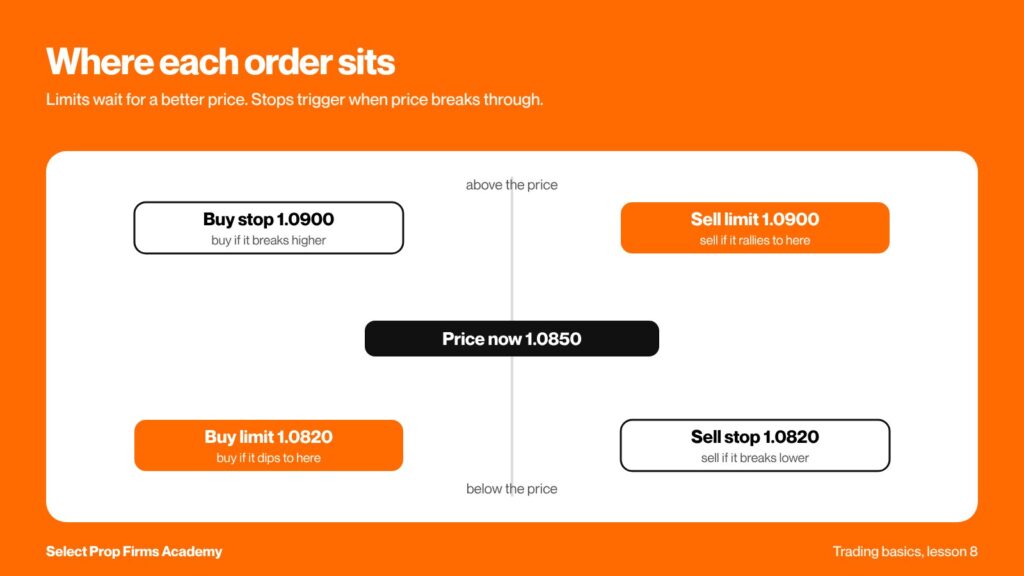
A limit order waits until price reaches your level, and fills at that price or better.
- Buy limit: placed below the current price. “Buy if it dips to 1.0820.”
- Sell limit: placed above the current price. “Sell if it rallies to 1.0900.”
You control the price but may not get filled at all if the market never comes back.
Stop order: once price breaks through
A stop order becomes a market order once price touches your level.
- Buy stop: placed above the current price. “Buy if it breaks above 1.0900.”
- Sell stop: placed below the current price. “Sell if it drops below 1.0820.”
Traders use these to join a breakout. Because it fills as a market order, a stop can slip.
Stop loss and take profit
These are the same orders attached to an open trade:
- A stop loss closes the trade if price moves against you to your level. On a long trade it is a sell stop below your entry.
- A take profit closes the trade at your target. On a long trade it is a sell limit above your entry.
Set both when you open the trade, so the decision is made while you are calm.
Worked example
EURUSD trades at 1.0850. You want to buy if it pulls back to 1.0830, with a stop loss at 1.0810 and a take profit at 1.0890.
- Order: buy limit at 1.0830
- Stop loss: 1.0810, which is 20 pips of risk
- Take profit: 1.0890, which is 60 pips of reward
- On 1 lot: risking $200 to make $600
Other orders you will meet
- Stop limit: a stop that becomes a limit order instead of a market order. No slippage, but it may not fill at all.
- Trailing stop: a stop loss that follows price by a set distance as the trade moves your way.
- OCO (one cancels the other): two orders where filling one cancels the other. Common on futures platforms.
How this works at a prop firm
Many prop firms require or strongly encourage a stop loss on every trade, and some count your risk from the stop distance. A stop is also your best protection against breaking a daily loss limit, but remember that stops can slip in fast markets and around news. Read about soft and hard breaches, slippage at prop firms, and the stop loss rules firms use.
Key takeaways
- Market = now, at any price. Limit = this price or better. Stop = once price breaks through.
- A stop loss and take profit are stop and limit orders attached to a trade.
- Stops and market orders can slip; limits never fill worse than your price.
Check yourself
3 quick questions. Your answers stay on this device.
-
Price is 1.2700. You want to sell if it rises to 1.2750. Which order?
A sell limit, above the current price.
-
Which order type can be filled worse than your price?
Market and stop orders can slip.
-
You buy at 1.0830 with a stop at 1.0810 on 0.5 lots. What is your risk?
20 pips times $5 = $100.
Go deeper
Educational content, not financial advice. Trading carries a high risk of loss, and most traders lose money. How we make money.