How Slippage Can Affect Your Prop Firm Trading Results
Prop firm slippage can affect trading results by changing the price at which an order is executed. Traders often focus on strategy, risk management and market conditions when reviewing their performance, but execution also plays an important role. Even a small difference between the expected price and the actual fill price can affect a trade’s […]

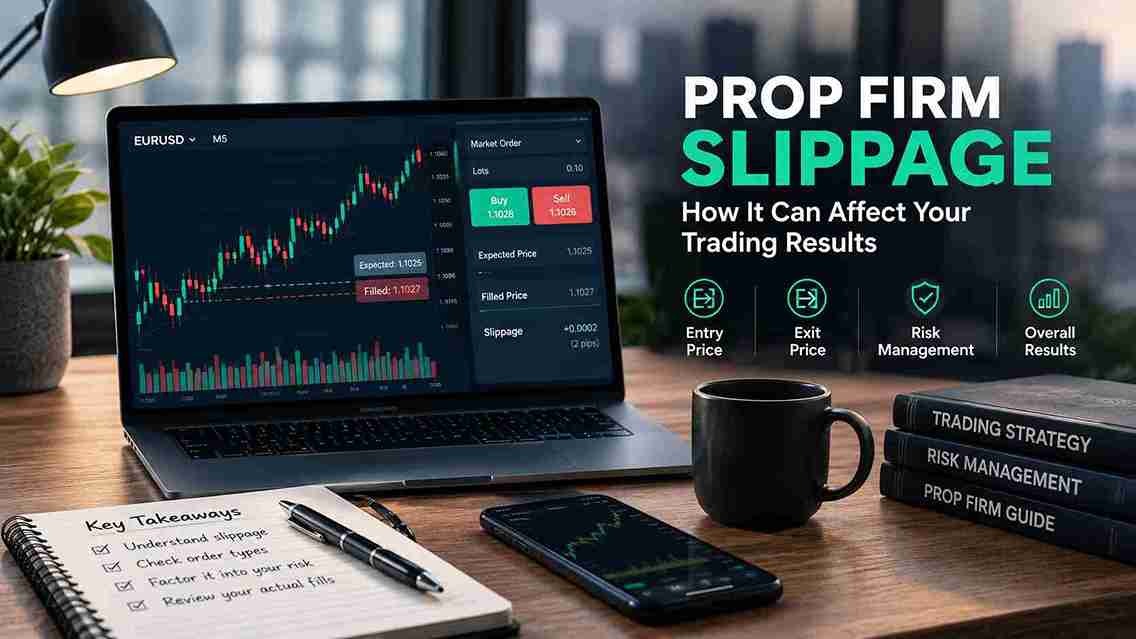
Prop firm slippage can affect trading results by changing the price at which an order is executed. Traders often focus on strategy, risk management and market conditions when reviewing their performance, but execution also plays an important role. Even a small difference between the expected price and the actual fill price can affect a trade’s entry, exit, potential loss or final profit.
For traders working within strict daily loss limits and maximum drawdown rules, understanding prop firm slippage is particularly important. Knowing why slippage occurs, when it is more likely and how to account for it can help traders assess their actual results and make more informed risk-management decisions.
What Is Slippage?
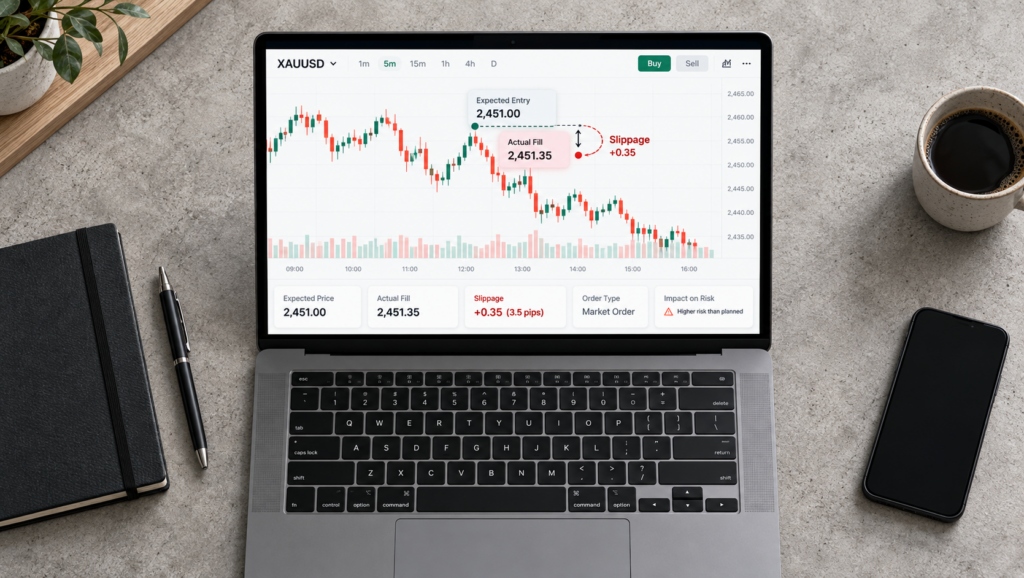
Slippage is the difference between the expected execution price and the actual price at which an order is filled.
For example, imagine a trader places a market order expecting to enter at $100. The order is filled at $100.20 instead.
The $0.20 difference is slippage.
Slippage can be:
- Positive, when the execution is better than expected
- Negative, when the execution is worse than expected
The amount can vary depending on market conditions, liquidity and the type of order being used.
Why Does Slippage Happen?
Markets are constantly moving.
When an order is submitted, the price available at the moment the order reaches the market may differ from the price displayed when the trader clicked to enter.
Slippage can become more noticeable when:
- Markets are moving quickly
- Liquidity is lower
- Large orders are being executed
- Major economic announcements are released
- Positions are opened or closed during volatile periods
This does not necessarily indicate a problem with the trading platform. Price movement and available liquidity are normal parts of market execution.
How Can Slippage Affect Prop Firm Trading?
Slippage can affect several parts of a trade.
Entry Price
If an entry order is filled at a less favourable price, the trade may start with a slightly different risk and reward profile than originally planned.
For example, if a trader expects to enter at $100 but receives a fill at $100.20, the distance to the stop-loss has changed.
Stop-Loss Execution
Slippage can also occur when a stop-loss is triggered.
Suppose a stop-loss is set at $95, but the market moves rapidly through that level. The position may be closed at a price below $95.
The resulting loss could therefore be larger than the amount calculated using the stop price alone.
Take-Profit Execution
Depending on the order type and market conditions, execution around a profit target can also differ from the expected price.
The actual result should therefore be based on the completed trade rather than the theoretical target.
Slippage and Prop Firm Drawdown
This is particularly relevant when trading under strict account limits.
Imagine a trader has a predefined maximum risk of $200 per trade. If unexpected slippage increases the actual loss, the trader may lose more than originally planned.
A single difference may be small, but repeated slippage can affect overall results.
This is why traders should leave enough room within their risk limits rather than treating the maximum drawdown as a target.
Slippage During High-Impact News
Market-moving announcements can cause rapid price changes.
During these periods, prices may move significantly between the time an order is submitted and the time it is executed.
This can increase the possibility of slippage.
However, traders should also check their prop firm’s specific rules around news trading. Some firms may restrict certain trading activity around major economic events.
Understanding both the market conditions and the firm’s rules is important.
Market Orders vs Pending Orders
The type of order can affect how execution works.
Market Orders
A market order prioritises execution rather than guaranteeing a specific price.
Because the market can move while the order is being processed, the final fill may differ from the displayed price.
Limit Orders
A limit order specifies the price at which the trader is willing to buy or sell, subject to the order’s execution conditions.
The trade-off is that the order may not be filled if the market does not reach the specified price or if the relevant execution conditions are not met.
Stop Orders
Stop orders can become market orders once their trigger conditions are reached, depending on the platform and instrument.
This means execution can differ from the stop price during fast-moving markets.
Traders should understand how each order type works on their specific platform.
How Traders Can Account for Slippage
Slippage cannot always be eliminated, but traders can account for it when planning their risk.
Avoid Overestimating Available Risk
If an account has a strict drawdown limit, do not calculate every trade as though execution will always occur exactly at the expected price.
Consider Market Conditions
Execution can behave differently during calm markets compared with periods of rapid price movement.
Understand Your Platform
Learn how the platform handles market, limit and stop orders.
Review Actual Trade Results
Compare expected entry and exit prices with actual fills.
Over time, this can help you understand how execution is affecting your trading results.
How to Monitor Prop Firm Slippage
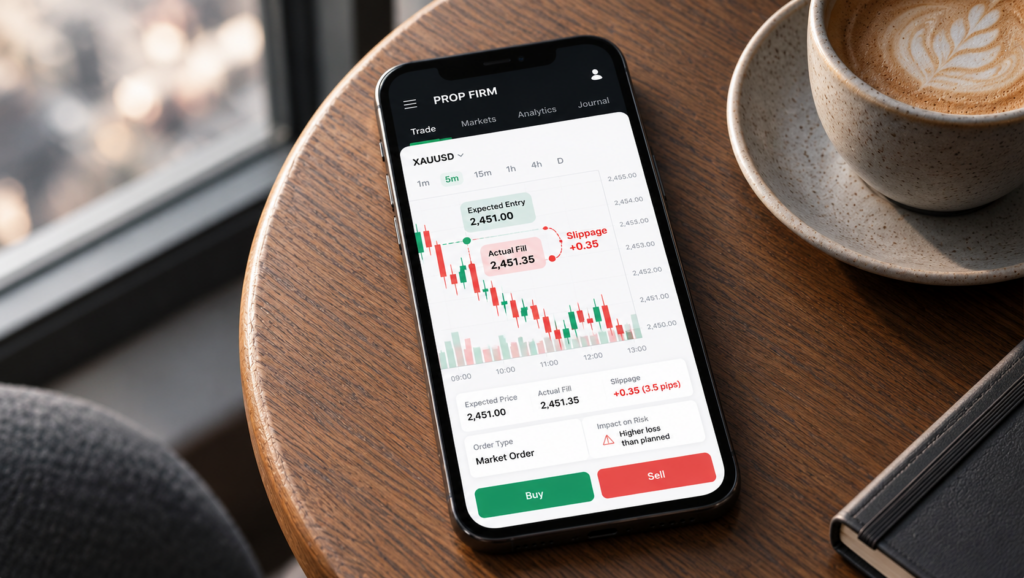
Traders can track slippage as part of their trading journal.
Record:
- Expected entry price
- Actual entry price
- Expected exit price
- Actual exit price
- Market conditions
- Order type
- Time of trade
- Difference between expected and actual execution
After collecting enough trades, you can look for patterns.
For example, you may notice that execution differences become larger during certain market sessions or around major announcements.
Common Mistakes Traders Make
Assuming the Displayed Price Is Guaranteed
The price shown on a chart is not necessarily the exact price at which a market order will be filled.
Ignoring Slippage When Calculating Risk
A planned stop-loss does not always mean the final loss will be exactly the amount calculated from the stop price.
Trading Too Close to Account Limits
If your strategy already operates close to the firm’s drawdown or daily loss limit, unexpected execution differences can have a greater impact.
Blaming Every Losing Trade on Slippage
Slippage is only one part of execution. A losing trade does not automatically mean slippage caused the loss.
Review the actual entry, exit and market conditions before drawing conclusions.
A Simple Slippage Checklist
Before trading, consider:
- What type of order am I using?
- How volatile is the market?
- Is there a major economic announcement?
- How much risk am I taking?
- How close am I to the firm’s loss limits?
- Does my platform provide the execution information I need?
- Am I recording actual fills in my trading journal?
These questions can help you incorporate execution into your overall risk-management process.
Final Thoughts
Prop firm slippage is an often-overlooked part of trading execution. A difference between the expected and actual fill price can affect entries, exits and the final result of a trade.
Slippage is a normal feature of market execution and can vary depending on liquidity, volatility, order type and market conditions.
For prop traders, understanding this difference is especially important because account drawdown and daily loss limits can make relatively small changes in trade outcomes more significant.
Rather than assuming every trade will execute exactly at the displayed price, include execution conditions in your risk-management process and review your actual fills over time.
Frequently Asked Questions
What is prop firm slippage?
Prop firm slippage is the difference between a trader’s expected execution price and the actual price at which their order is filled while trading through a prop firm.
Can slippage increase trading losses?
Yes. If an order is executed at a less favourable price, the resulting loss can be larger than originally expected.
Does slippage only happen during news?
No. Slippage can occur at any time, although fast-moving or less-liquid markets can increase the likelihood or size of execution differences.
Can slippage affect a prop firm’s drawdown?
It can. A less favourable execution price can increase the realised loss on a trade, which may affect the account’s drawdown or daily loss position.
How can I reduce the impact of slippage?
Traders can understand their order types, monitor market conditions, avoid taking unnecessary risk near account limits and review actual execution prices in their trading journal.
Is slippage the same for every prop firm?
No. Execution conditions can vary depending on the firm’s trading environment, platform, liquidity arrangements, instruments and other factors. Always review the firm’s current trading conditions.