Free Prop Firm Trials: Are They Worth Trying?
For traders who want to explore prop trading without immediately paying for a challenge, free prop firm trials can seem like an attractive option. A free trial may provide an opportunity to become familiar with a firm’s platform, rules and evaluation process before committing to a paid account. However, free trials can differ significantly from […]

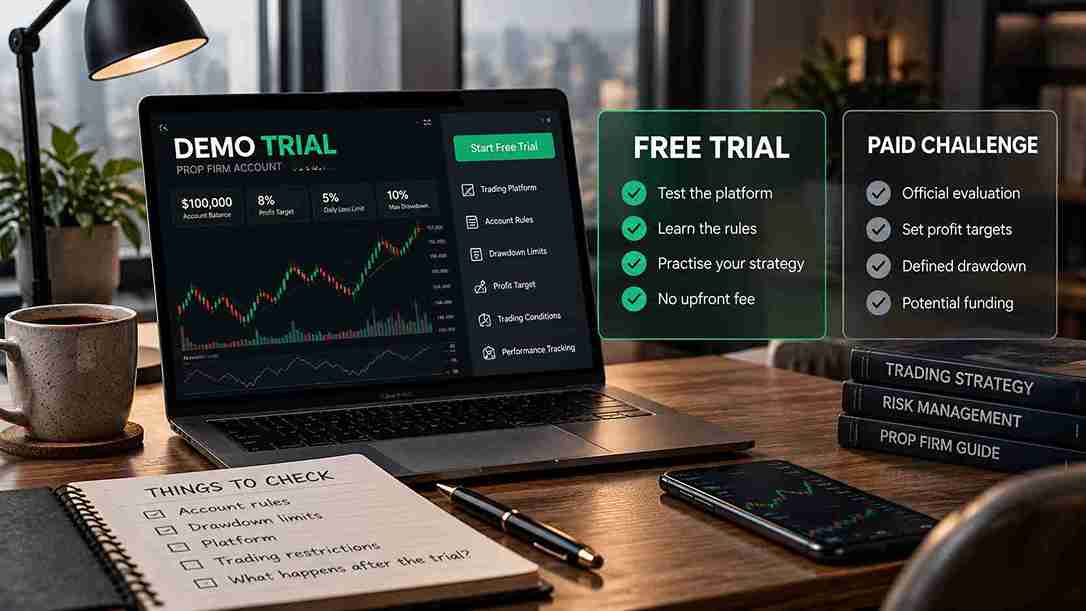
For traders who want to explore prop trading without immediately paying for a challenge, free prop firm trials can seem like an attractive option.
A free trial may provide an opportunity to become familiar with a firm’s platform, rules and evaluation process before committing to a paid account. However, free trials can differ significantly from the firm’s actual paid programmes.
Before treating a free trial as a direct alternative to a paid challenge, traders should understand what the trial includes, what it does not include and what happens after it ends.
What Are Free Prop Firm Trials?
A free prop firm trial is an account or evaluation offered without the usual upfront challenge fee.
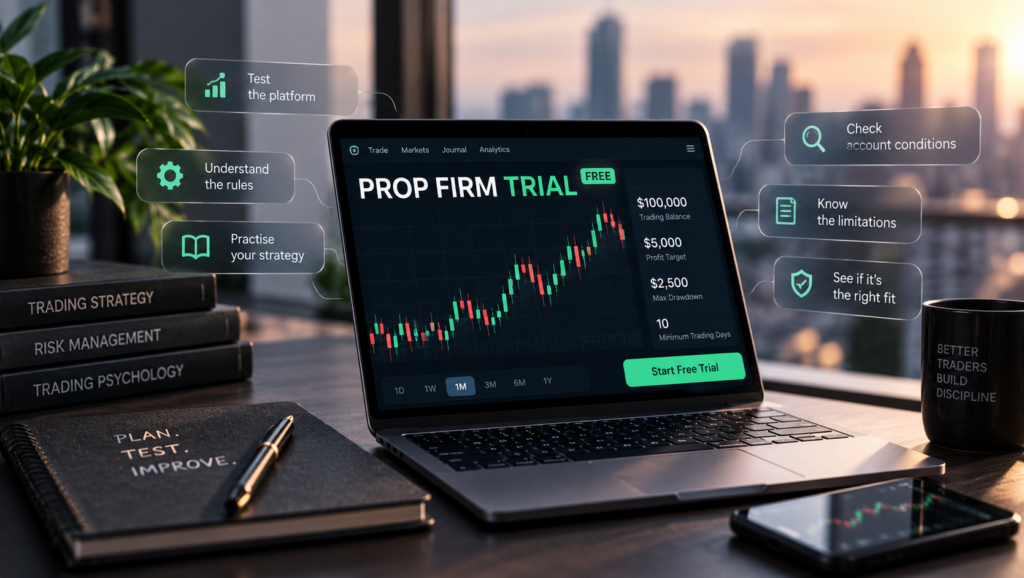
Depending on the provider, the trial may allow traders to experience some aspects of the firm’s trading environment, such as:
- Trading platform access
- Account rules
- Profit targets
- Drawdown limits
- Trading conditions
- Performance tracking
However, the exact structure varies between firms.
Some free trials may be designed primarily as demonstrations, while others may closely resemble the firm’s paid evaluation.
Always check the specific terms before assuming the trial works exactly like a paid account.
Why Do Prop Firms Offer Free Trials?
Free trials can serve several purposes.
A firm may use them to allow traders to:
- Test the platform
- Learn the account rules
- Experience the evaluation structure
- Practise their strategy
- Become familiar with the firm’s interface
- Introduce traders to its paid programmes
For traders, this can provide useful information before making a financial commitment.
However, completing a free trial does not necessarily mean that the trader has qualified for a funded account.
What Can You Learn From a Free Trial?
One of the main benefits is the opportunity to test your own process.
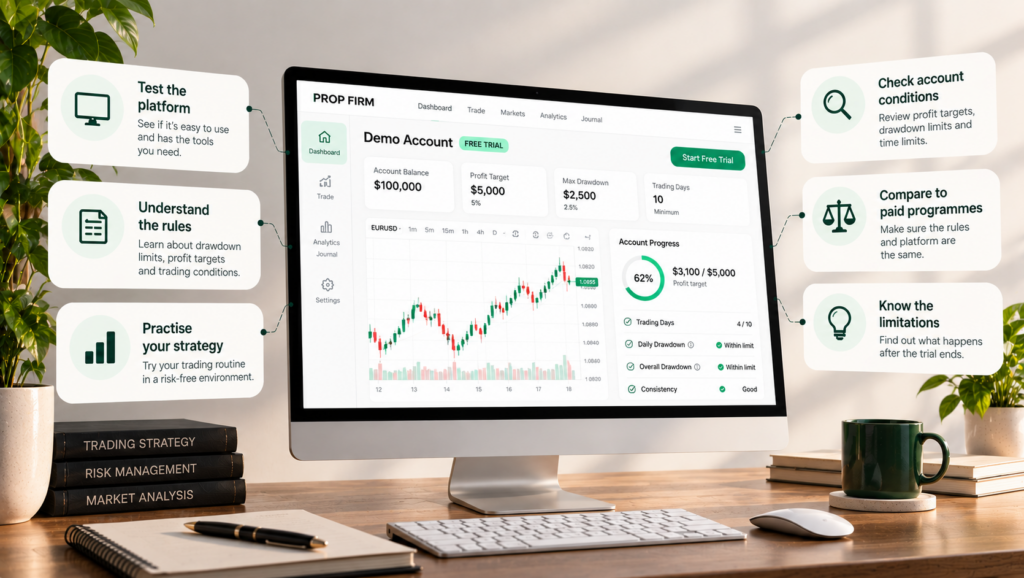
Test the Platform
You can determine whether the platform is easy to navigate and whether it provides the tools you normally use.
Understand the Rules
A trial can help you become familiar with:
- Daily loss limits
- Maximum drawdown
- Profit targets
- Position restrictions
- Trading hours
- Other account conditions
Test Your Trading Routine
A free environment can also show whether your normal trading schedule works with the firm’s requirements.
For example, if you only trade during specific market sessions, you can see whether the available trading conditions suit your routine.
What Should You Check Before Starting?
Not all free prop firm trials offer the same experience.
Before signing up, check the following.
1. Is the Trial Actually Free?
Some offers may be advertised as free but require payment details, a deposit or another form of commitment.
Check exactly what you are being asked to provide.
2. What Account Conditions Apply?
Find out:
- Starting balance
- Profit target
- Maximum drawdown
- Daily loss limit
- Minimum trading days
- Time limit
These conditions determine how useful the trial will be as a test of your trading process.
3. Is the Platform the Same?
A free trial is more useful if it uses the same platform and trading environment as the paid programme you are considering.
If the platform or execution environment is different, your experience may not represent the paid account.
4. Are the Trading Rules the Same?
Check whether the trial has the same restrictions as the paid account.
Pay particular attention to:
- News trading
- Overnight positions
- Weekend holding
- Scalping
- Automated trading
- Hedging
A trial with different rules may not accurately represent the paid challenge.
Free Trial vs Paid Challenge
| Feature | Free Trial | Paid Challenge |
| Upfront cost | Usually none | Requires payment |
| Purpose | Often testing or demonstration | Formal evaluation |
| Account rules | Vary by provider | Defined by the programme |
| Funding after passing | Not necessarily included | Depends on the programme |
| Trading conditions | May differ | Usually tied to the paid account |
| Financial commitment | Lower | Higher |
The key point is that passing a free trial does not automatically mean you have passed a paid evaluation.
Always check what happens after completion.
What Are the Limitations of Free Trials?
Free trials can be useful, but they may not reproduce every aspect of a paid account.
For example, a trial may have:
- Different profit targets
- Different drawdown limits
- Different time limits
- No payout eligibility
- Different trading restrictions
- No progression to a funded account
This means traders should treat the trial as an opportunity to learn about the firm’s environment rather than assuming it guarantees a particular outcome.
Can Free Trials Help You Prepare for a Challenge?
They can be useful for practising a consistent process.
Instead of focusing solely on hitting the trial’s profit target, use the experience to test:
- Position sizing
- Stop-loss placement
- Daily risk limits
- Trading frequency
- Entry and exit rules
- Trade journaling
- Platform familiarity
This can provide more useful information than simply trying to complete the trial as quickly as possible.
Common Mistakes With Free Prop Firm Trials
Chasing the Profit Target
Because there is no upfront fee, some traders may treat the trial casually and take larger risks than they normally would.
This can make the results less useful as a test of their actual trading approach.
Assuming the Trial Equals the Paid Account
Always compare the trial rules with the paid programme.
Ignoring Drawdown
A free account still provides an opportunity to practise risk management. Ignoring the loss limits can lead to poor habits.
Not Reading the Terms
Even when an account is free, understand what you are agreeing to and what information you are providing.
Assuming Passing Means Funding
A successful trial may simply demonstrate that you met the trial’s conditions. Check whether there is any progression to a paid evaluation or funded account.
Questions to Ask Before Using a Free Trial
Before signing up, ask:
- Is there genuinely no upfront cost?
- Is payment information required?
- How long does the trial last?
- What are the profit targets?
- What are the drawdown limits?
- Are there minimum trading days?
- Is the same platform used for paid accounts?
- Are the trading rules the same?
- Does passing lead to another stage?
- Is there any opportunity to receive a funded account?
Getting clear answers can help you understand the actual value of the offer.
Are Free Prop Firm Trials Worth Trying?
The value of free prop firm trials depends on what you want to get from them.
If your goal is to test a platform, understand account rules or practise a trading routine without an upfront challenge fee, a free trial may provide useful experience.
However, traders should not assume that a free trial is identical to a paid evaluation. The rules, account conditions and progression options can differ.
The most useful approach is to compare the trial with the paid programme and identify exactly what you can learn from the experience.
Final Thoughts
Free trials can give traders a low-cost way to explore a prop firm’s trading environment. They can be particularly useful for testing platforms, learning rules and practising risk management.
However, free prop firm trials should be evaluated based on their actual conditions rather than the word “free” alone.
Before signing up, check the account rules, platform, trading restrictions, time limits and what happens after the trial ends. That will give you a clearer idea of whether the trial is genuinely useful for your trading goals.
Frequently Asked Questions
Are free prop firm trials really free?
Some are, but conditions vary. Check whether payment information, deposits or other commitments are required before signing up.
Can you get funded from a free prop firm trial?
It depends on the provider. Some trials may simply be demonstrations, while others may offer a pathway to another evaluation or account.
Are free trials the same as paid prop firm challenges?
Not necessarily. Profit targets, drawdown, trading rules, time limits and progression can differ.
What should I practise during a free trial?
Focus on your normal risk management, position sizing, trading routine and strategy rather than simply trying to reach the profit target as quickly as possible.
Do free trials have drawdown limits?
Many do, but the specific limit depends on the provider. Always check the trial’s current terms.
Should I use a free trial before paying for a challenge?
It can be useful if you want to test the platform, understand the rules or practise your trading process first. Just make sure you understand how the trial differs from the paid programme.