How Professional Traders Manage Risk Inside Funded Accounts
Prop firm risk management is one of the biggest factors that separates consistently funded traders from those who repeatedly lose their accounts. While many traders spend countless hours improving their entries and exits, professional traders understand that protecting capital is what keeps them funded over the long term. Inside a funded account, every trade must […]

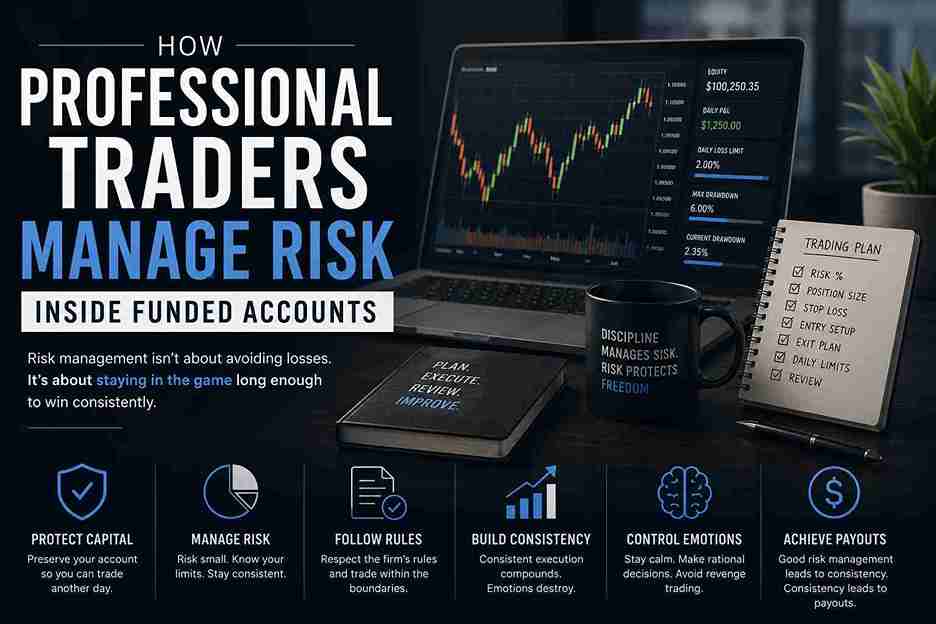
Prop firm risk management is one of the biggest factors that separates consistently funded traders from those who repeatedly lose their accounts. While many traders spend countless hours improving their entries and exits, professional traders understand that protecting capital is what keeps them funded over the long term.
Inside a funded account, every trade must balance opportunity with risk. Daily loss limits, maximum drawdown rules and consistency requirements mean that one emotional decision can undo weeks of disciplined trading.
In this guide, we’ll explore prop firm risk management strategies used by professional traders and explain how you can apply them to protect your funded account and improve long-term consistency.
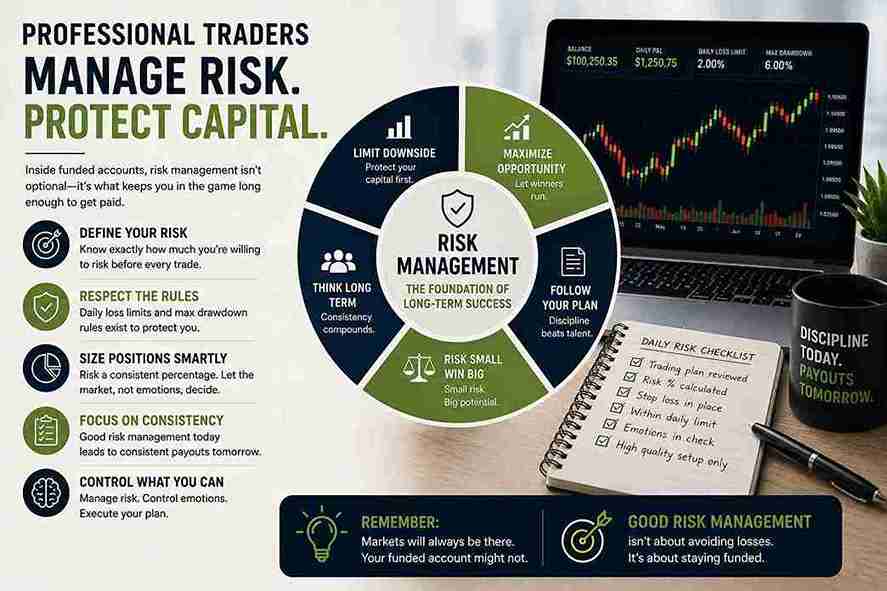
Prop Firm Risk Management Starts Before Every Trade
Professional traders rarely enter a position without first assessing the potential risk.
Before placing a trade, they evaluate:
- Market conditions.
- Position size.
- Stop-loss placement.
- Risk-to-reward ratio.
- Daily exposure.
- Current drawdown.
This structured process helps remove emotion from decision-making while improving consistency over time.
Prop Firm Risk Management Prioritises Capital Preservation
Successful traders understand that protecting capital always comes before chasing profits.
Instead of asking:
“How much can I make?”
They ask:
“How much can I afford to lose?”
This mindset allows traders to remain disciplined while avoiding unnecessary account breaches.
Risk Small Percentages on Every Trade
One of the most effective prop firm risk management techniques is risking a fixed percentage rather than a fixed dollar amount.
Many professional traders risk between:
- 0.25%
- 0.50%
- 1%
depending on market conditions and their trading plan.
This approach keeps risk consistent regardless of account size.
| Account Size | 0.5% Risk |
|---|---|
| $25,000 | $125 |
| $50,000 | $250 |
| $100,000 | $500 |
Position Size Should Match Market Conditions
Professional traders never increase position size simply because they feel confident.
Instead, position size is determined by:
- Stop-loss distance.
- Account balance.
- Percentage risk.
- Market volatility.
If wider stops are required, traders reduce their lot size rather than increasing their overall exposure.
Respect Daily Loss Limits
Every prop firm sets daily loss limits for a reason.
Professional traders rarely trade anywhere near these limits.
Many create personal rules such as stopping for the day after losing:
- 1%
- 1.5%
- 2%
even if the firm’s limit is higher.
This extra buffer protects the funded account from emotional decisions.
Never Chase Losing Trades
Revenge trading is one of the fastest ways to lose a funded account.
After a losing trade, professional traders avoid:
- Increasing position size.
- Entering impulsive trades.
- Ignoring their trading plan.
- Trying to recover losses immediately.
Instead, they wait patiently for the next high-quality opportunity.
Trade Quality Over Quantity
Professional traders don’t measure success by the number of trades they take.
They focus on executing only high-probability setups.
Trading less often often results in:
- Better entries.
- Better decision-making.
- Lower emotional stress.
- Greater consistency.
Sometimes doing nothing is the best trading decision.
Keep a Trading Journal
Another important prop firm risk management habit is maintaining a trading journal.
Professional traders record:
- Entry and exit.
- Risk percentage.
- Market conditions.
- Emotional state.
- Mistakes.
- Lessons learned.
Reviewing these notes regularly helps identify recurring mistakes and improve future performance.
Control Emotions
Risk management isn’t only about numbers.
It’s also about psychology.
Professional traders recognise emotional triggers such as:
- Fear of missing out.
- Revenge trading.
- Overconfidence.
- Frustration after losses.
When emotions begin influencing decisions, they step away rather than forcing trades.
Think Long Term
Professional traders understand that one profitable week doesn’t define success.
Instead, they focus on:
- Consistency.
- Capital preservation.
- Disciplined execution.
- Long-term profitability.
This mindset helps them remain funded while steadily increasing their earning potential.
Common Prop Firm Risk Management Mistakes
Many funded accounts are lost because traders:
- Risk too much on one trade.
- Ignore drawdown rules.
- Remove stop losses.
- Increase position size after losses.
- Trade emotionally.
- Break firm rules.
Avoiding these mistakes is often more valuable than finding a new trading strategy.
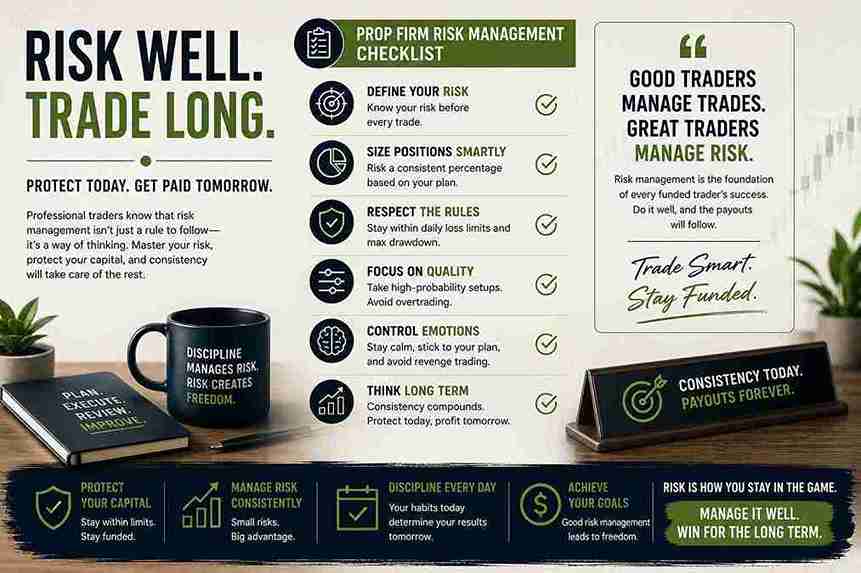
Prop Firm Risk Management Checklist
Before every trade, ask yourself:
- Does this trade match my trading plan?
- Have I calculated my position size?
- Is my stop loss in place?
- Am I risking a consistent percentage?
- Am I trading logically rather than emotionally?
- Does this trade keep me comfortably within drawdown limits?
If the answer is no, it’s usually better to wait.
Final Thoughts
Developing strong prop firm risk management habits is essential for anyone who wants to remain funded over the long term.
Professional traders don’t survive because they avoid losing trades. They stay funded because they manage risk consistently, protect their capital and follow disciplined trading processes every day.
If you want to achieve consistent payouts, focus less on chasing profits and more on building a repeatable risk management process that supports sustainable trading success.
Frequently Asked Questions
What is prop firm risk management?
Prop firm risk management is the process of controlling trading risk through position sizing, capital preservation, drawdown management and disciplined execution.
Why is risk management important for funded traders?
Effective risk management helps traders avoid breaching daily loss limits and maximum drawdown rules while improving long-term consistency.
How much should funded traders risk per trade?
Many professional traders risk between 0.25% and 1% of their account per trade, depending on their trading strategy and market conditions.
Can good risk management improve trading performance?
Yes. Consistent risk management helps traders protect capital, reduce emotional decisions and increase their chances of maintaining funded accounts.