Prop Firm Red Flags: What to Check Before Joining
Last reviewed 28 September 2026. Prop firm red flags can be easy to overlook when you’re focused on account size, profit splits or passing a challenge. Before joining a prop firm, traders should look beyond the marketing and carefully check its rules, fees, payout conditions, reputation and customer support. Before paying for an evaluation, take […]


Last reviewed 28 September 2026.
Prop firm red flags can be easy to overlook when you’re focused on account size, profit splits or passing a challenge. Before joining a prop firm, traders should look beyond the marketing and carefully check its rules, fees, payout conditions, reputation and customer support.
Before paying for an evaluation, take time to research the company, understand its rules and look beyond its marketing.
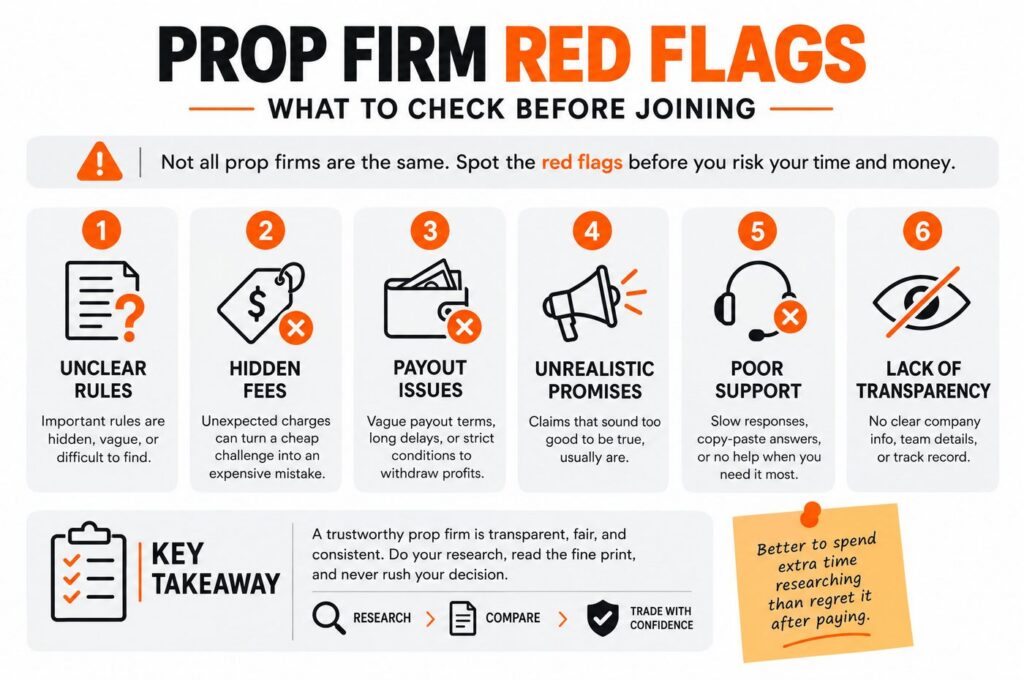
Here are the biggest prop firm red flags to watch for before joining.
1. Unclear or Difficult-to-Find Trading Rules
One of the biggest prop firm red flags is a lack of clarity around the rules.
A reputable firm should clearly explain:
- Daily loss limits.
- Maximum drawdown.
- Profit targets.
- Trading restrictions.
- News trading conditions.
- Overnight and weekend rules.
- Payout requirements.
- Prohibited strategies.
If important rules are buried across multiple pages or difficult to interpret, take a closer look before purchasing.
You should know exactly what you’re agreeing to before paying for an evaluation.
2. Unexpected Fees
A challenge fee may look affordable until additional charges appear later.
Before joining, check whether the firm charges for:
- Account resets.
- Activation.
- Platform access.
- Data.
- Payout processing.
- Account upgrades.
- Other administrative services.
The total cost should be clear before you purchase.
A low headline price isn’t necessarily a good deal if the actual cost is significantly higher.
3. Vague Payout Conditions
A high profit split is attractive, but it doesn’t tell you everything about the payout process.
Look for clear information about:
- First payout eligibility.
- Minimum withdrawal amounts.
- Payout frequency.
- Profit split.
- Maximum payout limits.
- Consistency requirements.
- Verification procedures.
If you cannot easily determine when and how you can withdraw profits, consider that a warning sign.
4. Unrealistic Marketing Claims
Be cautious when a prop firm relies heavily on claims that sound too good to be true.
Examples include:
- Guaranteed profits.
- “Risk-free” trading.
- Instant wealth.
- Extremely high success rates without evidence.
- Claims that passing is almost effortless.
- Promises that traders can make large returns with minimal risk.
Trading involves risk and uncertainty.
Professional firms should communicate realistic expectations rather than making exaggerated promises.
5. Aggressive Sales Pressure
You shouldn’t feel pressured to purchase an evaluation immediately.
Be cautious if a firm repeatedly uses:
- Countdown timers.
- “Last chance” offers.
- Constant discount messages.
- Pressure to upgrade.
- Claims that prices will disappear immediately.
Promotions aren’t automatically a problem, but excessive urgency can make it harder to evaluate the product objectively.
Take your time and read the terms before paying.
6. Poor Customer Support
Customer support becomes particularly important when you have questions about rules or payouts.
Before purchasing, test the firm’s support.
Ask a straightforward question about:
- Drawdown.
- News trading.
- Payouts.
- Account rules.
Pay attention to whether the answer is clear, specific and consistent with the published rules.
If support cannot explain basic account conditions before you become a customer, that deserves attention.
7. Rules That Don’t Match the Marketing
Another important prop firm red flag is a gap between what the firm advertises and what the detailed rules actually allow.
For example, a firm may promote:
“Trade your way.”
But the detailed terms may contain extensive restrictions on certain strategies, news events, holding periods or account behaviour.
Always compare the marketing claims with the actual terms and conditions.
The rulebook matters more than the headline.
8. Frequently Changing Rules Without Clear Communication
Rules can legitimately change as firms update their programmes.
The issue is how those changes are communicated.
Pay attention to whether the firm:
- Publishes changes clearly.
- Explains what has changed.
- Provides updated documentation.
- Identifies when changes take effect.
- Explains which accounts are affected.
A firm that makes important changes without clear communication can create unnecessary uncertainty for traders.
9. No Clear Company Information
Research the business behind the trading programme.
Look for:
- A clearly identified company.
- Contact information.
- Terms and conditions.
- Privacy policy.
- Refund policy.
- Payout policy.
- A clear explanation of its account structure.
A professional website should make it reasonably easy to understand who operates the service and how it works.
If basic company information is difficult to find, investigate further before paying.
10. Confusing Account Structures
Some firms offer multiple account types, which isn’t automatically a problem.
The concern arises when it is difficult to understand the differences.
Before choosing an account, you should be able to determine:
- What you are purchasing.
- Whether it is an evaluation or another account model.
- What happens after passing.
- How drawdown works.
- How payouts work.
- Which trading rules apply.
If two account types appear almost identical but have materially different conditions, compare them carefully.
11. Rules That Don’t Fit Your Trading Strategy
A prop firm doesn’t need to be bad for its rules to be wrong for you.
For example, your strategy may depend on:
- News trading.
- Overnight positions.
- Weekend positions.
- Automated systems.
- High-frequency execution.
- Specific markets.
If the firm’s rules restrict the way you trade, forcing your strategy to fit the account could create unnecessary problems.
This is one reason understanding the rules before joining matters so much.
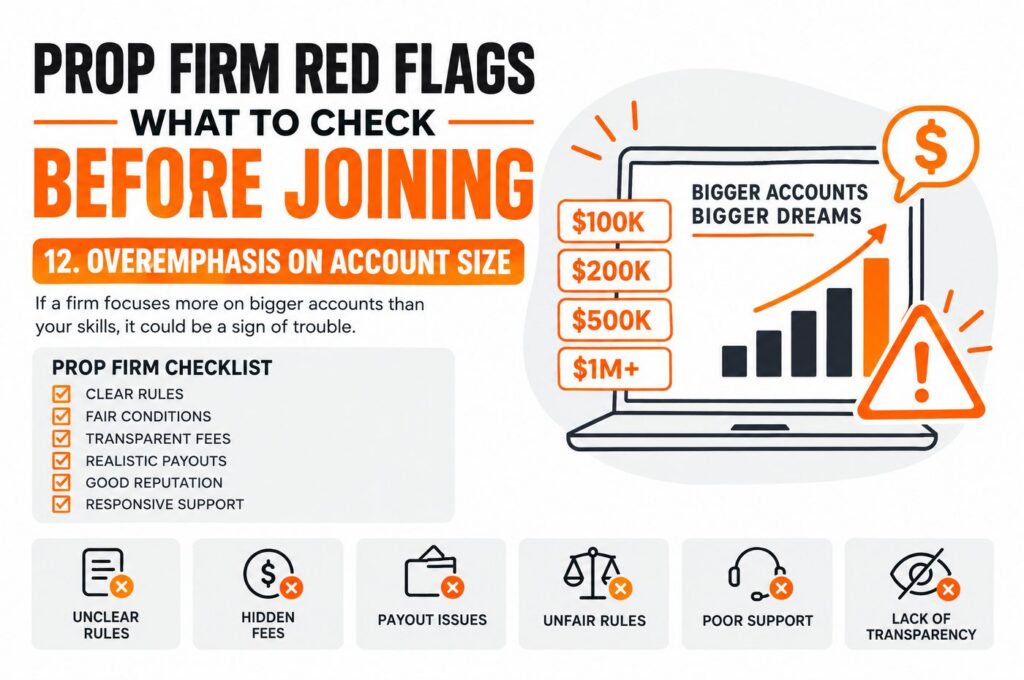
12. Overemphasis on Account Size
A massive advertised account can make a challenge look more attractive than it really is.
But the account’s nominal size doesn’t tell you how much drawdown you can actually use.
Instead of asking:
“How big is the account?”
Ask:
“How much room do I actually have to manage risk?”
Compare the drawdown model, daily loss limit, position restrictions and other conditions before deciding.
How to Research Prop Firm Red Flags Before Joining
Spotting prop firm red flags isn’t about finding one negative review and immediately rejecting a company.
Use several sources of information.
Start With the Official Rules
Read the current terms and trading conditions.
Check Independent Feedback
Look for trader experiences across multiple sources rather than relying on testimonials published by the firm.
Research Payout Experiences
Look for consistent patterns rather than isolated complaints or praise.
Test Customer Support
Ask questions before spending money.
Compare Several Firms
Comparing providers makes unusual conditions easier to identify.
Check for Recent Changes
Old reviews may no longer reflect the current account structure.
Prop Firm Red Flags: A Simple Checklist
Before purchasing, ask:
- Are all trading rules clearly explained?
- Are there unexpected fees?
- Are payout conditions easy to understand?
- Does the marketing make unrealistic promises?
- Is customer support responsive?
- Can I find clear company information?
- Are recent rule changes communicated properly?
- Does the account actually suit my trading strategy?
- Do independent trader experiences raise recurring concerns?
- Have I read the current terms myself?
If you cannot answer several of these questions, don’t rush the purchase.
Red Flags Don’t Always Mean a Firm Is Bad
It’s important to distinguish between a genuine warning sign and a simple difference in business model.
For example, a firm may:
- Have strict news trading rules.
- Use a trailing drawdown.
- Require minimum trading days.
- Offer a lower profit split.
- Limit certain automated strategies.
None of these automatically makes a firm unreliable.
The key question is whether the conditions are clearly disclosed and suitable for your trading strategy.
A transparent firm with strict rules can be a better choice than a firm with attractive marketing but unclear conditions.
What to Prioritise Instead
Rather than choosing a firm based on one impressive feature, look for:
Transparency
Rules, fees and payouts should be clearly explained.
Consistency
The firm’s published information should match its actual account conditions.
Reputation
Look for credible evidence of how the firm treats traders.
Suitable Trading Conditions
The rules should work with your strategy.
Clear Payout Policies
You should understand what is required to withdraw profits.
Responsive Support
Questions should receive clear and useful answers.
These factors provide a much better basis for comparison than account size alone.
Final Thoughts
The most important prop firm red flags aren’t always obvious.
Sometimes the warning sign is an unclear payout policy. Sometimes it’s a rule hidden in the terms. Other times, it’s aggressive marketing, unexpected fees or conditions that simply don’t suit your strategy.
The safest approach is to slow down before purchasing.
Read the rules. Compare the costs. Research the firm’s reputation. Understand the payout process. And make sure the account fits the way you actually trade.
Don’t choose a prop firm because it looks impressive. Choose one because you understand what you’re signing up for.
Frequently Asked Questions
What are the biggest prop firm red flags?
Major warning signs include unclear rules, unexpected fees, vague payout conditions, unrealistic marketing claims, poor customer support and a lack of clear company information.
Should I avoid a prop firm with negative reviews?
Not necessarily. Individual reviews can be subjective. Look for recurring patterns across multiple independent sources and compare those findings with the firm’s published policies.
Is a high profit split a red flag?
No. A high profit split isn’t automatically a problem. However, you should check whether other conditions, payout requirements or restrictions affect how much you can actually withdraw.
What should I check before buying a prop firm challenge?
Review the current trading rules, drawdown model, fees, payout requirements, trading restrictions, company information and independent trader feedback.
Can strict prop firm rules be a good thing?
Yes. Strict rules aren’t automatically a warning sign if they are clearly communicated and reasonable for the account structure. The important issue is whether you understand and can realistically follow them.