Funded Account Risk Management: Expert Guide
Funded account risk management is what separates consistently profitable traders from those who repeatedly lose funded accounts. Many traders believe that getting funded is the hardest part of prop trading. However, professional trader risk management is what truly separates consistently profitable traders from those who repeatedly lose funded accounts. While passing an evaluation certainly takes […]

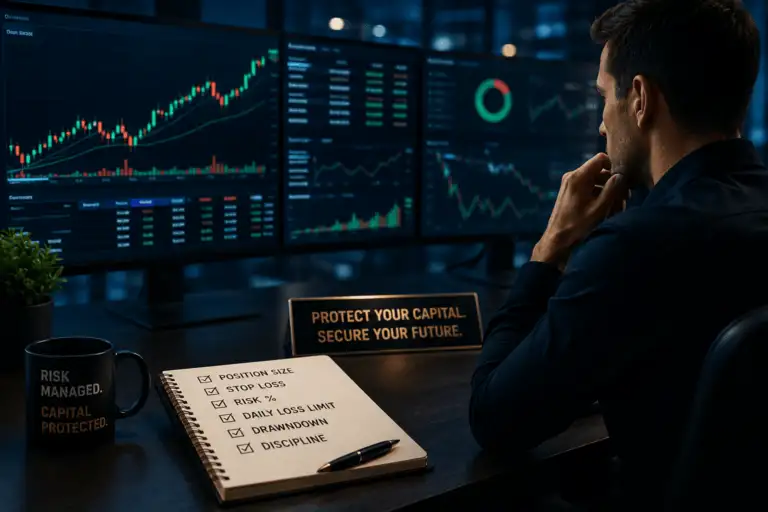
Funded account risk management is what separates consistently profitable traders from those who repeatedly lose funded accounts. Many traders believe that getting funded is the hardest part of prop trading. However, professional trader risk management is what truly separates consistently profitable traders from those who repeatedly lose funded accounts. While passing an evaluation certainly takes discipline, maintaining a funded account requires structured risk management, emotional control and consistent execution.
Successful funded traders don’t survive because they have a perfect strategy or because they predict every market move correctly. Instead, they stay funded by managing risk consistently. Every trading decision is designed to protect their account first and grow it second.
Inside a funded account, preserving capital is often more important than maximising profits. Daily loss limits, maximum drawdown rules and consistency requirements mean that one poor trading session can undo weeks of progress. As a result, professional traders place risk management at the centre of every trading decision.
In this guide, you’ll learn how professional traders manage risk inside funded accounts, the habits that separate successful traders from the rest and practical techniques you can apply to improve your long-term trading performance.
Funded Account Risk Management Starts Before Every Trade
Many aspiring traders spend months searching for the perfect indicator, the perfect entry or the perfect trading strategy. In reality, no strategy wins every trade.
However, experienced traders accept that losses are part of trading. Their goal is not to eliminate losses but to ensure that no single loss has the power to damage their account significantly.
Rather than asking:
“How much can I make from this trade?”
They ask:
“How much am I willing to lose if this trade doesn’t work?”
This simple mindset shift allows traders to survive losing streaks while remaining confident in their overall trading plan.
They Risk Small Percentages Instead of Fixed Dollar Amounts
One of the biggest differences between beginner and professional traders is how they measure risk.
Beginners often think in dollar amounts.
For example:
“I’m happy risking $500 on this trade.”
Professional traders think in percentages.
For example:
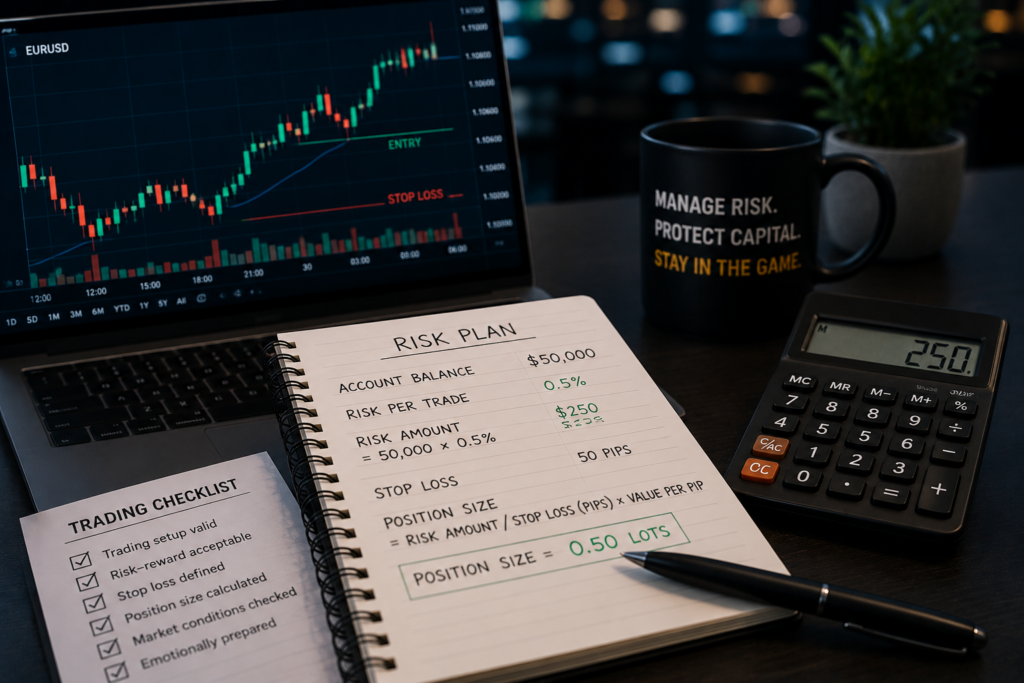
“I’m risking 0.5% of my account.”
Using percentages keeps risk consistent regardless of account size.
| Account Size | Risk Per Trade (0.5%) |
|---|---|
| $25,000 | $125 |
| $50,000 | $250 |
| $100,000 | $500 |
Consequently, this approach helps traders remain disciplined while staying comfortably within prop firm drawdown rules.
Position Size Is Calculated Before Every Trade
Successful funded traders never choose position size based on confidence or emotion.
Instead, they calculate their position size using:
- Account balance
- Stop-loss distance
- Acceptable percentage risk
- Current market volatility
If market conditions require a wider stop loss, they reduce their lot size instead of increasing the amount they are willing to lose.
As a result, every trade follows the same structured process regardless of whether the previous trade was a winner or a loser.
Daily Loss Limits Are Personal Before They Are Company Rules
Most prop firms have strict daily loss limits.
Rather than trading right up to these limits, experienced traders create their own personal limits that are even more conservative.
For example:
| Rule | Example |
|---|---|
| Firm Daily Loss Limit | 5% |
| Trader’s Personal Limit | 2% |
Once their personal limit is reached, they stop trading for the day.
This prevents emotional decisions from turning a manageable loss into an account-ending mistake.
They Never Chase Losses
One losing trade does not require another trade.
Likewise, one losing day does not require a recovery session.
Professional traders understand that revenge trading is one of the fastest ways to lose a funded account.
Instead of trying to recover immediately, they step away, review what happened and return when the next high-quality opportunity appears.
Ultimately, patience protects capital.
They Trade Only High-Probability Setups
Professional traders are comfortable doing nothing.
Not every trading session presents an opportunity that matches their trading plan.
Instead of forcing trades out of boredom, they wait until their conditions are met.
This discipline reduces unnecessary losses while improving the overall quality of trades.
Remember, missing a trade rarely causes a funded account to fail. Taking poor-quality trades often does.
Drawdown Rules Shape Every Decision
Every funded trader understands the importance of respecting drawdown limits.
These rules commonly include:
- Daily drawdown
- Maximum drawdown
- Trailing drawdown
Rather than viewing these rules as restrictions, professional traders build their trading plan around them.
Many even create their own internal safety buffer below the firm’s limits, allowing room for unexpected market volatility without risking an account breach.
Funded Account Risk Management During Losing Streaks
One of the biggest mistakes inexperienced traders make is increasing position size after several losses.
Instead, professional traders usually do the opposite.
If they experience multiple losing trades, they may:
- Reduce position size
- Trade fewer setups
- Lower their daily risk
- Pause trading to review performance
Reducing risk during difficult periods helps preserve capital while allowing confidence to rebuild gradually.
Every Trade Is Documented
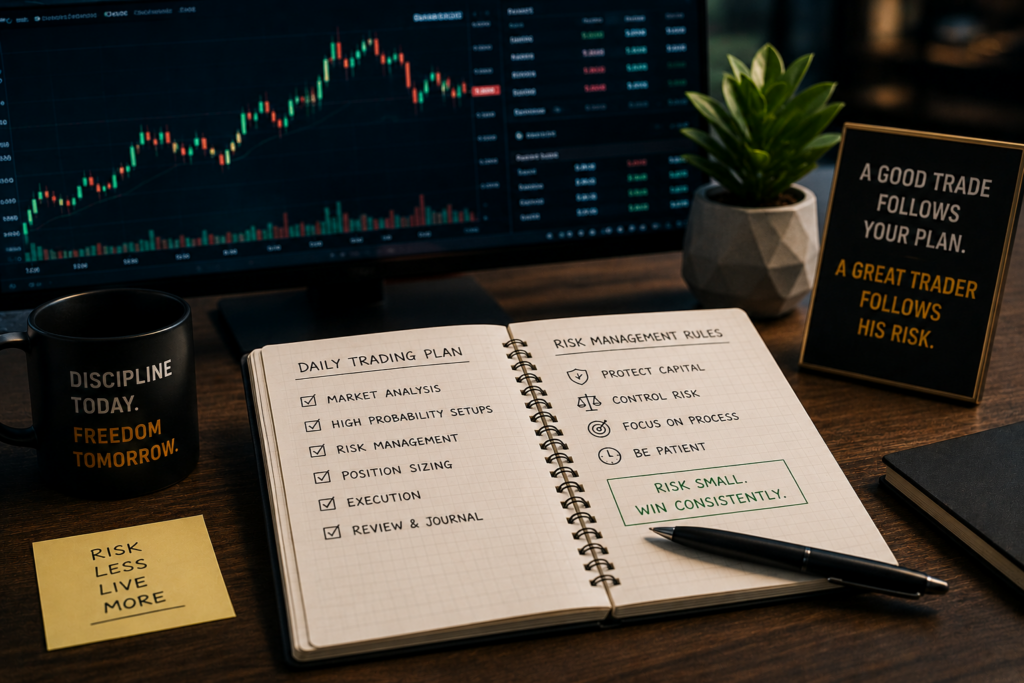
Professional traders treat trading like a business.
After every session they record information such as:
- Entry and exit
- Risk percentage
- Market conditions
- Reason for taking the trade
- Emotional state
- Result
- Lessons learned
A trading journal helps identify patterns that would otherwise go unnoticed.
Over time, these insights become one of the most valuable tools for improving consistency.
Emotional Discipline Is Part of Risk Management
Risk management isn’t only about numbers.
It’s also about emotions.
Experienced traders recognise when emotions begin influencing decisions.
Common emotional triggers include:
- Fear of missing out
- Revenge trading
- Overconfidence after winning
- Frustration after losses
Rather than ignoring these emotions, professionals build routines that reduce their impact.
This might include taking breaks, reviewing their journal or simply ending the trading session for the day.
They Focus on Long-Term Consistency
Professional traders understand that funded accounts are not won in one week.
Instead, their goal is steady, repeatable performance over months and years.
Rather than chasing extraordinary returns, they focus on:
- Consistent execution
- Controlled risk
- Capital preservation
- Following their trading plan
Ironically, this disciplined approach often produces better long-term profits than constantly trying to maximise gains.
Common Risk Management Mistakes
Many traders lose funded accounts because of avoidable mistakes.
Some of the most common include:
- Risking too much on a single trade.
- Ignoring daily loss limits.
- Increasing position size after losses.
- Removing stop losses.
- Trading outside their plan.
- Taking trades to recover previous losses.
- Failing to review performance.
Avoiding these mistakes is often more valuable than finding a new trading strategy.
Professional Risk Management Checklist
Before placing a trade, ask yourself:
- Does this trade meet my trading plan?
- Have I calculated my position size?
- Is my stop loss defined?
- Does the potential reward justify the risk?
- Am I trading because of opportunity or emotion?
- Will this trade keep me comfortably within drawdown limits?
If the answer to any of these questions is no, it’s usually better to wait.
Final Thoughts
Professional trader risk management is built on disciplined decisions rather than perfect market predictions.
Successful traders think in percentages instead of dollars, protect their capital through careful position sizing, respect drawdown limits and never allow emotions to dictate their trading decisions.
The reality is that long-term success in prop trading isn’t determined by how much you make on your best day. It’s determined by how well you protect your account during your worst days.
By adopting these professional risk management habits, you’ll improve your chances of staying funded, building consistency and achieving sustainable trading success.
Frequently Asked Questions
Why is risk management important in funded accounts?
Funded accounts have strict trading rules. Effective risk management helps traders avoid breaching daily loss limits and maximum drawdown while maintaining consistent performance.
How much should I risk per trade?
Many professional traders risk between 0.25% and 1% of their account on each trade, depending on market conditions and their trading strategy.
What is the biggest mistake funded traders make?
One of the most common mistakes is increasing risk after losing trades in an attempt to recover losses quickly.
Can good risk management make up for an average strategy?
In many cases, yes. A disciplined trader with solid risk management often outperforms a trader with an excellent strategy but poor discipline.
How do professionals stay consistent?
They follow a written trading plan, review their performance regularly, manage emotions and prioritise protecting capital over chasing profits.