SabioTrade vs My Forex Funds: Which Prop Firm Is Better?
Updated 28 September 2026. Figures checked against each firm’s official website. Key Takeaways SabioTrade vs My Forex Funds Overview The SabioTrade vs My Forex Funds comparison highlights two very different approaches to prop trading and trader development. SabioTrade positions itself as a learning-focused platform that combines education with funded trading opportunities. Meanwhile, My Forex Funds […]


Updated 28 September 2026. Figures checked against each firm’s official website.
Key Takeaways
- SabioTrade focuses heavily on education, psychology and trader development
- My Forex Funds previously became popular for flexible evaluation models and scaling opportunities. Update, September 2026: My Forex Funds shut down in 2023 and is not currently selling challenges.
- Both firms attracted traders looking for funded account access and profit-sharing opportunities
- Risk management and drawdown rules remain important with both models
- The better choice depends on trading goals, experience and preferred learning structure
SabioTrade vs My Forex Funds Overview
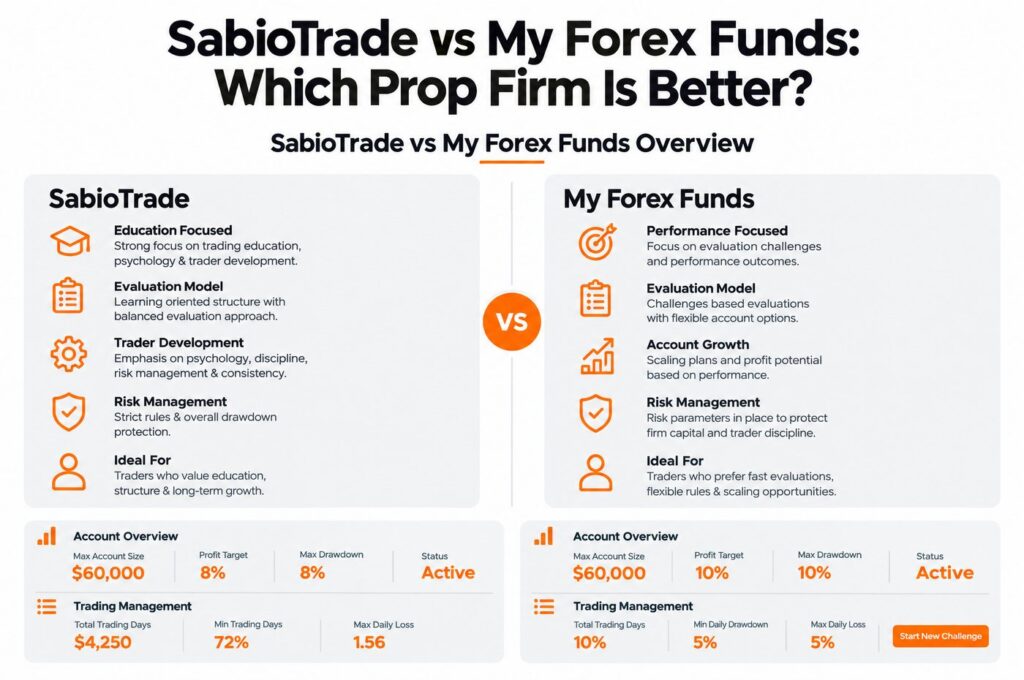
The SabioTrade vs My Forex Funds comparison highlights two very different approaches to prop trading and trader development.
SabioTrade positions itself as a learning-focused platform that combines education with funded trading opportunities. Meanwhile, My Forex Funds became widely known for its challenge models, scaling systems and flexible funding structures before operations changed significantly.
As a result, traders often compare the two firms based on education, evaluation structure, risk management and overall trading experience.
What Is SabioTrade?
SabioTrade is a prop trading platform that combines funded trading opportunities with educational support and trader development.
The platform focuses strongly on:
- Trading psychology
- Risk management
- Discipline and consistency
- Long-term trader improvement
Therefore, SabioTrade may appeal to traders seeking structured learning alongside account funding.
What Was My Forex Funds Known For?
My Forex Funds became popular within the prop trading industry because of its flexible evaluation programmes and relatively accessible funding models.
The platform was known for:
- Multiple account types
- Evaluation challenges
- Profit split opportunities
- Account scaling systems
- Lower entry costs for traders
As a result, many traders viewed My Forex Funds as one of the more accessible prop firms during its peak popularity.
Educational Approach
One of the biggest differences between the two firms involves trader education.
SabioTrade
SabioTrade promotes trader development through educational content and structured learning systems.
This includes:
- Trading lessons
- Psychology training
- Risk-management education
- Strategy guidance
My Forex Funds
My Forex Funds focused more heavily on evaluation performance and account scaling rather than structured education.
Therefore, traders were generally expected to develop strategies independently.
Evaluation and Funding Models
Both firms used funded account structures, but the approach differed significantly.
| SabioTrade | My Forex Funds |
|---|---|
| Education-focused structure | Evaluation-focused structure |
| Emphasis on trader development | Emphasis on challenge completion |
| Learning-first approach | Faster progression systems |
| Structured support environment | Performance-driven model |
Ultimately, traders may prefer different systems depending on experience and learning preferences.
Risk Management Rules
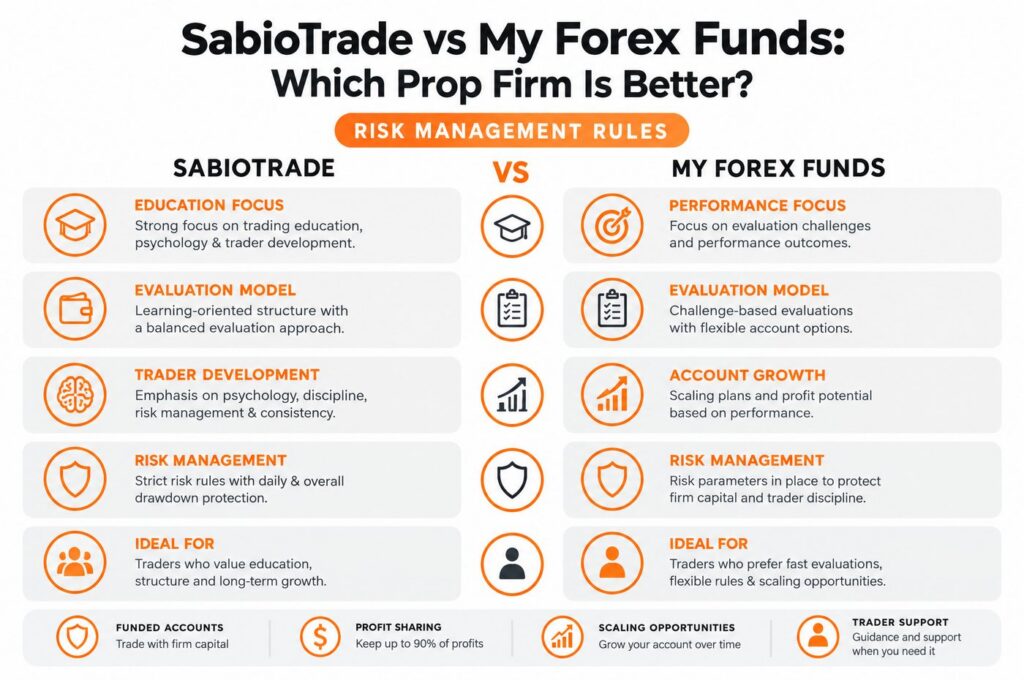
Both firms apply strict risk-management requirements to protect trading capital.
Common rules include:
- Daily drawdown limits
- Maximum loss restrictions
- Consistency requirements
- Position size controls
As a result, disciplined trading remains critical regardless of the funding model.
Which Firm Is Better for Beginners?
SabioTrade may suit beginners who want:
- Structured guidance
- Educational support
- Psychology development
- A slower learning-focused environment
Meanwhile, My Forex Funds historically appealed more to traders seeking faster funding opportunities and flexible evaluation models.
However, beginners should still understand that all prop trading involves significant risk and emotional pressure.
Profit Splits and Growth Opportunities
Both firms promoted profit-sharing opportunities for successful traders.
Potential benefits included:
- Funded account access
- Profit split payouts
- Scaling opportunities
- Performance-based growth
However, payout structures and account conditions varied depending on the programme selected.
Potential Advantages of SabioTrade
Strong Educational Focus
The platform emphasises trader development and long-term consistency.
Structured Learning Environment
Traders may benefit from additional guidance and support systems.
Psychology and Discipline Training
Risk management and emotional control are strongly prioritised.
Potential Advantages of My Forex Funds
Flexible Evaluation Systems
The platform previously offered several challenge structures for traders.
Faster Account Progression
Some traders preferred the quicker funding pathways.
Lower Initial Costs
Entry-level programmes were often more accessible financially.
Final Verdict
The SabioTrade vs My Forex Funds comparison ultimately depends on what traders value most in a prop firm.
SabioTrade may appeal more to traders seeking education, structured development and psychology support. Meanwhile, My Forex Funds historically attracted traders focused on fast evaluations, flexibility and account scaling.
Ultimately, success with either model still depends heavily on discipline, risk management and trading consistency.
FAQ
1. What is SabioTrade?
SabioTrade is a prop trading platform focused on trader education and funded trading opportunities.
2. What made My Forex Funds popular?
The platform became known for flexible evaluations, account scaling and funded trading models.
3. Is SabioTrade beginner-friendly?
It may suit beginners because of its educational and learning-focused structure.
4. Did My Forex Funds focus on education?
The platform focused more heavily on evaluations and trading performance.
5. Which platform is better for trader development?
SabioTrade places stronger emphasis on psychology, discipline and structured learning.