
How Australian Traders Get Paid by Prop Firms: AUD, Fees and Tax Records
Payout methods at the main firms, what each route costs on a real payout, how stablecoin payouts are taxed, and the records the ATO expects you to keep.


Passing the challenge is the hard part, but getting the money into an Australian bank account has its own costs. Prop firms charge and pay in US dollars, and every step between their account and yours can take a slice: your card when you pay the fee, the payout method, the exchange rate and, if you take stablecoins, the exchange you sell them on. This guide covers the routes the main firms offer Australians, what each one costs, and the records the ATO expects you to keep.
How the money moves
A typical payout goes: the firm approves your request, sends US dollars or a stablecoin by its chosen method, and you convert it to Australian dollars, either at your bank, through a payment platform, or by selling the stablecoin on an Australian exchange. Each of those steps has a fee or an exchange rate margin, and the total can differ by a few percent between routes.
Payout methods at the main firms
| Firm | Methods open to Australians | Firm’s fee | Speed |
|---|---|---|---|
| FTMO (FTMO Australia) | Bank wire | None from FTMO. Minimum closed profit of US$20 | Usually one to two business days after the invoice is confirmed |
| FundedNext | USDT, USDC, Rise, bank transfer, card | Trader pays the gateway charges | Issued within 24 hours |
| The5ers | Rise, crypto, bank transfer | 3.5% commission | See the firm’s withdrawal FAQ |
| Topstep | International wire (SWIFT) | US$30 | Five to ten business days, after one to three days of approval |
| TradePath Funding | The firm’s current outbound methods, which it says can change | Ask support | Ask support |
Topstep offers Wise transfers too, but only to traders in China, Canada and the UK, so Australians are paid by wire. The5ers also offers HUB Credits with no commission, but they can only be spent on new programmes. Payouts at every firm go only to an account in your own name.
Paying the challenge fee
Challenge prices are set in US dollars, so paying with an Australian card means the card scheme’s exchange rate plus, on many cards, an international transaction fee, often around 3% of the purchase. On a US$500 challenge that is about US$15 before the exchange rate margin. A card with no international transaction fees, or a multi currency account that holds US dollars, avoids most of it. Several firms also take crypto for fees, which avoids the card fee but means buying the crypto first.
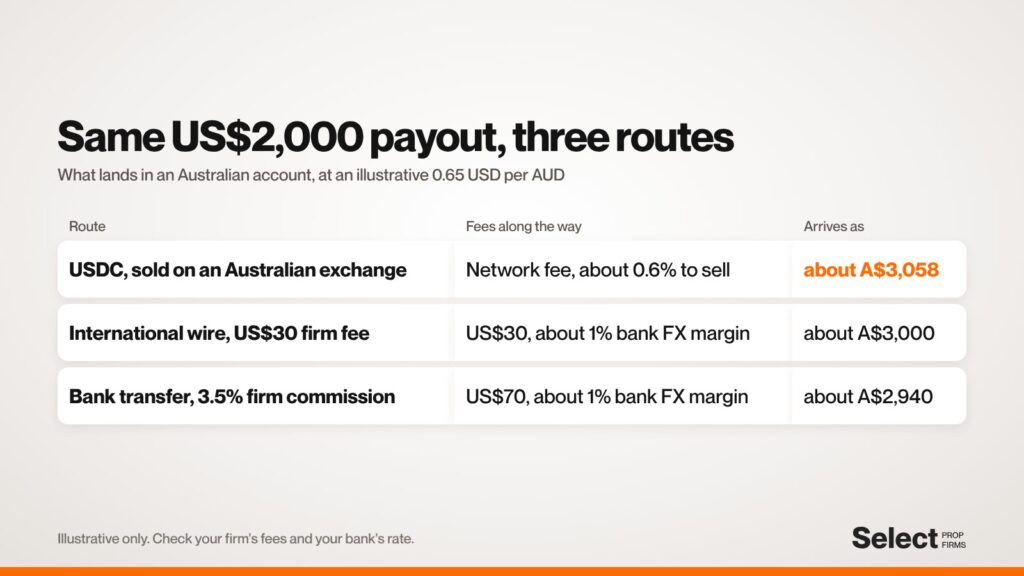
Worked example: a US$2,000 payout
These figures are illustrative, using an exchange rate of 0.65 US dollars to the Australian dollar. Your bank’s fees and rates will differ, so look them up.
- International wire at a firm that charges US$30. US$1,970 arrives. Your bank may charge a fee to receive a foreign transfer, and its exchange rate will usually sit a percent or more below the mid market rate. At a 1% margin, US$1,970 becomes about A$3,000.
- Stablecoin with no firm fee. You receive about 2,000 USDC, less the network fee. Selling it on an Australian exchange for Australian dollars costs a trading fee and a spread, which vary by exchange and by how you trade. If they come to 0.6% all in, that is about A$3,058.
- Bank transfer at a firm that charges 3.5%. US$70 goes in commission before the money leaves the firm, so US$1,930 arrives and becomes about A$2,940 at a 1% bank margin.
The gap between the best and worst route here is over A$100 on one payout. Over a year of regular payouts it adds up, so pick the route before you need it and open the accounts early, because platform and exchange identity checks can take days.
-end
Stablecoin payouts and tax
A stablecoin payout is not tax free just because it never touched a bank. The ATO says that if you receive crypto as payment for services, you treat its Australian dollar market value when you receive it as assessable income. When you later sell or swap it, that can trigger capital gains tax on any change in value since you received it, and the value you declared as income is usually the starting cost base. With a dollar stablecoin the change is usually small, but the Australian dollar can move between the day you are paid and the day you sell, so record both.
Records to keep for the ATO
This is general information, not tax advice. Australian residents for tax purposes declare their worldwide income, so payouts from an overseas firm belong in your return. The income year runs from 1 July to 30 June. Keep a simple log from your first purchase:
| Column | What to record |
|---|---|
| Date | The day the fee was paid or the payout received |
| Firm and account | Firm name, account number and programme |
| Type | Challenge fee, reset fee, data fee, refund or payout |
| Amount in US dollars or crypto | Exactly as shown on the firm’s invoice or statement |
| Rate and amount in AUD | The rate you used and the converted amount. The ATO publishes monthly and annual exchange rates you can use |
| Method and fees | Wire, Rise, USDC and so on, with every fee taken along the way |
| Evidence | A link or file name for the invoice, receipt or exchange statement |
Whether your trading counts as a business decides whether fees like challenge costs are deductible, so take the log to a registered tax agent. Our prop firm income and tax guide covers how payouts are usually treated in Australia, the US and the UK.
Common mistakes
- Using an account in someone else’s name. Payouts go only to the account holder, and a mismatch with your ID can hold up or void a payout.
- Leaving the payout setup until the first payout. Rise, Wise and exchange accounts all need identity checks.
- Converting at a bad moment out of habit. If you hold US dollars or stablecoins, you can choose when to convert, but record the rate either way.
- Forgetting the fee side of the ledger. Failed challenges and resets are part of the picture for your tax agent.
Checklist
- Check which payout methods your firm offers Australians, and each one’s fee and speed, before you buy.
- Pay fees with a card or account that has no international transaction fee.
- Open your payout platform or exchange account early and finish its identity checks.
- Log every fee and payout in both currencies from day one.
- See our guide for Australian traders for which firms accept you, and prop firm payout methods for how each route works.
Frequently Asked Questions
How do Australian traders receive prop firm payouts?
Usually by international bank wire, through a payment platform such as Rise, or in stablecoins such as USDC or USDT that you sell on an exchange for Australian dollars. Which methods you can use depends on the firm.
Are prop firm payouts taxed in Australia?
Australian tax residents declare their worldwide income, so payouts from an overseas firm belong in your tax return, converted to Australian dollars. Whether your trading counts as a business affects what you can claim. Check your position with a registered tax agent.
How is a crypto payout from a prop firm taxed in Australia?
The ATO says crypto received as payment for services is assessable income at its Australian dollar market value when you receive it. Selling or swapping it later can trigger capital gains tax on any change in value.
Which payout method is cheapest from Australia?
It depends on the firm's fee, your bank's charges and the exchange rate margin. In our worked example on a US$2,000 payout, the gap between the cheapest and dearest route was over A$100.