
Before Buying a Prop Firm Challenge: 10 Questions to Ask
Buying a prop firm challenge is a financial decision, not something traders should rush into because of an attractive promotion or a large advertised account size. Before buying a prop firm challenge, you should understand exactly what you’re paying for, what rules you’ll need to follow and what happens if you successfully complete the evaluation. […]

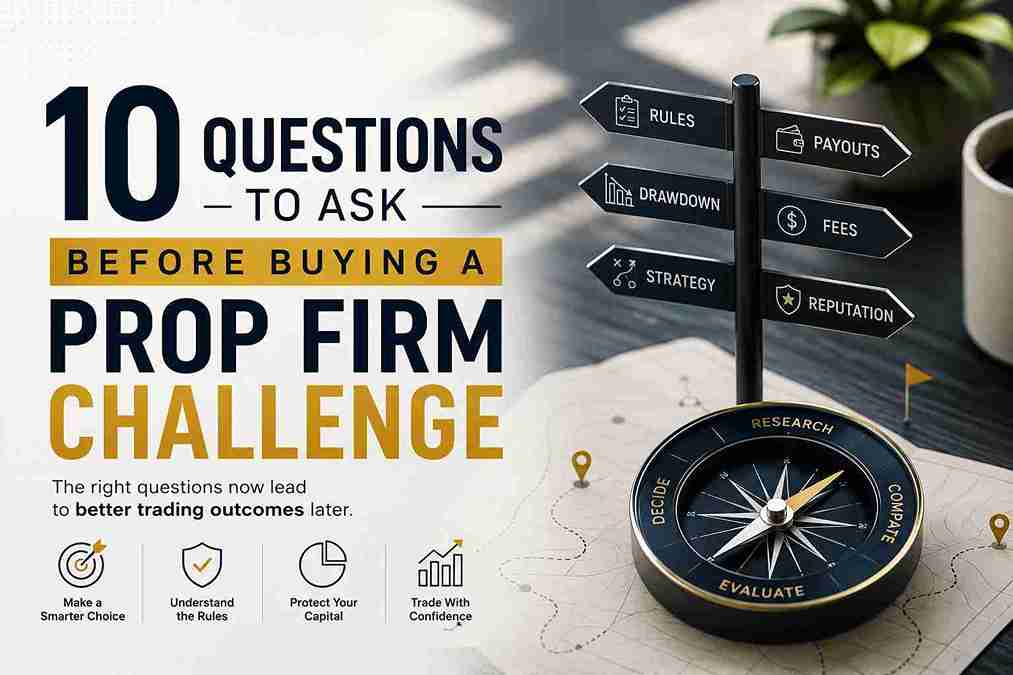
Buying a prop firm challenge is a financial decision, not something traders should rush into because of an attractive promotion or a large advertised account size.
Before buying a prop firm challenge, you should understand exactly what you’re paying for, what rules you’ll need to follow and what happens if you successfully complete the evaluation.
A low challenge fee or high profit split can look appealing, but these numbers don’t tell the whole story. Trading rules, drawdown limits, payout conditions and account restrictions can have a much greater impact on your experience.
In this guide, we’ll cover 10 questions to ask before buying a prop firm challenge so you can compare your options and make a more informed decision.
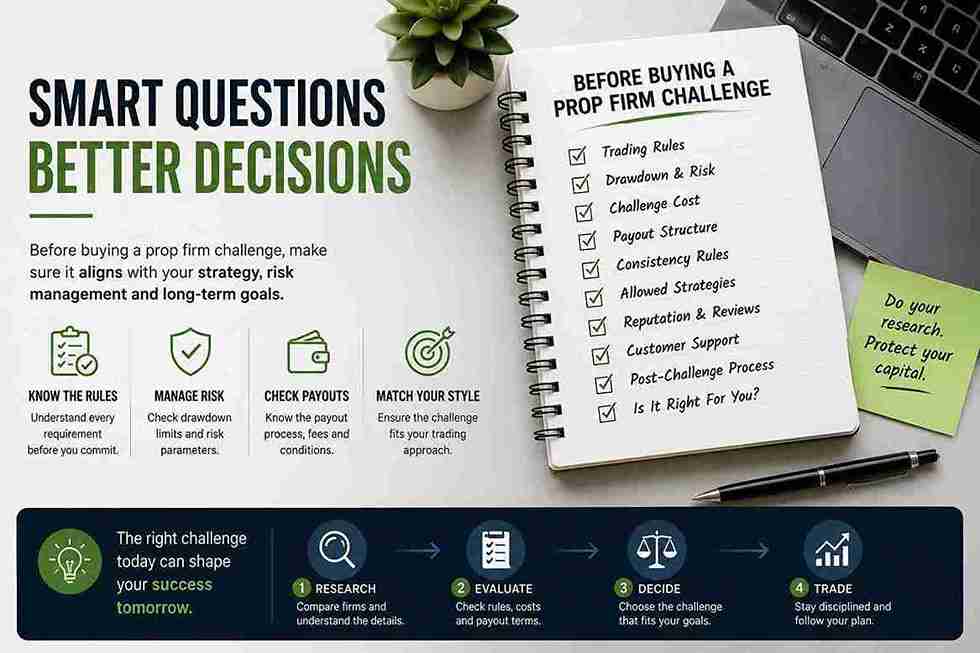
1. What Are the Challenge Rules?
The first question to ask before buying a prop firm challenge is simple: What exactly are the trading rules?
- Profit targets.
- Daily loss limits.
- Maximum drawdown.
- Minimum trading days.
- Trading hours.
- Position size restrictions.
- News trading rules.
- Weekend holding policies.
Don’t rely only on promotional summaries. Read the full trading conditions and make sure you understand how each rule works.
2. How Is Drawdown Calculated?
Drawdown can be one of the most important factors in a prop firm challenge.
Find out whether the firm uses:
- Static drawdown.
- Trailing drawdown.
- Daily drawdown.
- Equity-based calculations.
- Balance-based calculations.
A large account size doesn’t necessarily mean you have a large amount of room to lose.
Understanding the drawdown calculation helps you determine whether the account actually suits your trading strategy.
3. How Much Does the Challenge Cost?
Before committing, calculate the total cost, not just the advertised evaluation fee.
Check:
- Initial challenge fee.
- Reset fees.
- Activation fees.
- Platform fees.
- Data fees.
- Any recurring charges.
You should know exactly how much you’re committing before purchasing.
4. What Happens After I Pass?
Passing the challenge is only one part of the process.
Ask what happens next.
Does the firm:
- Automatically provide a funded account?
- Require additional verification?
- Charge an activation fee?
- Move you to a different account structure?
- Change any trading conditions?
Understanding the post-evaluation process prevents unexpected surprises after you’ve passed.
5. How Do Payouts Work?
Payout conditions should be reviewed carefully before buying a prop firm challenge.
Check:
- Profit split.
- First payout timing.
- Minimum withdrawal amount.
- Payout frequency.
- Payment methods.
- Processing times.
- Any consistency requirements.
A high advertised profit split means little if the payout conditions are difficult to understand or achieve.
6. Are There Consistency Requirements?
Some prop firms may have rules affecting how profits can be generated or withdrawn.
Ask whether the firm has requirements relating to:
- Daily profit limits.
- Largest winning day.
- Profit distribution.
- Position sizing.
- Trading frequency.
These conditions can significantly affect certain trading strategies.
7. What Trading Strategies Are Allowed?
Not every prop firm supports every trading style.
Check whether the firm permits your preferred approach, including:
- Scalping.
- Swing trading.
- News trading.
- Automated trading.
- Expert advisors.
- Hedging.
- Overnight positions.
- Weekend positions.
If your strategy isn’t permitted, the account isn’t suitable regardless of its size or profit split.
8. What Happens If I Break a Rule?
It’s important to understand the consequences of a rule violation.
Ask:
- Is the account immediately terminated?
- Can the account be reset?
- Is there a warning system?
- Does a breach affect future accounts?
- Are there different consequences for different rules?
Understanding these conditions helps you manage your account more responsibly.
9. Does the Prop Firm Have a Strong Reputation?
Research the company before spending your money.
Look for:
- Independent trader reviews.
- Community discussions.
- Verified payout experiences.
- Company history.
- Transparent communication.
- Responsive customer support.
Don’t base your decision entirely on testimonials displayed on the firm’s own website.
A trustworthy provider should make it easy to find information about its rules, policies and business practices.
10. Does the Challenge Actually Suit My Trading Style?
This may be the most important question of all.
The best challenge isn’t necessarily the cheapest or the largest.
Ask yourself:
- Does the drawdown suit my strategy?
- Can I comfortably meet the profit target?
- Are my preferred markets allowed?
- Are the trading restrictions manageable?
- Can I follow the rules without changing my strategy?
If the answer is no, another challenge may be a better fit.
Don’t Choose a Prop Firm Based on Price Alone
A common mistake is comparing firms primarily by challenge fees.
For example, one provider might offer a cheaper evaluation, while another offers:
- More suitable drawdown conditions.
- Better trading flexibility.
- Clearer payout rules.
- Stronger customer support.
- Better platform conditions.
The cheapest option isn’t automatically the best value.
Think about the overall trading conditions rather than the upfront price alone.
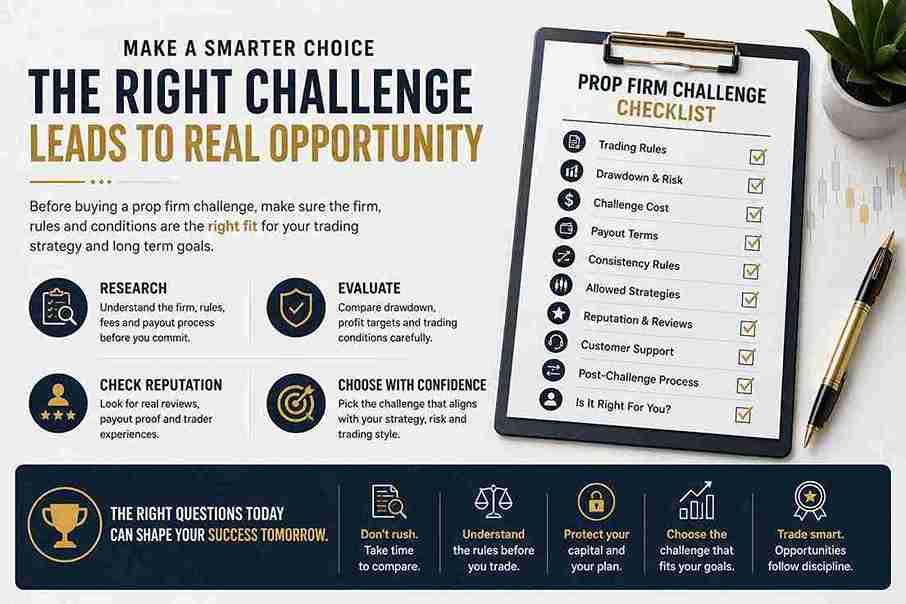
Create a Prop Firm Challenge Checklist
Before purchasing, create a simple checklist containing:
Trading rules
Are they clear and suitable for your strategy?
Drawdown
Do you understand exactly how it is calculated?
Cost
Are there any additional fees?
Payouts
Do you understand when and how you can withdraw profits?
Trading restrictions
Are your preferred strategies permitted?
Reputation
Does the firm have a credible track record?
Support
Can you get help when you need it?
Post challenge process
Do you understand what happens after passing?
If you can’t confidently answer these questions, continue researching before making a purchase.
Red Flags to Watch For
While researching before buying a prop firm challenge, be cautious if you encounter:
- Unclear trading rules.
- Hidden fees.
- Vague payout conditions.
- Unrealistic profit promises.
- Aggressive sales tactics.
- Difficult-to-find company information.
- Poor customer support.
- Restrictions that aren’t clearly explained.
None of these automatically proves that a firm is unreliable, but they are reasons to investigate further.
Final Thoughts
Taking time to research before buying a prop firm challenge can help you avoid choosing an account that doesn’t fit your trading style or risk management approach.
Don’t focus only on the account size, challenge fee or advertised profit split. Look at the complete picture, including drawdown rules, trading restrictions, payout conditions, fees and the firm’s reputation.
The right challenge should fit your strategy and allow you to trade within rules you genuinely understand.
The goal isn’t simply to buy a challenge. It’s to choose one you can realistically trade.
Frequently Asked Questions
What should I check before buying a prop firm challenge?
Review the trading rules, drawdown calculation, challenge fee, payout conditions, trading restrictions, consistency requirements and the firm’s reputation.
Is the cheapest prop firm challenge the best option?
Not necessarily. A cheaper challenge may have trading conditions that don’t suit your strategy. Compare the entire offering rather than price alone.
What is the most important thing to check before buying a prop firm challenge?
Understand the drawdown rules and trading conditions. These determine how much flexibility you actually have while trading the account.
Should I research a prop firm before purchasing a challenge?
Yes. Review its rules, payout policies, reputation, customer support and trading conditions before committing money.
Can I choose a different prop firm if the rules don’t suit me?
Yes. There are many different account structures and trading conditions available, so it’s better to find one that matches your strategy than force your strategy to fit unsuitable rules.