
Swing Trading vs Scalping Prop Firm: Which Is Better?
Last reviewed 28 September 2026. Swing trading vs scalping prop firm is a common comparison among traders preparing for prop firm challenges or managing funded accounts. Both trading styles can be profitable, but they differ significantly in trade frequency, holding periods, risk management and how they align with prop firm rules. Choosing the wrong trading […]


Last reviewed 28 September 2026.
Swing trading vs scalping prop firm is a common comparison among traders preparing for prop firm challenges or managing funded accounts. Both trading styles can be profitable, but they differ significantly in trade frequency, holding periods, risk management and how they align with prop firm rules.
Choosing the wrong trading style won’t automatically cause you to fail an evaluation. However, selecting a style that doesn’t suit your strategy, schedule or your prop firm’s rules can make it much harder to remain consistently profitable.
In this guide, we’ll compare swing trading vs scalping prop firm strategies, explain their advantages and disadvantages, and help you decide which approach best suits your trading objectives.
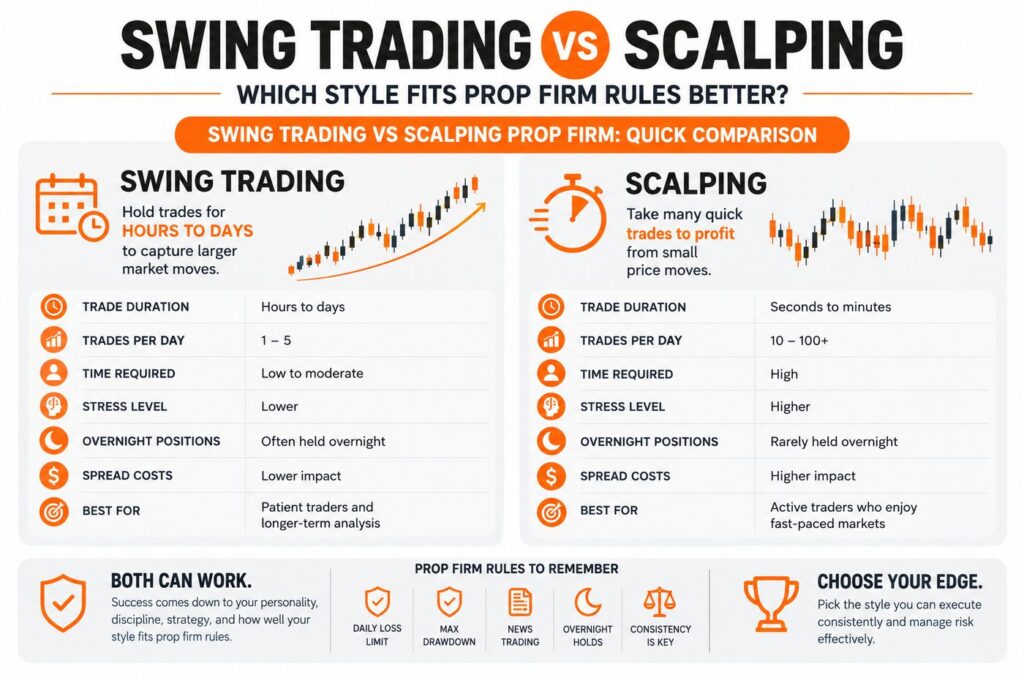
Swing Trading vs Scalping Prop Firm: Quick Comparison
| Feature | Swing Trading | Scalping |
|---|---|---|
| Trade Duration | Several hours to days | Seconds to minutes |
| Trades Per Day | 1–5 | 10–100+ |
| Time Required | Low to moderate | High |
| Stress Level | Lower | Higher |
| Overnight Positions | Often held overnight | Rarely held overnight |
| Spread Costs | Lower impact | Higher impact |
| Best For | Patient traders | Active traders |
Both styles can work in prop firms, but success depends on matching your trading approach to the firm’s rules.
What Is Swing Trading?
Swing trading involves holding positions for several hours or multiple days to capture larger market movements.
Rather than reacting to every short-term price fluctuation, swing traders focus on broader trends and wait for high-quality trade setups.
Common characteristics include:
- Fewer trades each week
- Higher reward-to-risk ratios
- Greater patience
- Longer holding periods
- Less screen time
Swing trading is often popular among traders who have full-time jobs or cannot monitor the markets continuously.
What Is Scalping?
Scalping is a short-term trading strategy that aims to profit from small price movements throughout the trading session.
Scalpers typically execute many trades each day and rely on speed, discipline and precise execution.
Typical characteristics include:
- High trading frequency
- Small profit targets
- Tight stop losses
- Fast decision-making
- Constant market monitoring
Scalping requires excellent emotional discipline because multiple losing trades can occur within a short period
How Prop Firm Rules Affect Swing Traders
Most prop firms allow swing trading, but traders should carefully review the firm’s policies before holding positions overnight.
Some firms:
- Charge overnight holding fees.
- Restrict trading during major news events.
- Prohibit holding positions over weekends.
- Apply swap or financing costs.
If overnight trading is part of your strategy, always confirm the firm’s specific rules before opening positions.
How Prop Firm Rules Affect Scalpers
Scalpers must pay close attention to execution quality.
High-frequency trading can expose traders to:
- Slippage
- Spread widening
- Execution delays
- Increased commission costs
Some prop firms also discourage trading strategies that rely solely on latency or platform inefficiencies.
Understanding these limitations helps scalpers avoid unnecessary problems during evaluations.
Risk Management Differences
Risk management is essential regardless of trading style.
However, the way traders manage risk differs considerably.
Swing Traders
Swing traders typically:
- Risk fewer trades.
- Use wider stop losses.
- Aim for larger reward-to-risk ratios.
- Focus on long-term consistency.
Scalpers
Scalpers usually:
- Take many small trades.
- Use tighter stop losses.
- Accept smaller profits.
- Require strict execution discipline.
Neither approach is inherently safer.
Success depends on following a structured risk management plan.
Which Style Is Better for Prop Firm Challenges?
Many traders assume scalping is easier because it offers more trading opportunities.
In reality, both approaches have strengths and weaknesses.
Swing Trading May Be Better If You:
- Prefer patience over speed.
- Have limited trading hours.
- Like analysing higher timeframes.
- Want fewer emotional decisions.
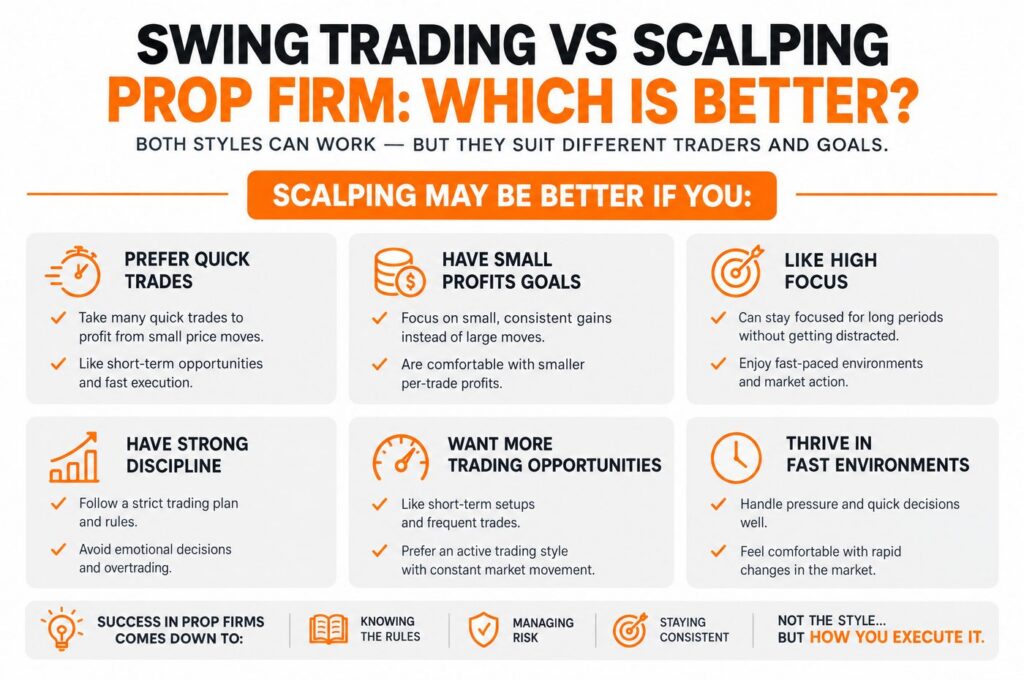
Scalping May Be Better If You:
- Enjoy fast-paced markets.
- Can monitor charts throughout the day.
- Have strong discipline.
- Prefer frequent trading opportunities.
The best style is the one you can execute consistently.
Common Mistakes Traders Make
Whether swing trading or scalping, many traders fail prop firm evaluations because they:
- Change strategies too frequently.
- Increase position size after losses.
- Ignore drawdown limits.
- Trade emotionally.
- Fail to follow their trading plan.
Consistency matters far more than trading style.
Can You Combine Both Styles?
Some experienced traders successfully combine swing trading and scalping.
For example, they may:
- Hold swing positions based on higher-timeframe trends.
- Use scalping opportunities during active market sessions.
- Reduce position size when combining strategies.
However, beginners are usually better off mastering one approach before experimenting with another.
Which Style Do Professional Funded Traders Prefer?
There is no universal answer.
Some of the most successful funded traders are swing traders.
Others build consistent profitability through disciplined scalping.
Professional traders don’t choose a style because it’s popular.
They choose the one that matches:
- Their personality.
- Their schedule.
- Their experience.
- Their risk tolerance.
- Their prop firm’s rules.
Consistency is always more important than trade frequency.
Final Thoughts
The debate around swing trading vs scalping prop firm strategies doesn’t have a single winner. Both approaches can succeed when supported by disciplined execution, sound risk management and a clear understanding of prop firm rules.
Rather than copying another trader’s style, focus on building a strategy that fits your strengths and can be repeated consistently over time. Whether you prefer the patience of swing trading or the fast pace of scalping, success ultimately comes from following your trading plan and respecting the firm’s risk limits.
Frequently Asked Questions
Is swing trading allowed in prop firms?
Yes. Most prop firms allow swing trading, although some restrict overnight or weekend positions. Always check the firm’s trading rules before holding positions for extended periods.
Is scalping allowed in prop firms?
Many prop firms permit scalping, but traders should review restrictions relating to execution methods, latency strategies and trading during high-impact news events.
Which style is better for beginners?
Swing trading is often considered more beginner-friendly because it requires fewer trades and allows more time for analysis. However, the best choice depends on your personality, schedule and trading experience.
Can I use both swing trading and scalping?
Yes. Experienced traders sometimes combine both styles, but beginners should focus on mastering one strategy before adding another.