
Why Risk-to-Reward Ratio Matters in Prop Firm Trading
Risk management is one of the most important parts of trading with a prop firm. While traders often focus on profit targets and account sizes, the relationship between potential profit and potential loss also deserves attention. The prop firm risk reward ratio helps traders compare how much they are risking on a trade with how […]


Risk management is one of the most important parts of trading with a prop firm. While traders often focus on profit targets and account sizes, the relationship between potential profit and potential loss also deserves attention.
The prop firm risk reward ratio helps traders compare how much they are risking on a trade with how much they are targeting in return.
Understanding this ratio can make trade planning more structured and help traders manage their risk within a firm’s account rules.
What Is Risk-to-Reward Ratio?
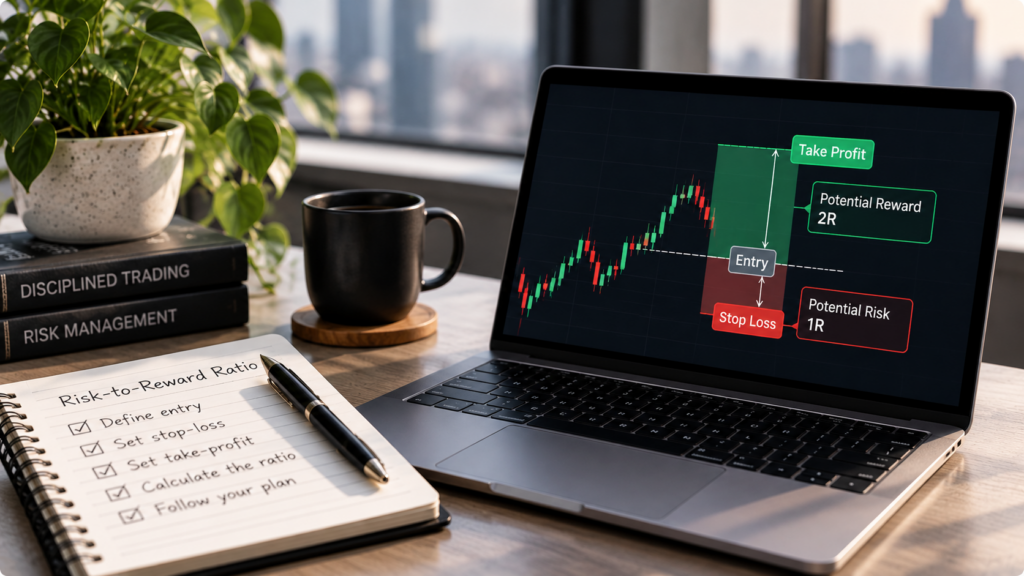
Risk-to-reward ratio compares the potential loss on a trade with its potential profit.
For example, if a trader risks $100 to potentially make $200, the risk-to-reward ratio is 1:2.
This means:
- Potential risk: $100
- Potential reward: $200
- Risk-to-reward ratio: 1:2
A 1:1 ratio would mean the potential profit and potential loss are equal.
The ratio does not predict whether a trade will succeed. Instead, it provides a framework for planning the trade before entering.
How Do You Calculate Risk-to-Reward Ratio?
The basic calculation is:
Risk-to-Reward Ratio = Potential Loss ÷ Potential Profit
For example:
- Entry price: $100
- Stop-loss: $95
- Take-profit: $110
The trader is risking $5 to potentially make $10.
$5 ÷ $10 = 1:2
The trade therefore has a 1:2 risk-to-reward ratio.
The same principle applies regardless of the account size. What changes is the actual dollar amount being risked.
Why Does Risk-to-Reward Ratio Matter in Prop Firm Trading?
Prop firm accounts often have specific limits on how much a trader can lose.
These may include:
- Daily loss limits
- Maximum drawdown
- Position-size restrictions
- Other account-specific risk rules
Because of these limits, traders need to think about potential losses before entering a position.
A trade with a large potential reward can still be inappropriate if the amount being risked is too high for the account’s rules.
Risk-to-Reward Ratio and Win Rate
Risk-to-reward ratio should also be considered alongside win rate.
A trader does not necessarily need to win every trade to remain profitable.
For example, imagine a trader makes 10 trades with a 1:2 risk-to-reward ratio:
- 4 winning trades = +8R
- 6 losing trades = -6R
- Net result = +2R
Here, R represents the amount risked on each trade.
This example shows why looking only at the percentage of winning trades can be misleading. The relationship between losses and gains also matters.
However, a higher risk-to-reward ratio does not automatically make a strategy better. The ratio needs to work with the trader’s actual strategy and win rate.
How Risk-to-Reward Ratio Can Support Prop Firm Risk Management
A clearly defined risk-to-reward ratio can help traders establish their trade parameters before entering.
For example, a trader might decide that each setup must have:
- A defined entry
- A predetermined stop-loss
- A planned profit target
- A maximum amount they are willing to risk
This creates a more structured process.
Instead of deciding how much to risk after entering a trade, the trader can establish the parameters beforehand.
Avoid Using Risk-to-Reward Ratio in Isolation
Risk-to-reward ratio is only one part of a complete risk-management process.
A trader should also consider:
Account Drawdown
Understand how much total loss the account can tolerate before the account reaches its maximum drawdown.
Daily Loss Limits
A series of losing trades can potentially push an account beyond its daily loss limit, even when each individual trade appears reasonable.
Position Size
The same 1:2 setup can involve very different levels of risk depending on position size.
Market Conditions
A theoretical profit target may not always be realistic in current market conditions.
Trading Strategy
A ratio should fit the strategy rather than being selected simply because it looks attractive on paper.
Common Risk-to-Reward Mistakes
Setting the Stop-Loss Too Tight
A stop that is too close to the entry may create an attractive-looking ratio but could be inconsistent with the market’s normal price movement.
Moving the Stop-Loss to Avoid a Loss
Changing the original risk because a trade is moving against you can significantly alter the planned risk-to-reward ratio.
Increasing Position Size to Reach a Target
Trying to reach a profit target faster can cause traders to take more risk than their account rules allow.
Focusing Only on High Ratios
A 1:5 setup may look better than a 1:2 setup, but the larger target may also be harder for the strategy to reach.
Ignoring the Firm’s Drawdown Rules
Even a carefully planned trade can create problems if the potential loss is too large relative to the account’s permitted drawdown.
What Is a Reasonable Risk-to-Reward Ratio?
There is no single ratio that works for every trader or strategy.
Some strategies may use smaller targets with higher win rates, while others may aim for larger potential rewards and accept fewer winning trades.
The important consideration is whether the ratio fits:
- Your trading strategy
- Your historical results
- Your win rate
- Your position size
- The prop firm’s loss limits
- Your overall risk-management plan
Rather than choosing a ratio because it is commonly recommended, traders should understand how their strategy performs with different risk parameters.
A Simple Prop Firm Risk-Reward Checklist
Before entering a trade, ask:
- Where is my entry?
- Where is my stop-loss?
- Where is my profit target?
- How much am I risking?
- What is my potential reward?
- What is my risk-to-reward ratio?
- Does the trade fit the firm’s drawdown and daily loss limits?
- Does the setup match my trading plan?
If these questions can be answered before entering, the trade has a clearer risk framework.
Final Thoughts
The prop firm risk reward ratio is a useful tool for planning trades and understanding the relationship between potential losses and gains.
However, the ratio should not be treated as a standalone measure of a good trade. Position size, drawdown, win rate, strategy and the firm’s specific rules all need to be considered together.
The goal is not simply to find the highest possible reward relative to risk. It is to create a risk framework that is realistic, repeatable and compatible with the account’s rules.
Frequently Asked Questions
What is the risk-to-reward ratio in prop firm trading?
It compares the amount a trader could potentially lose on a trade with the amount they could potentially gain.
Is a higher risk-to-reward ratio always better?
No. A higher ratio can require a larger price movement to reach the profit target. The appropriate ratio depends on the strategy and its historical performance.
What is a 1:2 risk-to-reward ratio?
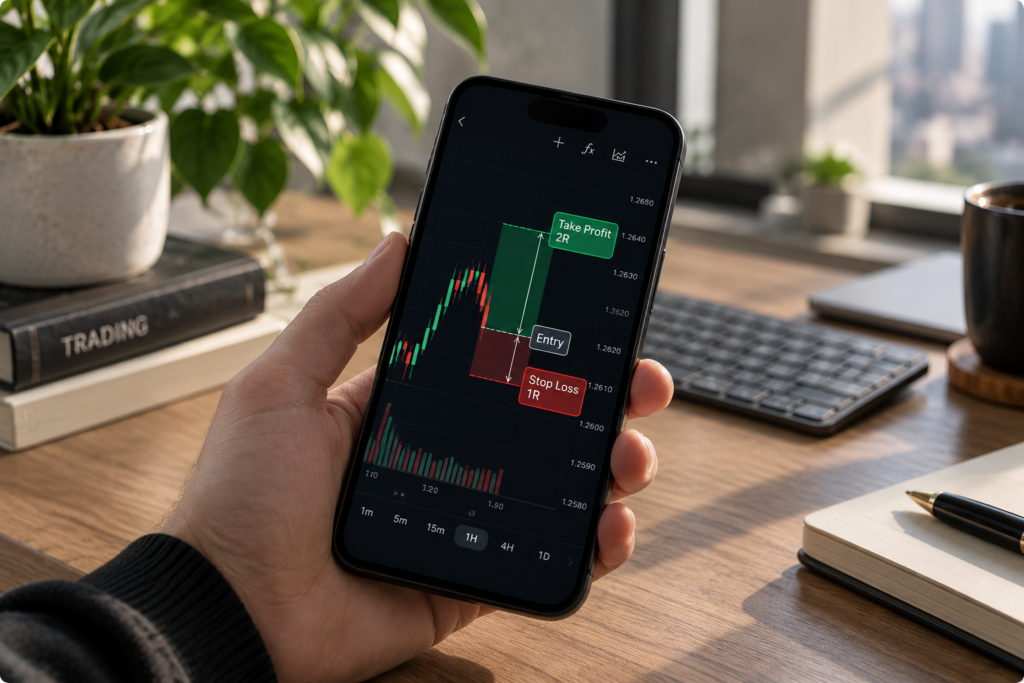
A 1:2 ratio means the potential reward is twice the amount being risked. For example, risking $100 to potentially make $200.
Does risk-to-reward ratio affect prop firm drawdown?
The ratio itself does not determine drawdown, but the amount actually risked on each trade can affect how quickly an account approaches its drawdown limit.
Should risk-to-reward ratio determine position size?
Position size should be calculated based on the amount you are willing to risk and the distance to your stop-loss, while also considering the prop firm’s account rules.
Can a trader be profitable with a low win rate?
Potentially, yes. A strategy’s profitability depends on the relationship between its win rate, average gains, average losses and trading costs, rather than win rate alone.