
Prop Firm Industry Trends: Q3 2026
The prop firm industry trends developing in Q3 2026 are giving new traders more to consider than simply the size of an advertised funded account. The industry is becoming increasingly competitive around payouts, account structures, trading rules and transparency. At the same time, new initiatives are putting greater attention on how firms communicate their rules […]

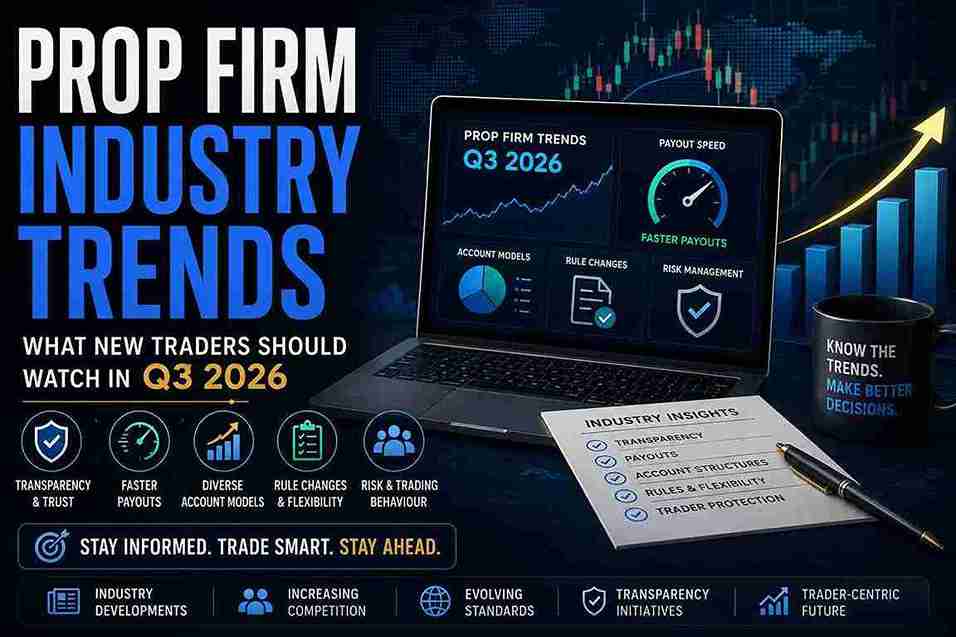
The prop firm industry trends developing in Q3 2026 are giving new traders more to consider than simply the size of an advertised funded account.
The industry is becoming increasingly competitive around payouts, account structures, trading rules and transparency. At the same time, new initiatives are putting greater attention on how firms communicate their rules and handle trader disputes.
For a new trader, keeping track of these developments can help you ask better questions before purchasing a challenge.
Here are the major prop firm industry trends worth watching this quarter.
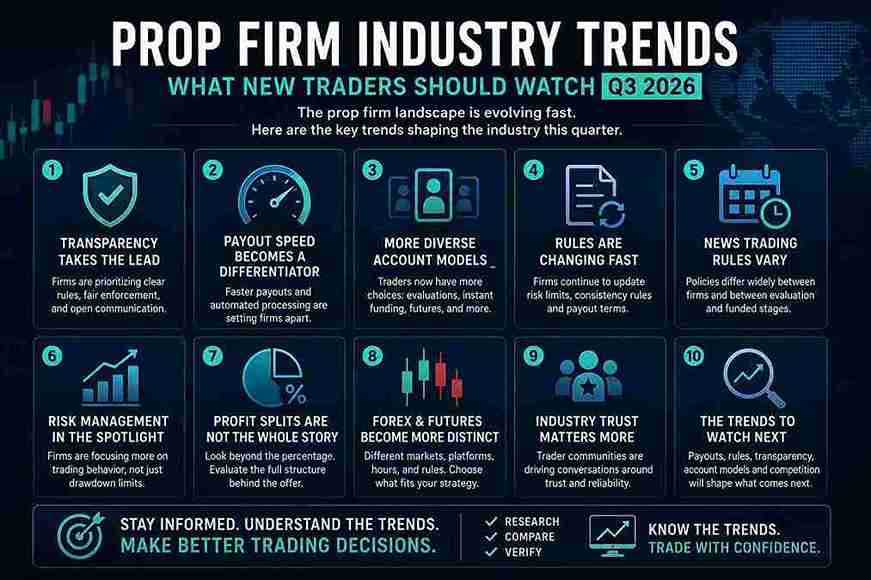
1. Transparency Is Becoming a Bigger Competitive Factor
One of the most important developments this quarter is the growing focus on transparency.
In July 2026, the Financial Commission launched a voluntary Prop Firm Certification framework designed to independently review firms for areas including transparent rules, fair enforcement and clear payouts. The framework also includes independent dispute resolution and ongoing monitoring.
For traders, this could make transparency an increasingly important factor when comparing firms.
Instead of asking only:
“How big is the account?”
New traders should also ask:
- Are the rules clearly published?
- Are payout conditions easy to understand?
- Are rule violations clearly defined?
- Is there a dispute process?
- Does the firm explain how its accounts work?
The industry is increasingly moving towards a model where clarity itself becomes part of the product.
2. Payout Speed Is Becoming a Bigger Differentiator
Another major prop firm industry trend is competition around payout speed.
Firms are increasingly marketing faster withdrawals and automated payout processing as selling points. Recent industry coverage has highlighted payout speed as an increasingly competitive feature, with some firms promoting automated approval and very short processing times.
For new traders, however, advertised payout speed shouldn’t be the only consideration.
Look at:
- First payout eligibility.
- Minimum withdrawal amounts.
- Payout frequency.
- Profit splits.
- Account buffers.
- Consistency requirements.
- Verification procedures.
A “same-day payout” headline doesn’t tell you whether you’re actually eligible for a withdrawal on day one.
3. Account Models Are Becoming More Diverse
The traditional evaluation model is no longer the only structure available.
The 2026 industry includes evaluation accounts, instant funding models and different approaches to firm-funded or simulated trading structures. Industry estimates also show substantial growth in the online evaluation-based segment, although market-size figures are estimates rather than audited industry totals.
This creates more choice for traders, but also more complexity.
A new trader may now encounter:
- One-step evaluations.
- Two-step evaluations.
- Instant funding.
- Futures evaluations.
- Forex evaluations.
- Scaling programmes.
- Different funded-account structures.
More choice doesn’t necessarily mean better choice.
The important question is whether the account structure fits your strategy and risk tolerance.
4. Prop Firm Industry Trends: Rule Changes Can Happen Quickly
Another trend new traders should watch is how frequently firms modify their rules.
Recent 2026 industry reporting has highlighted changes involving risk limits, consistency requirements, payout terms and account structures.
Some firms have also moved in the opposite direction by removing restrictions.
For example, Apex Trader Funding reportedly removed its 30% consistency requirement from its evaluation paths in March 2026.
The lesson is important:
Don’t assume a rule you read in an old review still applies today.
Before buying a challenge, check the firm’s current rules directly.
5. News Trading Rules Remain Highly Variable
News trading continues to be an area where prop firms can differ substantially.
Current industry comparisons show firms using different approaches, including:
- Allowing news trading.
- Restricting trading around major announcements.
- Limiting profits generated around news.
- Applying different rules between evaluation and funded stages.
Industry coverage from March 2026 showed significant variation among major firms’ news trading policies.
For traders who rely on economic releases, this can have a major impact.
Before joining a firm, check exactly how it treats:
- High-impact economic news.
- Positions opened before announcements.
- Positions held through announcements.
- Profits generated during restricted windows.
6. Risk Management Is Moving Further Into the Spotlight
Prop firms are paying increasing attention to trading behaviour, not simply whether an account reaches its maximum drawdown.
Rules can address:
- Position sizing.
- Excessive leverage.
- Account manipulation.
- Copy trading.
- Arbitrage.
- Abnormal trading behaviour.
The Financial Commission’s new framework specifically emphasises clearly defined risk controls and anti-abuse criteria.
For new traders, this means understanding the definition behind a rule matters just as much as knowing the numerical limit.
A trader may technically stay below a daily loss limit but still encounter restrictions if their trading behaviour violates other account conditions.
7. Profit Splits Aren’t the Whole Story
High profit splits remain one of the biggest marketing tools in the industry.
But they’re becoming less useful as a standalone comparison.
A firm advertising a 90% or 100% split may still have other conditions that affect how much you can actually withdraw.
Compare the complete structure:
| Factor | What to Check |
|---|---|
| Profit split | What percentage do you actually keep? |
| Payouts | When can you withdraw? |
| Payout cap | Is there a maximum? |
| Drawdown | How is it calculated? |
| Consistency | Is there a profit-distribution requirement? |
| Trading rules | What strategies are restricted? |
| Fees | Are there additional costs? |
| Scaling | Can the account grow? |
The headline percentage is only one part of the equation.
8. Futures and Forex Prop Firms Are Becoming More Distinct
New traders should also pay attention to the growing differences between forex and futures prop firms.
Although both may use the “prop firm” label, their:
- Markets.
- Platforms.
- Trading hours.
- Contract structures.
- Risk rules.
- Evaluation models.
can be very different.
This means choosing between futures and forex should start with the market you actually understand and the trading style you intend to use.
Don’t choose purely because one firm advertises a larger account.

9. Industry Trust Is Becoming More Important
Trust is increasingly becoming part of the conversation around prop firms.
Trader communities continue to discuss payout reliability, rule enforcement and whether firms communicate clearly when policies change. Community discussions can be useful for spotting potential issues, but individual posts should be treated as anecdotal rather than definitive evidence.
For new traders, use a combination of:
- Official terms and conditions.
- Current rule pages.
- Firm announcements.
- Independent reviews.
- Trader community feedback.
Don’t base a major purchasing decision on one Reddit post, YouTube video or promotional testimonial.
10. What Should New Traders Watch Next?
The most important prop firm industry trends to monitor throughout the rest of the quarter are:
Payouts
Will faster and more transparent payout systems become the industry standard?
Rules
Will firms continue simplifying rules, or introduce more detailed behavioural restrictions?
Account Models
Will instant funding continue expanding alongside traditional evaluations?
Transparency
Will independent certification and clearer rule disclosures become more common?
Competition
Will firms compete more aggressively on price, payout speed, account flexibility or trading conditions?
These developments could have a bigger impact on traders than another headline about a massive account size.
What This Means for a New Trader
You don’t need to follow every prop firm announcement.
Instead, develop a simple habit.
Before purchasing an account:
Check the current rules.
Before placing your first trade:
Understand the drawdown.
Before requesting a payout:
Understand the payout requirements.
And whenever a firm announces a major change:
Read the updated terms rather than relying on an old review.
This approach keeps you focused on information that can actually affect your account.
Final Thoughts
The biggest prop firm industry trends this quarter aren’t simply about bigger accounts or higher profit splits.
The industry is increasingly competing around payout speed, transparency, account flexibility, risk controls and clearly defined rules.
For new traders, that creates both more choice and more responsibility.
Don’t choose a prop firm because its marketing looks impressive.
Look at what the account actually allows you to do, how the rules are enforced and what happens when you become profitable.
The best industry trend for traders is greater transparency. The more clearly you understand the product before buying it, the better positioned you are to make a sensible decision.
Frequently Asked Questions
What are the biggest prop firm industry trends in 2026?
Key trends include greater competition around payouts, more varied account structures, evolving trading rules, increased attention to transparency and more detailed risk controls.
Are prop firm rules changing frequently?
Yes, individual firms can change their rules, account structures and payout conditions. Traders should always check current official documentation before purchasing or trading an account.
Are faster payouts becoming more common?
Fast payout processing is increasingly being used as a competitive feature, with some firms promoting automated or very rapid payout processing.
Should new traders choose a prop firm based on profit split?
No. Profit split should be considered alongside drawdown, payout rules, trading restrictions, fees, consistency requirements and account structure.
How can I keep up with prop firm industry trends?
Follow official firm announcements, review current terms and conditions, and use reputable industry sources and trader communities to identify changes worth investigating.