Successful Prop Firm Evaluation: A Day-by-Day Breakdown
A successful prop firm evaluation isn’t usually about making as much money as possible in the shortest amount of time. It is about managing risk, following a clear trading plan and consistently taking high-quality setups while staying within the firm’s rules. Many traders approach an evaluation with one goal: reach the profit target. That mindset […]

A successful prop firm evaluation isn’t usually about making as much money as possible in the shortest amount of time. It is about managing risk, following a clear trading plan and consistently taking high-quality setups while staying within the firm’s rules.
Many traders approach an evaluation with one goal: reach the profit target.
That mindset can lead to unnecessary pressure and aggressive trading.
A better approach is to focus on the process. Each trading day should have a purpose, from preparing for the session and identifying suitable setups to managing open positions and reviewing your decisions afterwards.
In this guide, we’ll break down what a successful prop firm evaluation can look like from day one through the final stage.
Important: There is no universal number of days required to pass a prop firm evaluation. The timeline below is an example of a disciplined process, not a guaranteed path or recommended schedule for every trader.
What Makes a Successful Prop Firm Evaluation?
Before looking at the individual days, it’s important to understand what success actually means.
A strong evaluation focuses on:
- Following the firm’s rules.
- Protecting available drawdown.
- Using consistent position sizing.
- Trading only planned setups.
- Avoiding emotional decisions.
- Reviewing performance regularly.
- Reaching the target without taking unnecessary risk.
The goal isn’t to finish as quickly as possible.
The goal is to finish without compromising your trading process.
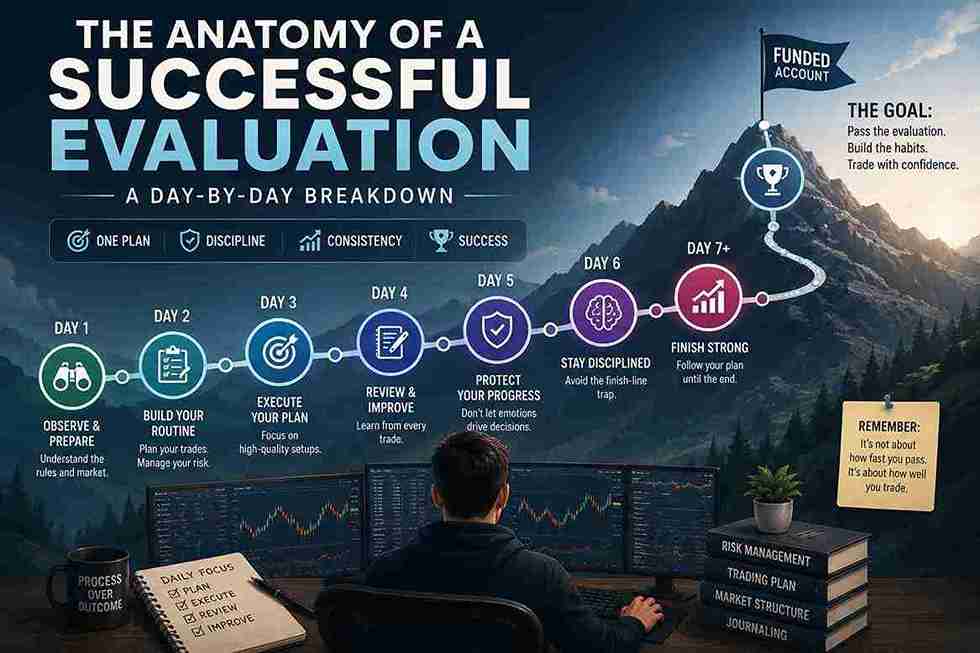
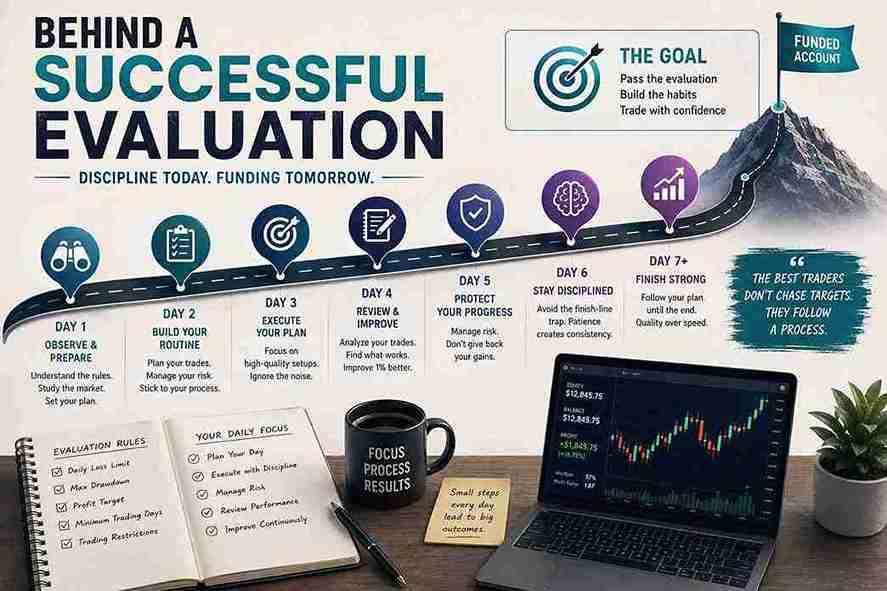
Day 1: Start With Observation, Not Pressure
The first day doesn’t need to be your biggest trading day.
Before entering a position, review:
- The firm’s daily loss limit.
- Maximum drawdown.
- Profit target.
- Trading restrictions.
- Your personal risk limit.
- The markets you intend to trade.
Then observe market conditions.
If a high-quality setup appears, take it according to your plan.
If nothing meets your criteria, not trading can be the correct decision.
A successful evaluation begins with understanding the environment rather than forcing an early result.
Day 2: Establish Your Risk Routine
Once you’ve experienced the first session, the next priority is consistency.
Keep your risk per trade within a predefined range and avoid changing your position size simply because the previous trade won or lost.
Your routine might include:
- Review the market.
- Identify potential setups.
- Define entry and invalidation levels.
- Calculate position size.
- Execute only if the setup qualifies.
- Record the trade.
The exact numbers will depend on your strategy and the firm’s rules.
What matters is having a repeatable process.
Day 3: Focus on Execution
By the third day, traders can become tempted to increase their activity.
If you’re behind your expected progress, you might feel pressure to make up the difference.
Avoid changing your strategy simply because the evaluation isn’t moving quickly enough.
Instead, ask:
Did I follow my plan?
A losing trade can still be a good trade if it followed your rules.
A winning trade can still be a bad trade if it was based on an impulsive decision.
This distinction is central to a successful prop firm evaluation.
Day 4: Review Your Trading Behaviour
Use the middle of the evaluation to review your behaviour rather than simply your account balance.
Look for patterns such as:
- Entering trades too early.
- Moving stop losses.
- Increasing position size.
- Trading outside your preferred hours.
- Taking setups you normally wouldn’t trade.
- Continuing after reaching your personal loss limit.
Your trading journal should help identify whether your execution matches your plan.
Day 5: Protect Your Progress
As the account moves closer to the target, protecting gains becomes increasingly important.
This is where some traders make a major mistake.
They see that they’re close to passing and suddenly become more aggressive.
Instead, maintain the same discipline that produced your progress in the first place.
Don’t increase risk simply because the target is within reach.
Getting close to the target doesn’t change your trading rules.
Day 6: Avoid the Finish-Line Trap
The closer traders get to passing, the stronger the temptation can become to force the final percentage.
You might see a setup that isn’t quite valid and think:
“I’ll just take this one.”
That’s exactly when discipline matters most.
If the setup doesn’t meet your criteria, wait.
A successful evaluation isn’t won by taking every opportunity. It’s won by taking the right opportunities.
Day 7: Evaluate Your Position
At this stage, review where you stand.
Consider:
- Current profit or loss.
- Remaining drawdown.
- Distance from the target.
- Number of trading days completed.
- Recent trading performance.
- Emotional state.
If you’re comfortably progressing, there’s no reason to suddenly change your approach.
If you’re behind, avoid trying to recover everything in one session.
Your evaluation doesn’t need to be completed according to an artificial deadline.
What If You Have a Losing Day?
A losing day doesn’t automatically mean your evaluation has failed.
Losses are part of trading.
The important question is how you respond to them.
After a losing session:
- Stop if you’ve reached your personal loss limit.
- Review your trades.
- Identify whether the losses came from valid setups.
- Avoid revenge trading.
- Return to your normal risk plan.
A controlled losing day can be part of a healthy trading process.
What If You Reach the Profit Target Early?
Reaching the target quickly can create a different psychological challenge.
Some traders immediately increase their activity because they want to maximise the opportunity.
Others may continue trading unnecessarily and give back their gains.
Before continuing, check the firm’s specific rules and requirements.
If the evaluation has been completed according to its conditions, there may be no reason to take unnecessary additional risk.
The Difference Between a Fast Pass and a Successful Evaluation
A fast pass and a successful prop firm evaluation aren’t necessarily the same thing.
Consider two hypothetical traders.
Trader A reaches the target quickly by taking oversized positions and accepting significant drawdown.
Trader B reaches the target more gradually while maintaining consistent risk and following a documented strategy.
Trader A may have reached the target faster.
But Trader B has potentially developed a process that is easier to repeat.
The second approach is generally more aligned with the habits needed for long-term funded trading.
A Simple Evaluation Day Checklist
Before each trading session, ask:
Before Trading
- Do I understand today’s market conditions?
- What setups am I looking for?
- What is my maximum personal risk today?
- Are there any relevant trading restrictions?
During Trading
- Does this setup meet my criteria?
- Is my position size appropriate?
- Am I following my trading plan?
- Am I trading because of analysis or emotion?
After Trading
- Did I follow my plan?
- What went well?
- What mistakes did I make?
- What should I improve tomorrow?
This routine keeps the focus on execution rather than constantly watching the account balance.
Why Risk Management Matters More Than Speed
The profit target is visible, but your drawdown limit is what determines how much room you have to make mistakes.
For example, aggressively trying to reach a target can result in:
- Larger losses.
- Greater emotional pressure.
- Poorer entries.
- Revenge trading.
- Drawdown breaches.
A slower approach can give you more opportunities to learn from the evaluation and maintain control.
Speed is not the same as success.
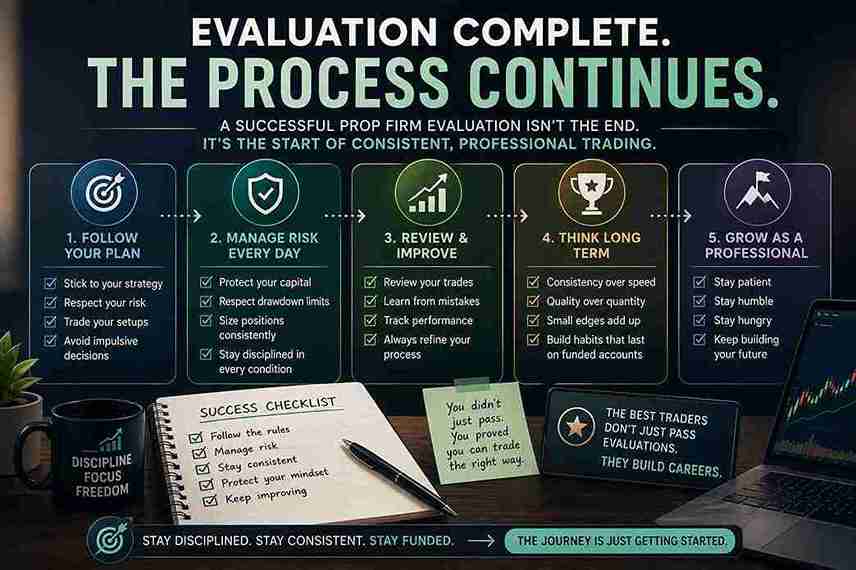
How to Know You’re Ready to Pass
A strong evaluation process should leave you confident in your ability to repeat your strategy.
Before considering the evaluation complete, ask yourself:
- Did I follow my trading plan?
- Did I maintain consistent risk?
- Did I respect the firm’s rules?
- Did I avoid unnecessary trades?
- Did I manage losing trades appropriately?
- Can I repeat this process on a funded account?
The final question is particularly important.
Passing an evaluation is only useful if the habits that got you there can continue afterwards.
Final Thoughts
A successful prop firm evaluation isn’t defined by how quickly you hit a profit target.
It’s defined by how well you manage risk, follow your strategy and maintain discipline throughout the process.
Whether it takes several days or considerably longer, the strongest approach is to treat each session as another opportunity to execute your plan correctly.
The objective isn’t simply to pass.
It’s to develop a trading process worth carrying into the funded account.
Frequently Asked Questions
How long does a successful prop firm evaluation take?
There is no universal timeframe. The required duration depends on the firm’s rules, minimum trading days and the trader’s strategy and performance.
What is the most important part of a prop firm evaluation?
Risk management is one of the most important elements. Traders need to reach the required target while staying within the firm’s drawdown and trading rules.
Should I try to pass a prop firm challenge as quickly as possible?
Not necessarily. Rushing can encourage excessive risk-taking and emotional decisions. A controlled approach that follows your trading plan is generally more sustainable.
What should I do after a losing day?
Review your trades, identify whether you followed your strategy and avoid trying to immediately recover the loss through larger or impulsive trades.
What happens after I pass a prop firm evaluation?
The process varies between firms. Some may move you to a funded or simulated funded account, while others have additional requirements. Always review the specific firm’s current terms.