
Prop Firm Rule Changes: How Rules Have Evolved in 5 Years
The prop firm rule changes seen over the past five years have significantly changed how traders approach funded trading. As the industry has grown, firms have introduced new evaluation structures, adjusted drawdown models, changed payout conditions and developed more detailed rules around trading behaviour. What was once a relatively simple combination of a profit target […]

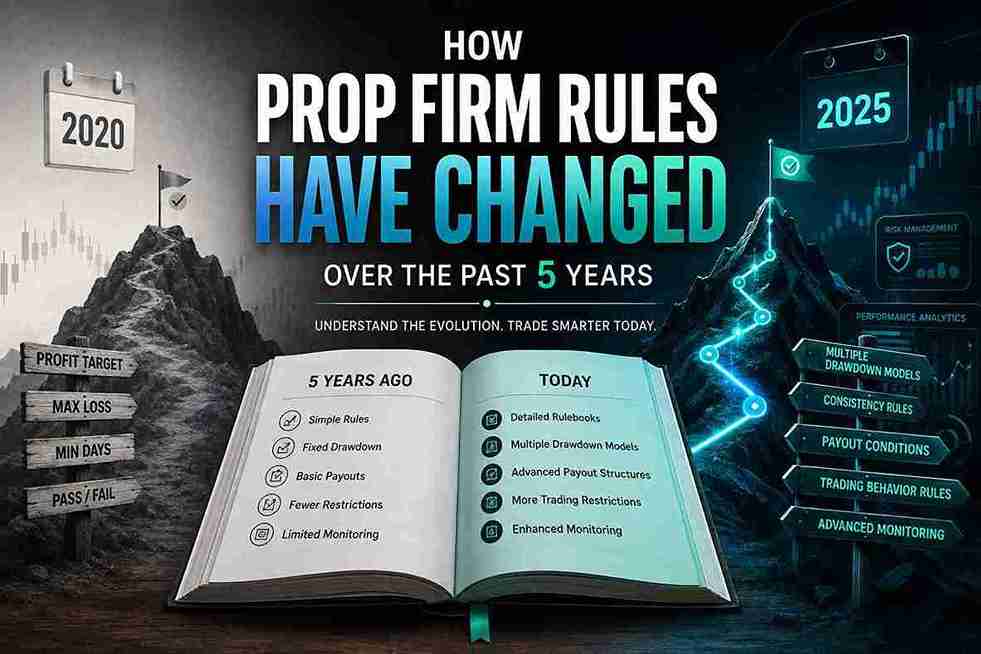
The prop firm rule changes seen over the past five years have significantly changed how traders approach funded trading. As the industry has grown, firms have introduced new evaluation structures, adjusted drawdown models, changed payout conditions and developed more detailed rules around trading behaviour.
What was once a relatively simple combination of a profit target and maximum loss limit has evolved into a much broader set of conditions covering risk, consistency, trading strategies, payouts and account behaviour.
In this guide, we’ll look at how prop firm rules have changed over the past five years and what those changes mean for traders today.
Prop Firm Rule Changes: What Trading Looked Like Five Years Ago
Around 2021, online prop firms were already offering retail traders a way to access simulated or evaluation-based funded trading programmes.
The basic structure was relatively straightforward:
- Pay an evaluation fee.
- Reach a predefined profit target.
- Stay within the maximum loss limit.
- Complete any required trading days.
- Progress to the next stage.
The exact rules varied between firms, but the core idea was relatively simple.
As competition increased, firms began experimenting with different account structures, pricing models and risk controls.
Prop Firm Rule Changes Became More Detailed
One of the biggest developments has been the increasing complexity of trading rules.
Today’s traders may need to consider:
- Daily loss limits.
- Maximum drawdown.
- Trailing drawdown.
- Consistency requirements.
- News trading restrictions.
- Overnight holding rules.
- Weekend trading restrictions.
- Position size limitations.
- Copy trading policies.
- Automated trading restrictions.
- Payout conditions.
This means traders now need to understand the entire rulebook, rather than focusing only on the advertised profit target.
Drawdown Rules Have Evolved
Drawdown has always been an important part of prop trading, but the way it is calculated can differ significantly between firms.
Some programmes use a fixed maximum loss, while others use trailing drawdown models that move as the account reaches new equity highs.
More recently, some firms have also introduced or promoted end-of-day drawdown models.
The difference can significantly change how a trader manages open positions and protects an account.
For example, a trailing drawdown can make early profits important because the risk threshold may move upward with the account.
An end-of-day model can behave differently because the calculation is based on a specified end-of-session balance or equity level.
This is why traders should understand how drawdown is calculated, rather than simply looking at the advertised account size.
Consistency Rules Became More Important
Another major development has been the introduction and evolution of consistency requirements.
These rules can limit how much of a trader’s total profit can come from a single day or require profits to be distributed across multiple trading sessions.
The purpose is generally to discourage traders from reaching a target through one unusually large trade or extremely aggressive session.
However, consistency requirements have not remained static.
Some firms have tightened them, while others have relaxed or removed them. For example, Apex Trader Funding removed its 30% consistency requirement across its evaluation paths in March 2026.
This illustrates an important point: prop firm rules can change, sometimes substantially, even when traders are familiar with the previous version of an evaluation.
Payout Rules Have Become a Bigger Part of the Equation
In earlier evaluations, traders often focused primarily on passing the challenge.
Today, payout conditions are a much bigger part of the decision-making process.
Traders may need to consider:
- When the first payout can be requested.
- Minimum payout amounts.
- Profit split structures.
- Consistency requirements.
- Payout frequency.
- Account buffers.
- Verification requirements.
The result is that passing an evaluation doesn’t necessarily tell the full story.
A trader also needs to understand what happens after passing.
Trading Restrictions Have Become More Specific
Another notable area of prop firm rule changes involves permitted trading behaviour.
Depending on the firm and account type, traders may encounter restrictions involving:
- Major economic news.
- Overnight positions.
- Weekend positions.
- Hedging.
- Arbitrage.
- High-frequency trading.
- Expert advisors.
- Copy trading.
These rules can also vary between evaluation and funded stages.
For example, some firms now publish different news trading conditions depending on the specific plan or account stage.
This makes it increasingly important for traders to check the rules for their specific account, rather than assuming every account from the same firm follows identical conditions.
Technology Has Changed How Rules Are Enforced
Technology has also changed the way prop firms monitor trading behaviour.
Modern trading platforms can record detailed information about:
- Order timing.
- Position size.
- Execution patterns.
- Account activity.
- Trading frequency.
- Multiple-account behaviour.
This allows firms to define and monitor certain types of prohibited trading activity more precisely.
The Financial Commission’s current prop firm code of conduct, for example, calls for risk controls and anti-abuse criteria to be clearly defined, objectively describable and independently verifiable.
For traders, this means understanding the definitions behind the rules is increasingly important.
Five Years Ago vs Today
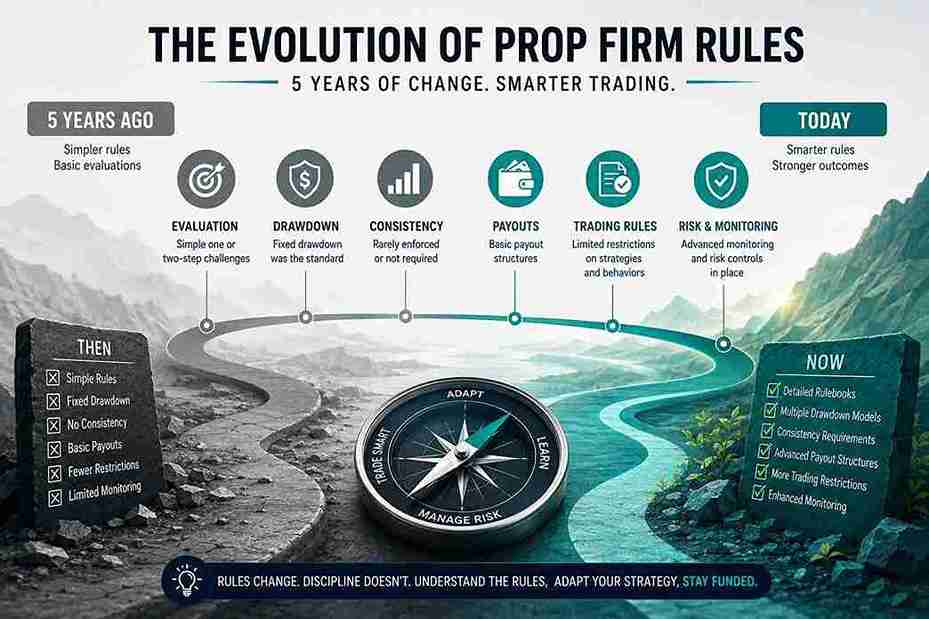
The evolution can be summarised like this:
| Area | Earlier Prop Firm Models | Today’s Environment |
|---|---|---|
| Evaluation | Relatively simple | More varied account structures |
| Drawdown | Often straightforward | Static, trailing and EOD models |
| Consistency | Less common | More widely used, though some firms now relax it |
| Payouts | Simpler structures | More conditions and account-specific requirements |
| News Trading | Firm-specific | Increasingly detailed restrictions |
| Trading Behaviour | Broad rules | More specific anti-abuse policies |
| Technology | Basic monitoring | More detailed automated monitoring |
| Account Options | Fewer structures | More plans and configurations |
The important takeaway is that there is no single “standard” prop firm rulebook today.

Why Prop Firm Rules Keep Changing
There isn’t one reason behind prop firm rule changes.
Several factors can influence them.
Risk Management
Firms need rules that control the amount of risk associated with traders and accounts.
Competition
As firms compete for traders, they may adjust pricing, account structures, payout terms and trading conditions.
Technology
Improved monitoring makes it possible to identify trading patterns that were more difficult to detect previously.
Trader Behaviour
When traders find ways to exploit particular account structures, firms may respond by modifying their rules.
Business Sustainability
Firms also need account structures and payout models that remain commercially sustainable.
What Prop Firm Rule Changes Mean for Traders
The biggest lesson is simple:
Never assume that a prop firm’s rules are permanent.
A strategy that worked under an older rule structure may not work under a newer one.
For example, a trader who previously relied on:
- Holding positions through news.
- Aggressive single-day profits.
- Large position sizes.
- Trailing drawdown recovery.
- Frequent payouts.
may find that another account structure requires a different approach.
That’s why traders should review the current terms before purchasing a challenge and again before making significant changes to their trading strategy.
How Traders Can Keep Up With Prop Firm Rule Changes
You don’t need to constantly monitor every prop firm in the industry.
Instead:
Read the Current Rules
Always use the firm’s current rules rather than relying on an old review or YouTube video.
Check the Specific Account
Different account types can have different conditions.
Save the Rules
Keeping a copy of the rules that applied when you purchased an account can make it easier to understand what you agreed to.
Check for Updates
If you already have an account, periodically review the firm’s official announcements and terms.
Don’t Rely on Community Posts Alone
Trader communities can highlight changes quickly, but always verify important information against the firm’s current documentation.
Are Prop Firm Rules Becoming Easier or Harder?
There isn’t a simple answer.
Some changes have made certain aspects of trading more flexible, while others have introduced additional restrictions.
For example, some firms have removed or relaxed consistency requirements, while others have introduced more detailed conditions around payouts, trading behaviour and account management. Current industry trackers show significant variation between firms rather than one universal direction.
So rather than asking whether prop firms are becoming “easier” or “harder”, it’s more useful to ask:
Are the current rules suitable for your trading strategy?
What Traders Should Look For Today
When evaluating a prop firm, don’t just look at:
- Account size.
- Challenge price.
- Profit split.
Also examine:
- Drawdown methodology.
- Daily loss limits.
- Consistency requirements.
- Payout conditions.
- News trading rules.
- Overnight restrictions.
- Platform conditions.
- Prohibited strategies.
- Account-specific rules.
This gives you a much more realistic picture of what you’re actually buying.
Final Thoughts
The biggest prop firm rule changes over the past five years have been less about one universal industry standard and more about increasing variety.
Drawdown models have evolved, consistency rules have appeared and changed, payout structures have become more detailed, and trading restrictions have become increasingly specific.
For traders, the lesson is straightforward: don’t trade based on what a prop firm used to allow. Trade based on the rules that apply to your account today.
The most important skill isn’t memorising every rule in the industry. It’s developing the habit of checking the rules, understanding how they affect your strategy and adapting when conditions change.
Frequently Asked Questions
How have prop firm rules changed over the past five years?
Prop firm rules have become more varied and detailed, particularly around drawdown, consistency, payouts, news trading, account behaviour and prohibited strategies.
What are the biggest prop firm rule changes?
Some of the most important changes involve different drawdown models, the introduction and modification of consistency rules, more detailed payout conditions and increasingly specific trading restrictions.
Do prop firm rules change after I buy a challenge?
This depends on the firm’s policies and the specific account. Traders should always check the current terms and any official updates that apply to their account.
Are prop firm rules becoming stricter?
Not universally. Some firms have introduced additional restrictions while others have removed or relaxed certain requirements. The industry now has more variation between firms and account types.
How can I keep up with prop firm rule changes?
Check the firm’s official rules and announcements regularly, especially before purchasing an account or changing your trading strategy.