
How Prop Firms Detect Rule Violations You Didn’t Know Existed
Last reviewed 28 September 2026. Prop firm rule violations don’t always happen because traders intentionally break the rules. In many cases, traders breach their funded accounts without realising they’ve violated a firm’s trading policies. While obvious mistakes like exceeding a daily loss limit are easy to identify, many prop firms also monitor less obvious behaviours […]


Last reviewed 28 September 2026.
Prop firm rule violations don’t always happen because traders intentionally break the rules. In many cases, traders breach their funded accounts without realising they’ve violated a firm’s trading policies. While obvious mistakes like exceeding a daily loss limit are easy to identify, many prop firms also monitor less obvious behaviours that can quickly put your account at risk.
Understanding how prop firms detect rule violations is essential if you want to keep your funded account and avoid unnecessary breaches. In this guide, we’ll explore the hidden rule violations many traders overlook and explain how to stay compliant while trading consistently.
Prop Firm Rule Violations: The Most Common Hidden Mistakes
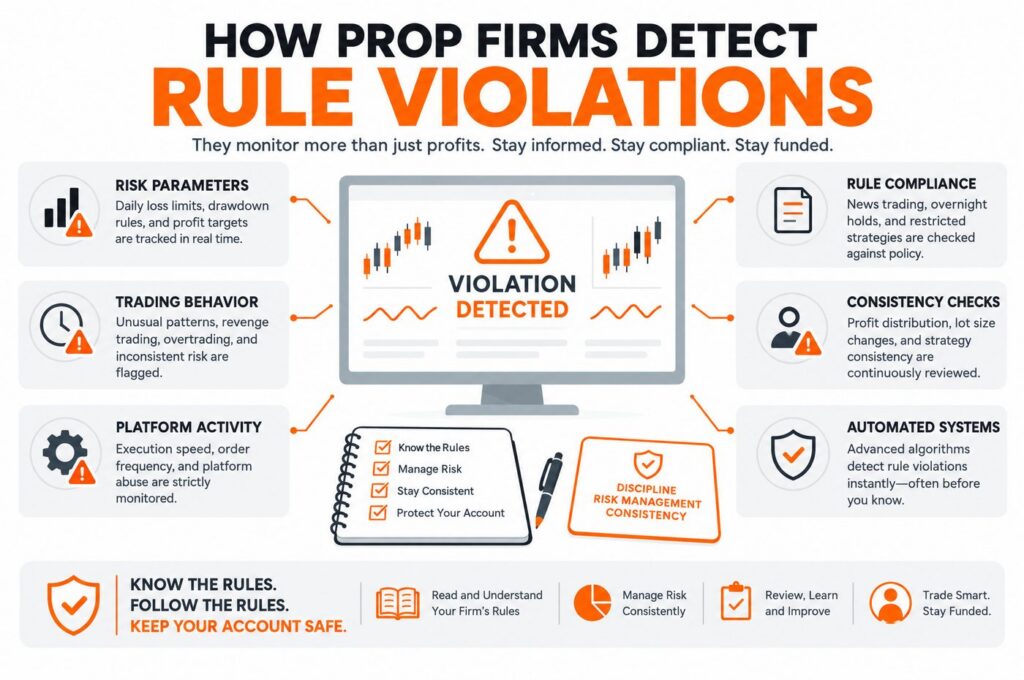
Most traders understand they shouldn’t exceed drawdown limits or ignore stop losses. However, prop firms monitor far more than your account balance.
Some rule violations develop gradually through repeated habits rather than one major mistake.
Let’s look at the hidden mistakes that often lead to account breaches.
1. Breaking Daily Loss Limits
One of the most common prop firm rule violations is exceeding the firm’s daily loss limit.
Many traders believe they are still within the rules because their overall account remains profitable. However, daily loss limits are measured independently from maximum drawdown.
Professional traders usually create their own personal daily loss limit below the firm’s maximum to reduce the risk of accidental breaches.
2. Exceeding Maximum Drawdown
Maximum drawdown protects the firm’s capital over the lifetime of the account.
Some traders continue trading aggressively after several losing sessions, eventually breaching the firm’s overall drawdown limit.
Professional traders monitor their drawdown daily rather than waiting until they’re close to the limit.
3. Inconsistent Position Sizing
Suddenly increasing lot size without a logical reason can attract attention.
For example, risking 0.5% on most trades before risking 5% after a losing streak suggests emotional rather than disciplined trading.
Consistent position sizing demonstrates effective risk management and helps traders avoid unnecessary rule violations.
4. Trading During Restricted Events
Many prop firms have restrictions around high-impact economic news.
Some firms prohibit opening trades immediately before major announcements, while others have limitations on holding positions during specific events.
Always review your firm’s trading policies before major economic releases.
5. Holding Trades When Overnight Trading Isn’t Allowed
Not every prop firm allows overnight or weekend positions.
Holding trades outside permitted trading hours may result in a rule breach even if the trade finishes in profit.
Understanding your firm’s overnight holding policy is essential before using swing trading strategies.
6. Using Prohibited Trading Strategies
Some firms prohibit specific trading practices such as:
- Latency arbitrage
- Tick scalping
- Platform exploitation
- High-frequency automated execution designed to exploit pricing delays
These strategies may trigger account reviews or breaches depending on the firm’s policies.
7. Ignoring Consistency Requirements
Certain prop firms require traders to demonstrate consistent performance rather than generating profits from one unusually large trade.
For example, earning 80% of your profits from a single position could violate consistency rules at some firms.
Understanding these requirements helps traders avoid unexpected account reviews.
8. Trading Emotionally After Losses
Many rule breaches occur because traders abandon their trading plan after several losses.
Emotional decisions often lead to:
- Larger position sizes
- Lower-quality setups
- Revenge trading
- Ignoring risk limits
Professional traders recognise emotional trading before it leads to account breaches.
9. Failing to Read Updated Rules
Prop firms occasionally update their policies.
Unfortunately, some traders continue following outdated rules without reviewing announcements or platform updates.
Regularly checking your firm’s official communications helps prevent avoidable mistakes.
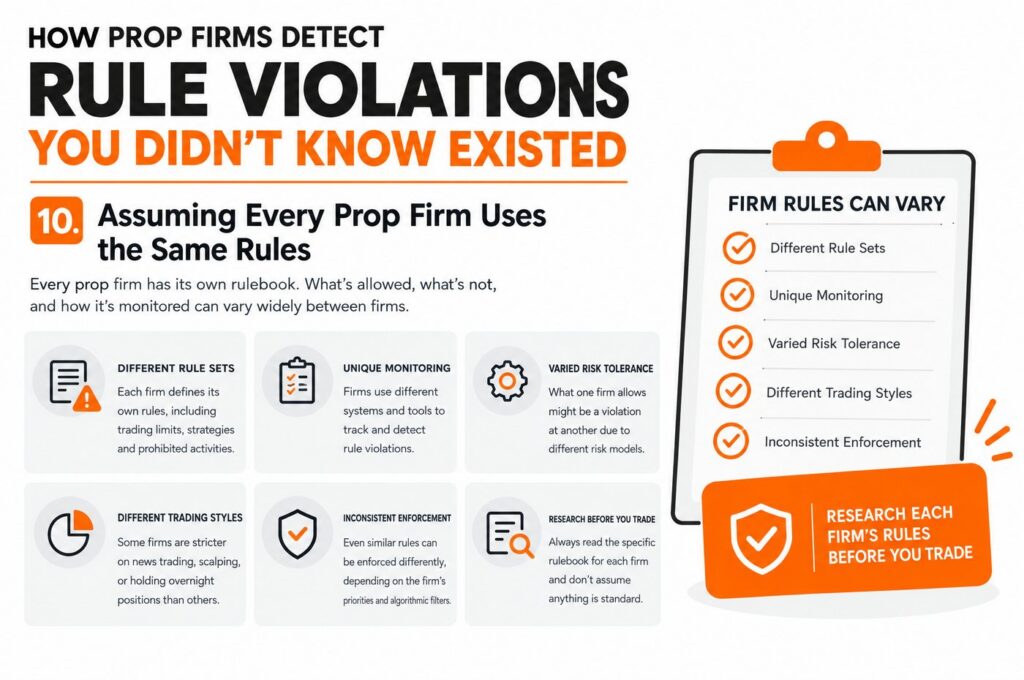
10. Assuming Every Prop Firm Uses the Same Rules
Every prop firm operates differently.
Rules relating to:
- Daily loss limits
- Maximum drawdown
- News trading
- Overnight positions
- Consistency requirements
- Automated trading
can vary significantly between firms.
Never assume that rules from one prop firm automatically apply to another.
How Professional Traders Avoid Prop Firm Rule Violations
Successful funded traders don’t simply memorise the rules.
Instead, they build routines that reduce the likelihood of breaking them.
These habits include:
- Reviewing prop firm rules regularly.
- Following a written trading plan.
- Monitoring drawdown daily.
- Risking a consistent percentage per trade.
- Keeping a trading journal.
- Stopping after reaching personal daily loss limits.
These habits make it much easier to remain compliant over the long term.
Warning Signs You May Be Breaking the Rules
You may be approaching prop firm rule violations if you:
- Frequently change position size.
- Ignore your trading plan.
- Trade emotionally after losses.
- Forget important news events.
- Stop reviewing your firm’s policies.
- Chase profits after losing trades.
Recognising these behaviours early can help prevent unnecessary account breaches.
Final Thoughts
Many prop firm rule violations happen because traders underestimate the importance of discipline rather than deliberately breaking the rules.
Professional traders protect their funded accounts by understanding their firm’s policies, managing risk consistently and reviewing their trading performance regularly.
If your goal is to keep your funded account over the long term, spend as much time learning the rules as you do developing your trading strategy.
In prop trading, consistency and discipline often matter more than finding the perfect trade.
Frequently Asked Questions
What are prop firm rule violations?
Prop firm rule violations occur when traders breach the rules set by a proprietary trading firm, such as exceeding drawdown limits, violating consistency requirements or trading during restricted periods.
Can I lose my funded account without breaking drawdown rules?
Yes. Many firms have additional rules covering news trading, overnight positions, consistency requirements and prohibited trading strategies.
Do all prop firms have the same rules?
No. Every prop firm has its own evaluation criteria, trading restrictions and funded account requirements. Always review the firm’s official rules before trading.
How can I avoid prop firm rule violations?
Read your firm’s rules carefully, follow a written trading plan, manage risk consistently, review your trading performance and monitor any policy updates.