
Daily Loss Limit vs Maximum Drawdown Explained
Last reviewed 28 September 2026. Daily Loss Limit vs Maximum Drawdown: What’s the Difference? Daily loss limit vs maximum drawdown is one of the most important concepts every prop trader should understand. Although both rules are designed to protect trading capital, they measure different types of risk. Understanding the difference can determine whether you keep […]


Last reviewed 28 September 2026.
Daily Loss Limit vs Maximum Drawdown: What’s the Difference?
Daily loss limit vs maximum drawdown is one of the most important concepts every prop trader should understand. Although both rules are designed to protect trading capital, they measure different types of risk. Understanding the difference can determine whether you keep or lose your funded account.
If you’ve ever explored prop firm trading, you’ve probably come across the terms daily loss limit and maximum drawdown. While they may seem similar, they serve different purposes. Many traders fail evaluations not because their strategy is poor, but because they misunderstand how these two essential risk management rules work.
In this guide, we’ll explain daily loss limit vs maximum drawdown, how each rule works, their key differences and practical ways to stay within both limits.
What Is a Daily Loss Limit?
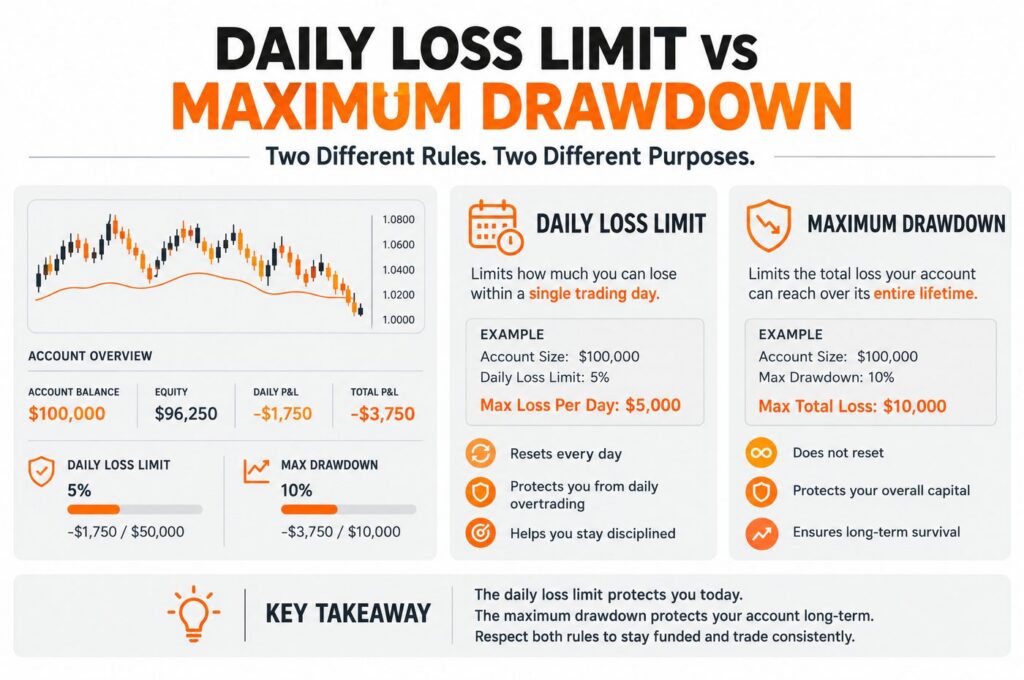
A daily loss limit is the maximum amount you can lose within a single trading day before violating your prop firm’s rules.
This rule exists to encourage disciplined trading and prevent traders from taking excessive risks after experiencing losses.
For example, if your funded account has a 5% daily loss limit on a $100,000 account, your maximum allowable loss for that trading day is:
| Account Size | Daily Loss Limit | Maximum Daily Loss |
|---|---|---|
| $100,000 | 5% | $5,000 |
Once that limit is reached, you should stop trading for the day. Continuing to trade could result in your account being breached.
What Is Maximum Drawdown?
A maximum drawdown is the largest overall loss your account can experience before it is considered failed.
Unlike a daily loss limit, maximum drawdown measures your cumulative losses over the life of the account rather than within a single trading day.
For example:
| Starting Balance | Maximum Drawdown | Lowest Allowed Balance |
|---|---|---|
| $100,000 | 10% | $90,000 |
If your account balance drops below $90,000 at any point, you’ve exceeded the maximum drawdown and may lose your funded account.
Daily Loss Limit vs Maximum Drawdown Comparison
Although both rules are designed to manage risk, they monitor different aspects of your trading performance.
| Daily Loss Limit | Maximum Drawdown |
|---|---|
| Measures losses within one trading day | Measures total losses over the account’s lifetime |
| Resets at the start of a new trading day (depending on the firm’s rules) | Continues until the account is closed or reset |
| Prevents emotional trading during a single session | Protects long-term account capital |
| Usually expressed as a percentage of the account balance | Usually expressed as a percentage of the starting or highest balance |
Understanding daily loss limit vs maximum drawdown helps traders build better risk management habits and avoid accidental rule violations.
Why Prop Firms Use Both Rules
Prop firms don’t create these rules to make trading harder. Instead, they are designed to protect capital and encourage disciplined decision-making.
Using both rules helps firms:
- Limit excessive daily losses.
- Prevent reckless recovery trading.
- Encourage consistent position sizing.
- Reduce emotional decision-making.
- Protect long-term account performance.
These rules also mirror the risk management practices used by professional trading desks and institutional traders.
Common Mistakes Traders Make
Many traders misunderstand how these rules work, leading to unnecessary account failures.
Some of the most common mistakes include:
Confusing Daily Loss With Maximum Drawdown
Some traders believe that staying below the maximum drawdown automatically keeps them safe.
However, exceeding the daily loss limit can still breach the account even if the overall drawdown hasn’t been reached.
Revenge Trading
After several losing trades, some traders increase their position size to recover losses quickly.
Unfortunately, this often causes them to hit the daily loss limit even faster.
Ignoring Floating Losses
Some prop firms calculate floating losses as part of the daily loss calculation.
Always check your firm’s specific rules before trading.
Trading Without a Daily Stop
Professional traders often stop trading well before reaching the firm’s maximum daily loss limit.
Creating a personal daily loss limit provides an additional safety buffer.
How Professional Traders Stay Within Both Limits
Successful funded traders don’t simply rely on the firm’s rules. They create stricter personal guidelines.
Many professionals:
- Risk only 0.5% to 1% per trade.
- Stop trading after two or three consecutive losses.
- Reduce position size during losing streaks.
- Review every trading session.
- Never increase risk to recover losses.
These habits help traders avoid both daily loss limit breaches and excessive drawdowns.
Which Rule Is More Important?
Neither rule is more important than the other.
Think of them as working together.
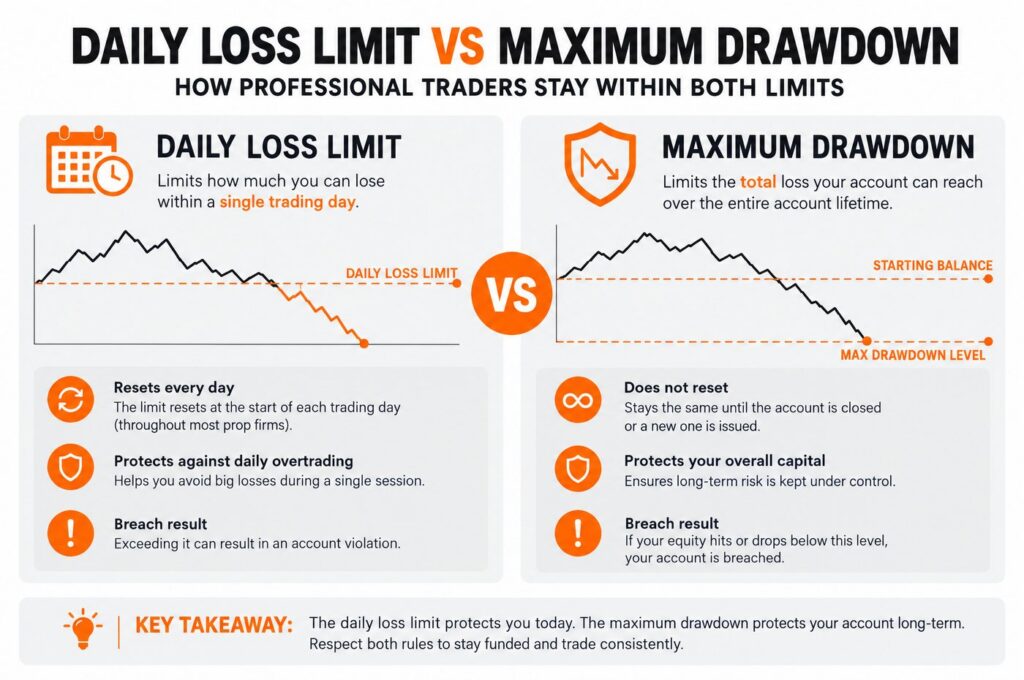
The daily loss limit protects you from making poor decisions during a single trading session.
The maximum drawdown protects your account over the long term.
Ignoring either one can result in losing your funded account.
Tips for Managing Both Rules
To reduce the risk of breaching either limit:
- Know your firm’s exact risk rules before trading.
- Calculate position size before every trade.
- Use stop losses consistently.
- Set a personal daily loss limit below the firm’s limit.
- Avoid revenge trading.
- Review your trading journal regularly.
- Focus on consistency rather than quick profits.
These simple habits can significantly improve your long-term performance.
Final Thoughts
Understanding daily loss limit vs maximum drawdown is essential for anyone trading with a prop firm. While both rules are designed to protect capital, they measure different types of risk and require different approaches to managing your trades.
Professional traders don’t wait until they’re close to these limits before changing their behaviour. Instead, they build disciplined habits that keep them well within the rules, allowing them to trade consistently and preserve their funded accounts.
By learning the difference between a daily loss limit and maximum drawdown, you’ll be better equipped to manage risk, avoid costly rule violations and improve your chances of long-term success in prop trading.
Frequently Asked Questions
What is the difference between daily loss limit and maximum drawdown?
A daily loss limit measures the maximum amount you can lose in one trading day, while maximum drawdown measures the largest total loss your account can experience before failing.
Does the daily loss limit reset every day?
In most prop firms, yes. However, each firm has its own rules, so always check the evaluation or funded account agreement.
Can I fail an evaluation by exceeding the daily loss limit?
Yes. Many prop firms will consider the account breached even if you haven’t reached the maximum drawdown.
Which rule causes traders to fail most often?
Many traders fail because they exceed the daily loss limit during emotional trading sessions, particularly after attempting to recover previous losses.