
Instant Funding 2026: A Trading Prop Overview
Key Takeaways Instant Funding 2026 Overview Instant funding in 2026 refers to prop trading programmes that provide traders with direct access to funded accounts without requiring them to complete a traditional evaluation challenge. Unlike standard prop firms, these funding structures prioritise speed and immediate market access. However, most providers still apply strict consistency rules, position […]

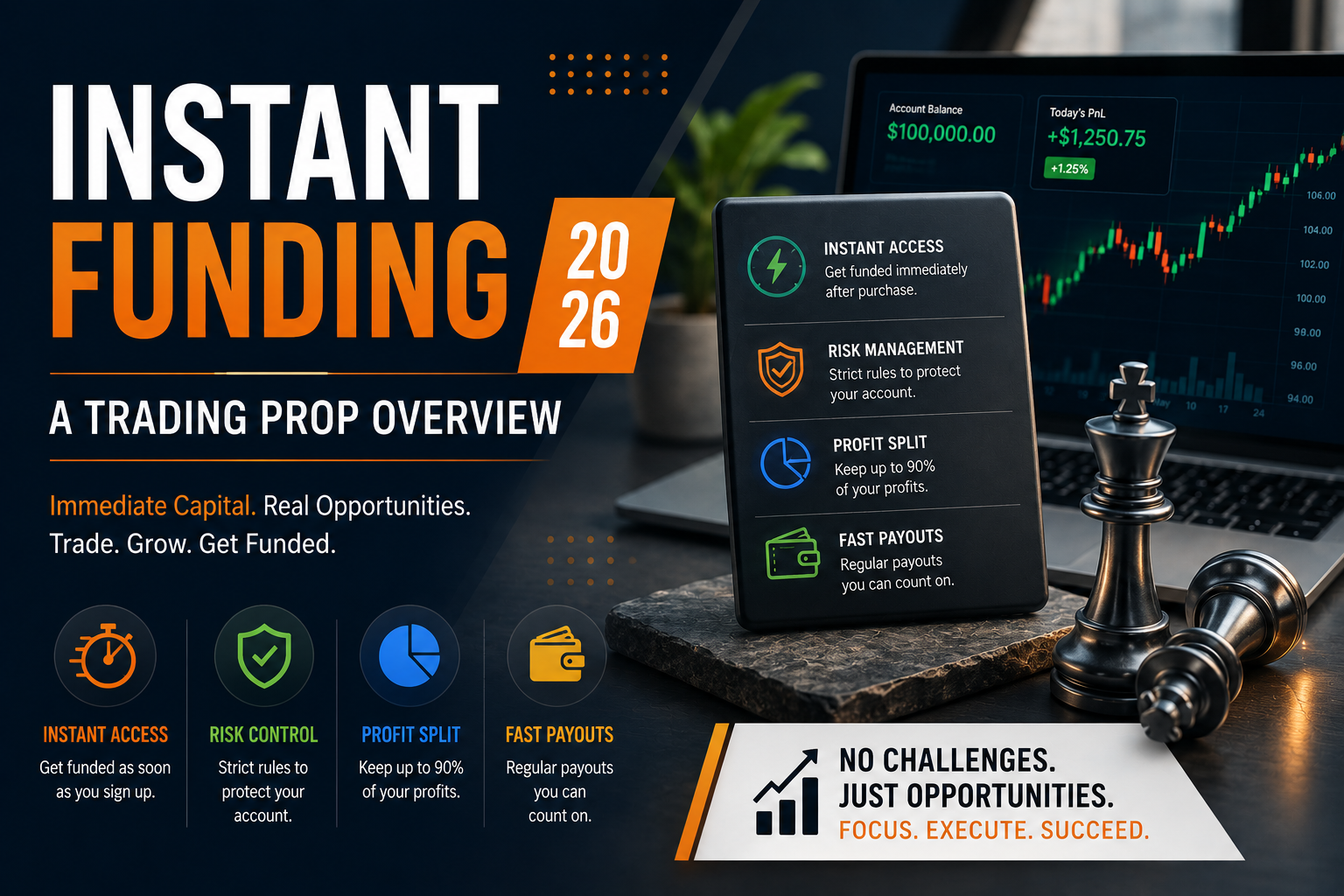
Key Takeaways
- Traders can access funded accounts immediately after purchase
- Unlike evaluation firms, there is usually no challenge phase
- Most direct funding programmes apply strict consistency and risk-management rules
- Upfront costs are generally higher compared to evaluation-based prop firms
- Suitable for experienced traders who prefer immediate access to capital

Instant Funding 2026 Overview
Instant funding in 2026 refers to prop trading programmes that provide traders with direct access to funded accounts without requiring them to complete a traditional evaluation challenge.
Unlike standard prop firms, these funding structures prioritise speed and immediate market access. However, most providers still apply strict consistency rules, position limits and payout conditions. Therefore, understanding how the model works is essential before committing.
Based on publicly available Trustpilot reviews, many traders compare this funding structure with traditional evaluation firms before choosing a provider.
What Is Instant Funding?
This evaluation-free funding model allows traders to purchase access to funded trading accounts immediately.
Instead of completing profit-target phases, traders typically:
- Pay an upfront fee
- Receive direct trading capital
- Follow predefined risk-management rules
As a result, traders can begin live trading from day one.
How the Funding Model Works
Most funded trading programmes follow a similar structure.
Step 1: Purchase an Account
Traders select an account size and pay a one-time fee.
Step 2: Access the Funded Account
After activation, traders receive access to live funded accounts immediately.
Step 3: Follow Trading Rules
Although there is no challenge phase, traders must still comply with:
- Daily drawdown limits
- Position size restrictions
- Consistency requirements
- Maximum account loss rules
Failure to follow these conditions can result in account termination.
Pricing and Fees
Most direct funding models involve:
- Higher upfront costs
- One-time payment structures
- No evaluation refund process
However, traders gain immediate access to capital without spending time completing challenges.
In addition, this structure appeals to traders who want faster access to live market conditions.
Profit Split and Payouts
Most funded account providers offer:
- Profit splits ranging from 50-90%
- Scheduled payout cycles
- Withdrawal conditions depending on the provider
As a result, payout structures vary significantly between firms.
Risk Management Rules
These funding programmes usually apply stricter live-account controls than evaluation firms.
Common rules include:
- Daily loss limits
- Consistency requirements
- Lot size restrictions
- Trading behaviour monitoring
Therefore, traders must manage exposure carefully despite skipping the evaluation stage.
Advantages of This Funding Structure
Faster Access to Capital
Traders can begin using funded accounts immediately.
No Evaluation Challenge
There is no need to complete profit targets before receiving capital access.
Suitable for Experienced Traders
Experienced traders may prefer immediate market participation instead of spending time completing evaluations.
Disadvantages of This Funding Structure
Higher Upfront Cost
Direct-funded trading programmes usually cost more than evaluation-based models.
Strict Consistency Rules
Many providers apply tight trading restrictions after activation.
Increased Pressure
Because accounts are live immediately, traders may face greater psychological pressure.
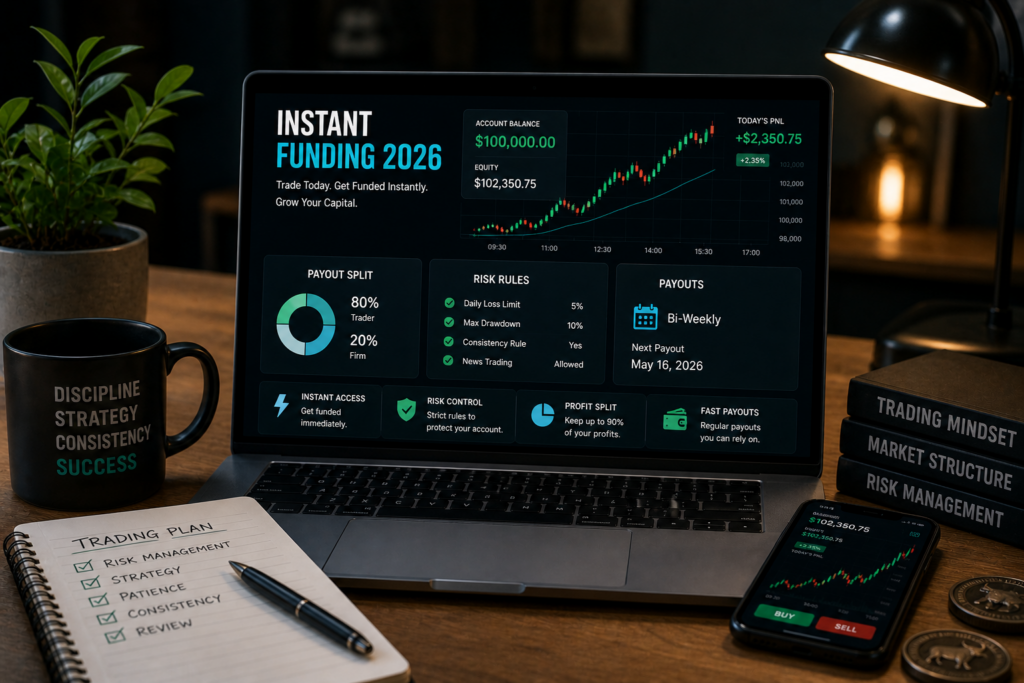
Is Instant Funding Legit?
Is instant funding legit? Yes – many prop firms offer legitimate funded account programmes with defined rules and payout structures.
However, legitimacy depends on the provider. Traders should always review:
- Risk-management rules
- Payout policies
- Trading restrictions
- Reputation and public feedback
As a result, proper research remains essential before purchasing an account.
Instant Funding vs Evaluation Models
This funding structure differs from traditional prop firms in several ways:
| Direct Funding Model | Evaluation Model |
|---|---|
| Immediate funded access | Requires challenge completion |
| Higher upfront cost | Lower starting fee |
| No profit target phase | Profit targets required |
| Stricter live-account rules | More structured progression |
Overall, the better option depends on trading experience and risk tolerance.
Many traders compare this model with evaluation firms when deciding between speed and structure.
Instant Funding for Beginners
This funding structure may suit traders who:
- Prefer immediate market access
- Already have a proven strategy
- Can manage strict consistency rules effectively
However, beginners may struggle with tighter restrictions commonly found in evaluation-free funding programmes.
Final Verdict
This funded trading model provides traders with fast access to live funded accounts without requiring a challenge phase.
It may suit traders who:
- Prefer immediate capital access
- Already trade consistently
- Can manage strict live-account rules
Ultimately, success depends on discipline, risk management and understanding the provider’s conditions.
FAQ
1. What is instant funding?
It is a funding model that provides immediate access to funded trading accounts without an evaluation challenge.
2. Is this model better than evaluation firms?
It depends on trading experience, discipline and preferred funding structure.
3. Do these firms still have rules?
Yes, strict risk-management and consistency requirements usually apply.
4. Is this model more expensive?
Generally, yes. Upfront costs are usually higher than evaluation-based programmes.
5. Is this suitable for beginners?
It may be difficult for beginners due to stricter live-account conditions.