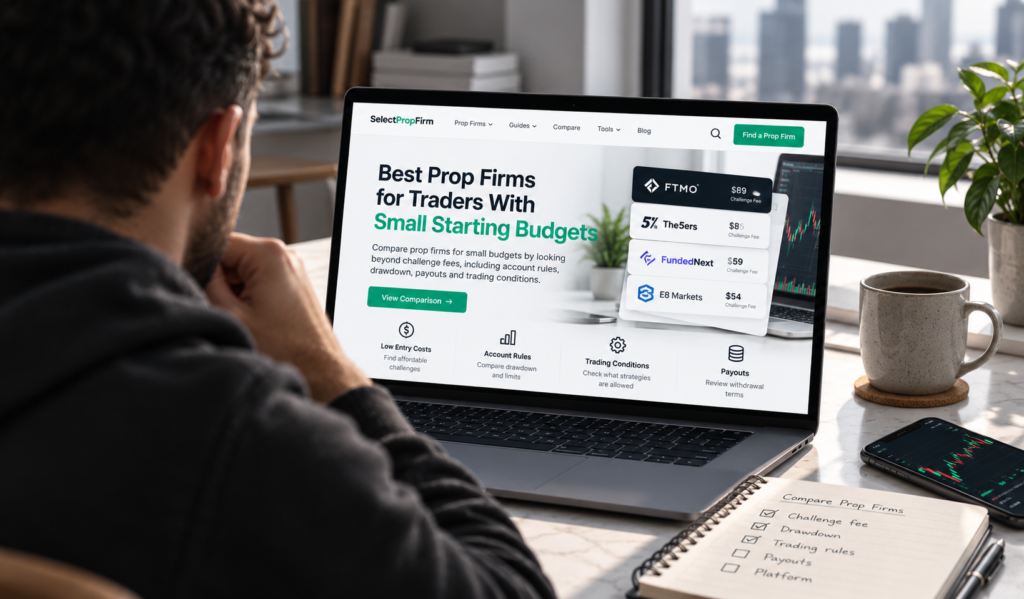
Best Prop Firms for Traders With Small Starting Budgets
Starting with a smaller budget does not mean you have to ignore important trading conditions. When comparing prop firms for small budgets, the challenge fee is only one part of the total cost and account structure. A lower upfront price may look attractive, but traders should also consider drawdown, trading rules, payout conditions, platform access […]


Starting with a smaller budget does not mean you have to ignore important trading conditions. When comparing prop firms for small budgets, the challenge fee is only one part of the total cost and account structure.
A lower upfront price may look attractive, but traders should also consider drawdown, trading rules, payout conditions, platform access and whether the account actually fits their trading style.
What Does a Small Starting Budget Mean?
A small starting budget generally means a trader wants to limit the amount they commit to a prop firm while still accessing a funded trading programme.
The important point is that budget should be considered alongside account conditions, rather than used as the only selection criteria.
Before comparing firms, establish how much you are comfortable allocating without putting pressure on your personal finances.
Your comparison can then focus on what you receive for that amount.
Look Beyond the Challenge Fee
The advertised challenge fee is often the first number traders notice.
However, the total value of an account can depend on several other factors.
Consider:
- Account size
- Maximum drawdown
- Daily loss limit
- Profit target
- Minimum trading days
- Payout conditions
- Trading restrictions
- Platform
- Commission and spread structure
- Scaling opportunities
A cheaper challenge is not necessarily cheaper in practice if its rules are poorly suited to your strategy.
Likewise, paying more does not automatically mean the account provides better conditions.
Compare the Account Structure
Account size is useful, but it should be viewed alongside the amount of risk the account allows.
For example, two accounts can have the same advertised starting balance but different drawdown limits.
When comparing prop firms for small budgets, check:
Starting Account Size
Look at the nominal account size and understand what it represents within the firm’s programme.
Maximum Drawdown
Find out how much the account can lose before reaching its limit.
Daily Loss Limit
Check whether there is a separate daily loss threshold and exactly how it is calculated.
Profit Target
Understand how much profit is required during an evaluation, if applicable.
The relationship between these figures can be more useful than the account size by itself.
Check the Drawdown Model
Drawdown is particularly important for budget-conscious traders because it determines the room available before an account reaches its loss threshold.
Check whether the firm uses:
- Static drawdown
- Trailing drawdown
- Balance-based calculations
- Equity-based calculations
- Daily loss limits
Also check when the drawdown level moves.
A trader should understand the calculation before purchasing an account, rather than discovering the mechanics after starting the evaluation.
Consider the Trading Rules
The cheapest account can become expensive if its rules conflict with your strategy.
Check whether the firm allows the type of trading you actually use.
Important areas include:
- Scalping
- News trading
- Overnight positions
- Weekend positions
- Automated trading
- Expert advisors
- Hedging
- Copy trading
- Maximum position sizes
Rules can vary significantly between firms, so do not assume that a strategy permitted by one provider is automatically permitted by another.
Look at Payout Conditions
A small-budget comparison should not stop at the cost of entering an account.
If your goal is to eventually withdraw trading profits, investigate the payout structure as well.
Check:
- Profit split
- Minimum payout requirements
- Payout frequency
- First payout conditions
- Consistency requirements
- Minimum trading days
- Any additional eligibility requirements
A firm’s advertised profit split does not provide the complete picture without understanding the conditions attached to receiving a payout.
Check the Platform and Trading Costs
Platform access can also affect the overall value of an account.
Before joining, check whether the platform provides the features you need.
Look at:
- Charting
- Order types
- Execution
- Market data
- Desktop or web access
- Mobile access
- Platform compatibility
Also investigate trading costs such as spreads and commissions.
For traders who enter and exit frequently, these costs may be more relevant than a small difference in the initial challenge fee.
Small Budget Does Not Mean Choosing the Smallest Account
It can be tempting to automatically select the cheapest or smallest account.
Instead, compare the account’s structure against your trading plan.
For example, consider:
Budget → Account conditions → Drawdown → Trading style → Payout structure
This creates a more useful comparison than simply:
Budget → Cheapest challenge
The objective is to understand what the money gives you and whether the conditions are workable.
Compare Value, Not Just Price
A simple comparison table can help:
| Factor | What to Check |
| Entry cost | Total amount paid to start |
| Account size | Advertised account balance |
| Drawdown | Maximum permitted loss |
| Daily loss | Daily risk threshold |
| Profit target | Required return, if applicable |
| Trading rules | Strategy and holding restrictions |
| Platform | Features and compatibility |
| Trading costs | Spreads and commissions |
| Payouts | Eligibility and withdrawal conditions |
| Scaling | Conditions for increasing account size |
This approach makes it easier to see differences between programmes without focusing exclusively on price.
Watch for Repeat Costs
Budget-conscious traders should also consider what happens if an evaluation is unsuccessful.
Before joining, understand:
- Whether fees are refundable
- Whether accounts can be reset
- Whether a new evaluation requires another fee
- Whether discounts apply only to the first purchase
- Whether there are recurring costs
The objective is not to assume that a trader will fail. It is simply to understand the potential financial commitment before purchasing an account.
Avoid Using Money You Cannot Afford to Lose
A prop firm challenge is a trading-related expense, not a guaranteed route to income.
A sensible budget should be money that you can afford to lose without affecting essential expenses.
This is especially important when comparing low-cost accounts because a lower individual fee can make repeated purchases feel insignificant.
The relevant question is therefore not just:
“Can I afford this challenge?”
It is also:
“What is the maximum amount I am prepared to spend on this trading programme?”
Setting that limit in advance can help prevent repeated purchases from turning into a larger unexpected expense.
Questions to Ask Before Choosing a Small-Budget Prop Firm
Before purchasing an account, ask:
- What is the total upfront cost?
- What is the maximum drawdown?
- How is drawdown calculated?
- Is there a daily loss limit?
- What trading strategies are restricted?
- Can I hold trades overnight or over weekends?
- What are the payout requirements?
- What platform will I use?
- Are there commissions or other trading costs?
- What happens if I breach a rule?
- Are there minimum trading-day requirements?
- Does the account structure fit my trading style?
If these questions cannot be answered clearly from the firm’s documentation, investigate the terms further before committing money.
A Simple Budget Comparison Framework
You can create a basic comparison using four categories:
1. Cost
What do you pay to access the programme?
2. Risk Structure
How are daily loss and maximum drawdown calculated?
3. Trading Conditions
Can you trade the instruments, sessions and strategies you normally use?
4. Payout Structure
What conditions apply before you can withdraw profits?
This framework keeps the comparison focused on the overall account rather than one advertised number.
Common Mistakes When Choosing on a Budget
Choosing the Cheapest Challenge
Price alone does not tell you whether the account is suitable.
Ignoring Drawdown
A low entry fee does not compensate for an account structure that does not fit your risk management.
Focusing Only on the Advertised Account Size
A larger nominal account does not automatically provide more usable trading room.
Ignoring Payout Conditions
The cost of entering an account is only one side of the comparison.
Repeatedly Buying Challenges
Set a clear budget before purchasing and avoid allowing losses to create pressure to keep buying new accounts.
Key Takeaways
When comparing prop firms for small budgets, look beyond the initial challenge fee.
Consider:
- Total cost
- Account structure
- Drawdown
- Daily loss limits
- Trading restrictions
- Platform
- Trading costs
- Payout conditions
- Scaling
- Your own trading style
A small starting budget can still be compared systematically. The goal is to understand the complete trading environment and determine whether the account conditions match what you actually need.
Final Thoughts
Choosing a prop firm with a limited budget does not have to mean choosing based solely on the lowest advertised fee.
The more useful approach is to compare cost against account conditions.
Look at the drawdown structure, trading restrictions, platform, trading costs and payout requirements alongside the initial price. This gives you a clearer picture of what you are actually paying for.
Before purchasing, review the firm’s current terms and make sure the potential cost fits within a budget you are comfortable with.
FAQs
What should traders with small budgets look for in a prop firm?
Look at the total cost, drawdown, daily loss limits, trading rules, platform, trading costs and payout conditions.
Are cheaper prop firm challenges always better for small budgets?
Not necessarily. A lower fee is only one factor. The account’s rules and conditions also determine whether it fits your trading strategy.
Should I choose the smallest prop firm account?
Not automatically. Compare the account’s drawdown, trading conditions and risk structure against your trading plan.
What is more important than the challenge fee?
Drawdown, trading restrictions, payout conditions, trading costs and platform compatibility can all affect the overall value of an account.
How much should I budget for a prop firm challenge?
There is no universal amount. Set a limit based on what you can comfortably afford to lose without affecting essential expenses, and consider the possibility of additional purchases if you decide to try another evaluation.
Can I compare prop firms without focusing only on price?
Yes. Compare the complete account structure, including cost, drawdown, rules, trading conditions, payouts and platform.