Prop Firm Terms and Conditions: What to Check Before Trading
Before opening a prop firm account, traders often focus on the account size, profit target or advertised profit split. But some of the most important information is buried in the prop firm terms and conditions. These documents explain how the account works, what trading activity is permitted, how losses are calculated, and what can happen […]

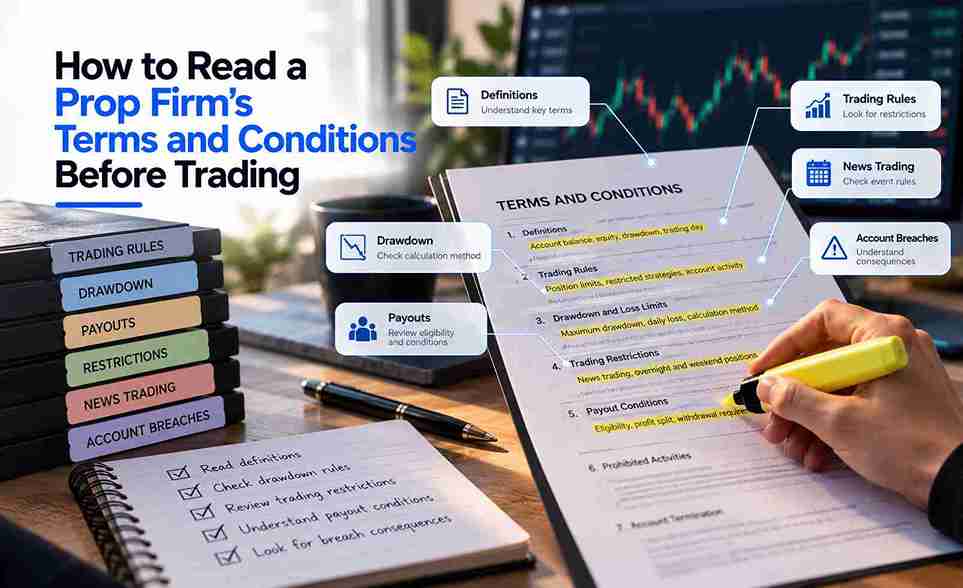
Before opening a prop firm account, traders often focus on the account size, profit target or advertised profit split. But some of the most important information is buried in the prop firm terms and conditions.
These documents explain how the account works, what trading activity is permitted, how losses are calculated, and what can happen if a rule is breached.
Knowing how to read them can help you identify important restrictions before placing a trade.
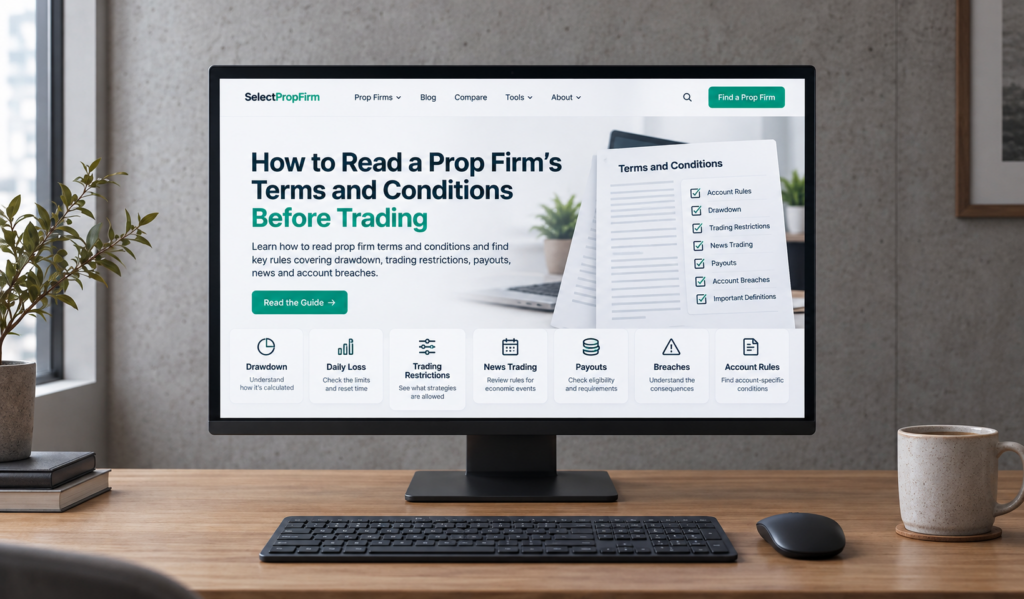
Why Prop Firm Terms and Conditions Matter
A prop firm’s terms and conditions are effectively the rulebook for the account.
They can contain information about:
- Account eligibility
- Trading restrictions
- Drawdown calculations
- Daily loss limits
- Trading hours
- News trading
- Overnight and weekend positions
- Minimum trading days
- Inactivity
- Payout requirements
- Prohibited strategies
- Platform conditions
- Account termination
Not every important rule will appear prominently on the firm’s homepage.
That is why traders should review the actual terms rather than relying only on marketing pages or summaries.
1. Start With the Definitions
One of the easiest sections to overlook is the definitions section.
Terms such as balance, equity, drawdown, daily loss, trading day and breach may have specific meanings within a firm’s rules.
For example, a firm may calculate a loss limit using equity rather than balance. That distinction can matter when a position is open and temporarily in profit or loss.
Before reading the rest of the document, identify how the firm defines its key terms.
Look for:
- Account balance
- Account equity
- Maximum drawdown
- Daily loss
- Profit
- Trading day
- Breach
- Inactivity
- Payout eligibility
If you do not understand a definition, do not assume it means the same thing it does at another prop firm.
2. Find the Drawdown Rules
Drawdown is one of the first areas traders should examine.
Look for language explaining:
- The maximum allowable loss
- Whether drawdown is static or trailing
- Whether it is based on balance or equity
- When the threshold is calculated
- Whether the threshold can move
- Whether unrealised profits affect the calculation
- What happens when the threshold is reached
A simple percentage shown on a comparison page may not explain the complete calculation.
Example
Suppose an account has a $100,000 starting balance and a 10% maximum drawdown.
That does not automatically tell you whether the account can fall to $90,000 at all times.
If the firm’s drawdown is trailing, the threshold may change as the account reaches certain equity or balance levels.
The terms and conditions should explain the mechanism.
3. Check the Daily Loss Limit
Daily loss rules deserve separate attention from maximum drawdown.
Look for:
- The daily loss percentage or amount
- What time the daily calculation resets
- Whether the calculation uses balance or equity
- Whether open trades count
- Whether commissions and other trading costs are included
- What happens when the limit is reached
The reset time is particularly important if you trade around the end of a trading day.
A trader should know exactly when a new trading period begins according to the firm’s rules.
4. Search for Trading Restrictions
Do not assume every trading strategy is permitted.
Search the document for terms related to:
- Scalping
- High-frequency trading
- Arbitrage
- Hedging
- Copy trading
- Expert advisors
- Automated trading
- Grid trading
- Martingale
- Account sharing
- Multiple accounts
- Opposite positions
Some firms may allow certain strategies while others restrict them.
The exact wording matters.
A rule saying that a strategy is prohibited can be very different from a rule saying that a strategy is permitted under specific conditions.
5. Check News Trading Rules
If you trade around economic announcements, find the firm’s rules for news events.
Search for terms such as:
- News
- High-impact news
- Economic releases
- News trading
- Restricted trading periods
- Major announcements
Then check exactly what the restriction applies to.
For example, a rule may concern opening trades, closing trades, holding positions or profits generated during a restricted period.
Do not rely on the general statement that a firm is “news friendly.” Read the actual conditions.
6. Check Overnight and Weekend Rules
If you hold positions beyond the trading session, look specifically for overnight and weekend restrictions.
Check:
- Whether positions can remain open overnight
- Whether positions can remain open over weekends
- When positions must be closed
- Whether rules differ between evaluation and funded accounts
- Whether specific instruments have different requirements
This is especially important for swing traders because a restriction that is minor for a day trader could directly affect their strategy.
7. Look for Minimum Trading Days and Inactivity Rules
Some accounts may have minimum trading-day requirements, while others may include inactivity provisions.
Search for:
- Minimum trading days
- Trading day definition
- Inactivity
- Dormant account
- Account expiration
- Time limits
Also check whether a trading day means simply placing a trade or meeting another requirement.
If you trade infrequently, these rules can be particularly important.
8. Read the Payout Conditions Carefully
Payout information deserves more attention than simply checking the advertised profit split.
Look for:
- Minimum payout requirements
- First payout eligibility
- Payout frequency
- Profit split
- Consistency requirements
- Minimum trading days
- Verification requirements
- Conditions that can affect payout eligibility
Also check whether the payout rules differ between account stages.
A firm may have different requirements for evaluation, funded or scaled accounts.
9. Find the Prohibited Activities Section
This is one of the most important sections to locate.
Search for headings such as:
- Prohibited activities
- Restricted trading
- Trading violations
- Unacceptable trading
- Abuse
- Breach
- Termination
Read the entire section rather than only searching for the strategy you personally use.
Some restrictions may concern account behaviour, technology or the way accounts are operated rather than a specific trading strategy.
10. Understand What Happens After a Rule Breach
Finding a restriction is only half the job.
You also need to understand the consequence.
Look for language explaining whether a breach can result in:
- Trade removal
- Account suspension
- Account termination
- Loss of payout eligibility
- Loss of profits
- Challenge failure
- Other account restrictions
Pay attention to whether the document distinguishes between different types of breaches.
A rule can have different consequences depending on the firm’s terms.
11. Check Which Rules Apply to Your Account
One common mistake is assuming every rule applies to every account in exactly the same way.
Check whether the terms distinguish between:
- Evaluation accounts
- Funded accounts
- Different account sizes
- Different programmes
- Different platforms
- Different account types
If the firm has separate rule pages, make sure you are reading the version that applies to the account you are considering.
12. Check the Version and Date
Terms and conditions can change.
Before relying on a document, look for:
- Publication date
- Last updated date
- Version number
- Effective date
- Change notices
Save or record the version you reviewed if the terms are important to your trading decision.
This gives you a reference point if the rules are updated later.

A Simple Prop Firm Terms and Conditions Checklist
Use this checklist before trading:
| Area | What to Find |
| Definitions | How key terms are calculated |
| Drawdown | Static, trailing, balance or equity |
| Daily loss | Amount, calculation and reset |
| Trading restrictions | Prohibited strategies and activity |
| News | Restrictions around economic releases |
| Overnight | Position-holding requirements |
| Weekend | Weekend holding restrictions |
| Trading days | Minimum trading-day requirements |
| Inactivity | Account inactivity conditions |
| Payouts | Eligibility and withdrawal requirements |
| Breaches | Consequences of breaking rules |
| Account type | Rules specific to your programme |
| Updates | Current version and effective date |
Search the Document Instead of Reading Every Word
Long terms and conditions can be difficult to navigate.
Using the document’s search function can help you find relevant sections quickly.
Useful search terms include:
Risk:
drawdown, daily loss, equity, balance
Trading:
news, overnight, weekend, scalping, hedging
Restrictions:
prohibited, restricted, violation, breach
Account:
inactivity, minimum trading days, termination
Money:
payout, profit split, withdrawal, eligibility
Searching is not a substitute for reading the document, but it can help you locate sections that deserve closer attention.
Common Mistakes Traders Make
Only Reading the Homepage
Marketing pages are designed to summarise an offer. They may not contain every operational condition.
Assuming Another Firm Uses the Same Rules
A familiar term can have a different calculation or definition at another firm.
Ignoring Small Clauses
A restriction can appear in a section that does not immediately sound relevant to your strategy.
Checking Only the Challenge Rules
Funded-account conditions may differ from evaluation conditions.
Not Checking for Updates
Rules can change, so always confirm that you are reviewing the current terms.
A Five-Minute Pre-Trading Review
Before placing your first trade, confirm these five things:
- Where is my drawdown threshold?
- How is my daily loss calculated?
- What trading activity is restricted?
- When can I hold positions?
- What conditions must I meet for a payout?
If you cannot answer these questions from the firm’s documentation, spend more time reviewing the terms before trading.
Key Takeaways
The prop firm terms and conditions contain information that can directly affect how you trade and whether your account remains compliant.
Before trading, pay particular attention to:
- Drawdown calculations
- Daily loss limits
- Trading restrictions
- News rules
- Overnight and weekend conditions
- Minimum trading days
- Inactivity
- Payout requirements
- Breach consequences
- Account-specific rules
- Document updates
The goal is not to memorise every sentence.
It is to identify the rules that interact with your trading strategy, risk management and account conditions.
Final Thoughts
Understanding a prop firm’s terms and conditions is part of preparing to trade responsibly.
Instead of relying entirely on summaries, promotions or third-party reviews, traders can use the firm’s own documentation to identify important restrictions and account requirements.
Take the time to find the key sections, understand how the calculations work and confirm which rules apply to your specific account.
That process can make it much easier to build a trading routine around the actual conditions of the account.
FAQs
What should I look for in prop firm terms and conditions?
Start with drawdown, daily loss, trading restrictions, news rules, overnight and weekend conditions, minimum trading days, payouts and breach consequences.
Why should I read a prop firm’s terms and conditions?
They provide the detailed rules governing the account and can contain restrictions that may not be fully explained on promotional pages.
Can prop firm rules differ between accounts?
Yes. Different programmes, account types or stages can have different conditions, so check which terms apply to your specific account.
What happens if I break a prop firm rule?
The consequences depend on the firm’s terms. They can include a trading violation, account termination or loss of payout eligibility.
How can I find important rules in a long terms-and-conditions document?
Use the document’s search function for terms such as “drawdown”, “daily loss”, “news”, “payout”, “prohibited”, “breach” and “inactivity”, then read the surrounding sections carefully.