
Prop Firm Drawdown Buffer: How It Works
A prop firm drawdown buffer helps traders understand how much room remains between their current account balance or equity and the applicable drawdown threshold. Knowing this figure is important when managing risk, planning position sizes and monitoring potential account breaches. However, the available buffer is not the same as the amount a trader should risk […]


A prop firm drawdown buffer helps traders understand how much room remains between their current account balance or equity and the applicable drawdown threshold. Knowing this figure is important when managing risk, planning position sizes and monitoring potential account breaches.
However, the available buffer is not the same as the amount a trader should risk on a single trade. The calculation depends on whether the prop firm uses static or trailing drawdown, whether it measures balance or equity, and how its specific account rules work.
Understanding these differences can help traders assess their remaining risk capacity and avoid making assumptions based on the advertised account size alone.
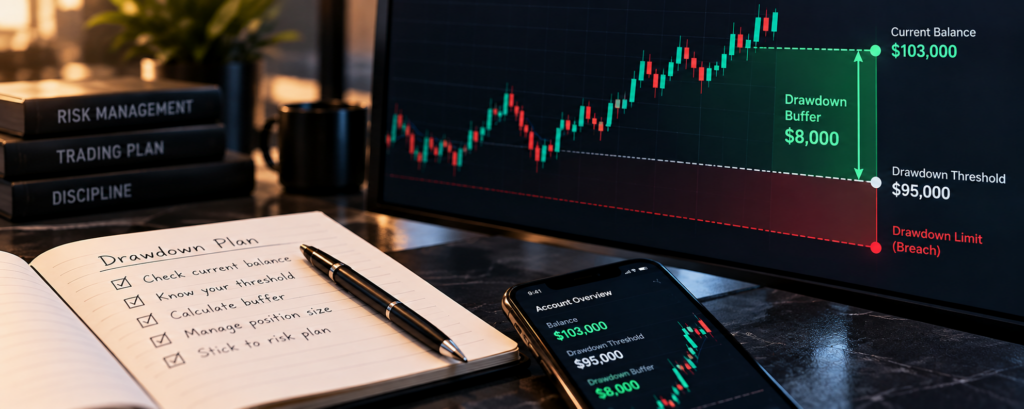
What Is a Drawdown Buffer?
A drawdown buffer is the amount of loss an account can absorb before reaching its drawdown threshold.
For example, imagine a trading account has a $100,000 starting balance and a $5,000 maximum drawdown.
If the drawdown threshold is $95,000, the account initially has a $5,000 buffer.
If the account balance later reaches $102,000 while the threshold remains at $95,000, the distance between the account and the threshold is now $7,000.
However, this does not necessarily mean the trader can safely risk the full $7,000.
The applicable drawdown calculation and the firm’s rules still determine the actual risk limits.
How Does a Drawdown Buffer Work?
The basic concept is straightforward:
Current account level − Drawdown threshold = Available buffer
For example:
- Current balance: $102,000
- Drawdown threshold: $95,000
- Buffer: $7,000
If the account falls from $102,000 to $99,000, the remaining buffer would be $4,000.
This provides a simple way to visualise the distance between the current account level and the drawdown limit.
However, traders need to know whether the firm calculates drawdown using balance, equity, a fixed threshold or a trailing level.
Static vs Trailing Drawdown Buffers
The way a firm’s drawdown works can significantly affect the buffer.
Static Drawdown
With a static drawdown model, the threshold generally remains fixed.
For example:
- Starting balance: $100,000
- Drawdown limit: $5,000
- Fixed threshold: $95,000
If the account grows to $103,000, the $95,000 threshold generally remains unchanged.
The account has therefore created more distance from the threshold.
Trailing Drawdown
With a trailing drawdown model, the threshold can move as the account reaches new highs, depending on the firm’s rules.
For example, if the account grows from $100,000 to $103,000, the applicable drawdown threshold may also move higher.
This means the additional profit does not necessarily create an equal increase in available risk.
The exact calculation varies between prop firms, so traders should check how and when the trailing threshold moves.
How Profits Can Affect Your Drawdown Buffer
Profits can change the distance between the account and its drawdown threshold.
With a fixed threshold, profits can increase the buffer because the account moves further away from the loss limit.
For example:
| Account Level | Drawdown Threshold | Buffer |
| $100,000 | $95,000 | $5,000 |
| $101,000 | $95,000 | $6,000 |
| $103,000 | $95,000 | $8,000 |
| $105,000 | $95,000 | $10,000 |
This is a simplified example assuming a fixed $95,000 threshold.
With a trailing model, however, the threshold may move as the account grows, so the relationship can be different.
Why Is the Drawdown Buffer Important?
The buffer gives traders a practical way to understand their current risk position.
Instead of looking only at the starting account balance, traders can consider how far the account currently is from its applicable drawdown threshold.
This can help with:
- Position sizing
- Risk planning
- Monitoring losses
- Managing multiple trades
- Avoiding unnecessary exposure
The buffer should be viewed as a risk boundary, not as an amount that needs to be used.
Don’t Treat the Entire Buffer as Trade Risk
One of the biggest mistakes traders can make is treating the available drawdown buffer as their trading budget.
For example, if your account has a $5,000 buffer, risking $5,000 on one trade would put the account directly at its drawdown threshold if the trade reaches its maximum loss.
A more structured approach is to establish a smaller amount of risk per trade.
For example:
Available buffer: $5,000
Planned risk per trade: $250
This means one losing trade represents 5% of the available buffer.
The appropriate amount depends on the trader’s strategy and the firm’s rules.
What Happens When the Buffer Gets Smaller?
Losses reduce the distance between the account and the drawdown threshold.
For example:
- Starting buffer: $5,000
- First loss: $500
- Remaining buffer: $4,500
- Second loss: $500
- Remaining buffer: $4,000
As the buffer becomes smaller, the account has less room to absorb additional losses.
This is why traders should monitor their account after a losing streak rather than continuing to use exactly the same risk without considering the remaining room.
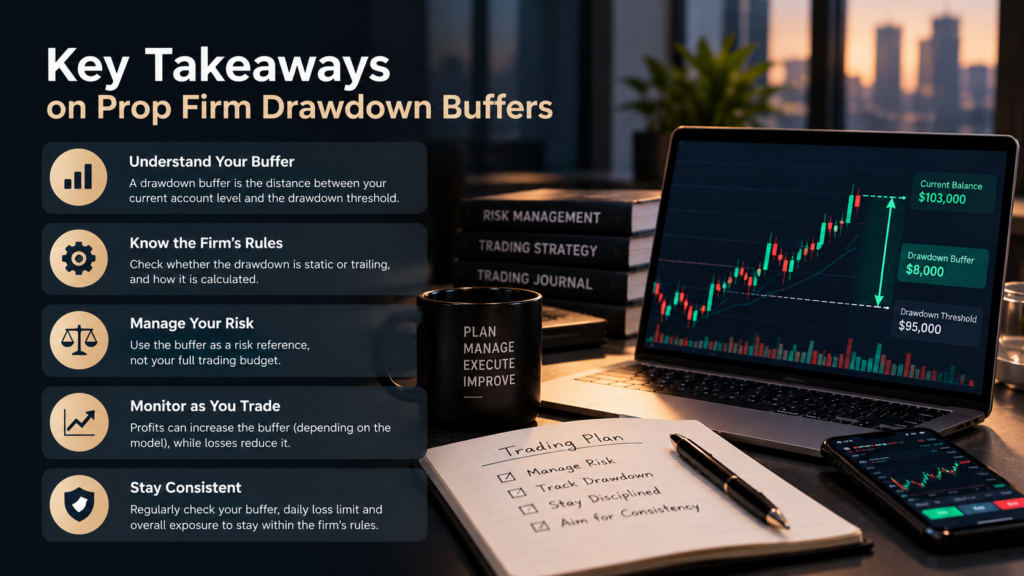
Common Drawdown Buffer Mistakes
Confusing Account Size With Available Risk
A $100,000 account does not necessarily mean you can risk $100,000.
The drawdown and daily loss rules determine the actual limits.
Assuming Profits Always Increase Available Risk
Under a trailing drawdown model, the threshold can move as profits are made.
Using the Entire Buffer
The drawdown buffer is not a target. It represents the distance to a rule limit.
Ignoring Daily Loss Limits
An account can have a substantial overall drawdown buffer while still being subject to a much smaller daily loss limit.
Forgetting Open Trade Risk
Unrealised losses can affect the account’s available room depending on how the firm’s rules calculate drawdown.
How to Monitor Your Prop Firm Drawdown Buffer
A simple tracking process can help.
Before each trading session, check:
- Current account balance or equity.
- Current drawdown threshold.
- Remaining buffer.
- Daily loss limit.
- Open-position exposure.
- Planned risk for new trades.
For trailing drawdown accounts, also identify the account level used by the firm to calculate the current threshold.
This can make the account’s risk position easier to understand before placing another trade.
A Simple Drawdown Buffer Example
Imagine a trader has a $50,000 account with a $2,500 drawdown limit.
If the applicable threshold is $47,500:
$50,000 − $47,500 = $2,500 buffer
The trader then makes $1,000 in profit.
If the threshold remains fixed:
$51,000 − $47,500 = $3,500 buffer
The account now has more distance from the threshold.
However, if the account uses a trailing drawdown model, the threshold may also move. This is why traders should calculate the buffer using the firm’s actual drawdown method rather than assuming profits automatically create additional room.
Final Thoughts
A prop firm drawdown buffer helps traders understand the distance between their current account level and the applicable drawdown threshold.
Profits may increase this distance when the threshold remains fixed. With trailing drawdown, however, the threshold can also move as the account grows.
The important point is to understand exactly how your prop firm’s drawdown is calculated and to avoid treating the entire buffer as available trade risk.
Use the buffer as a risk-management reference, monitor it regularly and keep your position sizes within the firm’s actual account limits.
Frequently Asked Questions
What is a prop firm drawdown buffer?
It is the amount of room between an account’s current balance or equity and its applicable drawdown threshold.
Does profit increase the drawdown buffer?
It can, particularly when the drawdown threshold is fixed. With trailing drawdown, the threshold may also increase as the account reaches new highs.
Is the drawdown buffer the amount I can risk?
No. The buffer represents the distance to a loss limit, not a recommended trade-risk amount.
Can the drawdown buffer decrease?
Yes. Losses reduce the distance between the current account level and the drawdown threshold.
Does daily loss affect the drawdown buffer?
Daily loss limits are separate from maximum drawdown, but they can restrict how much you can lose during a particular trading day.
Why is a trailing drawdown buffer different?
With trailing drawdown, the applicable threshold can move as the account reaches new highs. This can change the amount of room available even when the account is profitable.