
Static vs Trailing Drawdown: What Prop Traders Need to Know
Understanding static vs trailing drawdown is one of the most important things traders should do before joining a prop firm. While the percentage or dollar amount may look straightforward, the way that drawdown is calculated can significantly affect how an account behaves. What Is Static Drawdown? Static drawdown means the maximum loss threshold generally stays […]

Understanding static vs trailing drawdown is one of the most important things traders should do before joining a prop firm. While the percentage or dollar amount may look straightforward, the way that drawdown is calculated can significantly affect how an account behaves.

What Is Static Drawdown?
Static drawdown means the maximum loss threshold generally stays at a predetermined level.
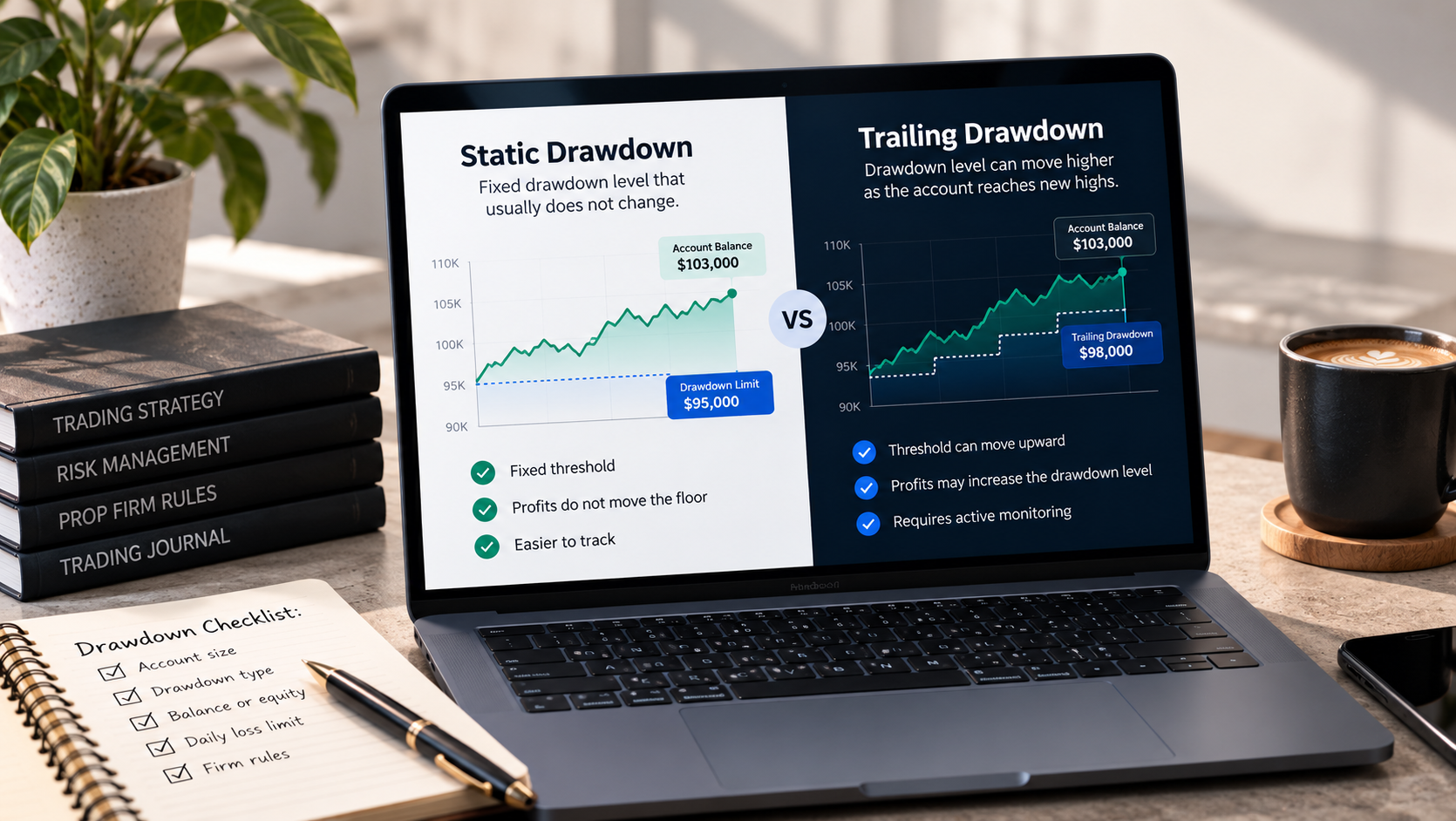
For example, suppose a trading account has a $100,000 starting balance and a $5,000 maximum drawdown. The drawdown threshold would be $95,000.
If the trader makes a profit and the account reaches $103,000, the original $95,000 threshold would generally remain unchanged.
This creates a fixed reference point that traders can use when calculating their available risk.
However, the exact calculation can vary between prop firms, so traders should always check the firm’s rules.
What Is Trailing Drawdown?
Trailing drawdown works differently because the drawdown threshold can move as the account’s balance or equity increases.
For example, imagine the same $100,000 account has a $5,000 trailing drawdown. If the account rises to $103,000, the drawdown threshold could move higher according to the firm’s rules.
This means the trader’s available buffer can change during the account’s growth.
Some firms calculate trailing drawdown using the account’s highest balance, while others may use equity or apply specific timing rules. As a result, traders need to understand exactly when and how the threshold moves.
Static vs Trailing Drawdown: Key Differences
| Feature | Static Drawdown | Trailing Drawdown |
| Drawdown threshold | Generally fixed | Can move upward |
| New profits | Usually do not move the floor | May increase the threshold |
| Monitoring | Fixed threshold is easier to track | Requires monitoring of the moving threshold |
| Risk calculation | Based around a fixed floor | Depends on the current trailing level |
| Firm rules | Can vary by provider | Can vary significantly by provider |
The most important difference is simple: static drawdown provides a fixed reference point, while trailing drawdown can change as the account develops.
How Drawdown Affects Your Trading
Drawdown rules influence how much room a trader has to absorb losses.
A trader might have a profitable strategy but still breach an account’s rules if losses push the account below the permitted threshold.
This is why account size alone does not tell you how much risk you can actually take.
Before trading, consider:
- Maximum permitted loss
- Daily loss limits
- Whether drawdown is static or trailing
- Whether balance or equity is used
- When the drawdown is calculated
- Whether profits or withdrawals affect the threshold
Understanding these details can make risk calculations much more practical.
Why Trailing Drawdown Requires Extra Attention
Trailing drawdown can require more active monitoring because the threshold may change as the account reaches new highs.
For example, a trader could make several profitable trades and then assume that the additional profits have created a larger safety buffer. However, if the drawdown threshold has also moved upward, the actual distance between the account and the threshold may be smaller than expected.
This is particularly important during periods of rapid account growth.
Traders should therefore understand exactly what causes the trailing level to move and whether it stops trailing at a particular point.
Common Mistakes With Drawdown Rules
1. Focusing Only on Account Size
A larger account does not automatically mean a larger practical risk buffer. The drawdown rule determines how much room you actually have.
2. Ignoring How Drawdown Is Calculated
Balance-based and equity-based calculations can produce different outcomes. Make sure you know which one the firm uses.
3. Assuming Every Prop Firm Is the Same
Two firms can advertise similar account sizes but use completely different drawdown structures.
4. Increasing Risk After Making a Profit
Making money does not necessarily mean you should immediately increase your position size. With a trailing model, the relationship between profits and the drawdown threshold can become particularly important.
5. Forgetting About Withdrawals
Some firms may have specific rules about how withdrawals interact with account balances and drawdown. Always check the relevant terms before requesting a payout.
What Should You Check Before Joining a Prop Firm?
Before paying for an evaluation or trading account, find the exact drawdown rules.
Look for answers to these questions:
- Is the drawdown static or trailing?
- What percentage or dollar amount is the drawdown?
- Is it calculated from balance, equity or another value?
- When does the trailing threshold move?
- Does it stop trailing at a certain level?
- Do unrealised profits affect the threshold?
- Can withdrawals change the available drawdown?
- What happens when the threshold is reached?
If these details are difficult to find, ask the firm directly before committing to an account.
A Simple Drawdown Checklist
Before placing trades, make sure you know:
Account balance → Drawdown amount → Drawdown threshold → Daily loss limit → Current available buffer
This gives you a clearer picture of how much room the account has before a rule breach.
For trailing drawdown accounts, also keep track of the highest balance or equity level used to calculate the trailing threshold, depending on the firm’s rules.

Static vs Trailing Drawdown: What Should Traders Remember?
The main difference between static vs trailing drawdown is how the loss threshold behaves.
A static drawdown generally provides a fixed floor. A trailing drawdown can move as the account reaches new highs.
Neither description alone tells you whether an account is suitable for your trading approach. The important thing is understanding the specific calculation, monitoring requirements and other rules attached to the account.
Final Thoughts
Drawdown is more than a number displayed in a prop firm’s account specifications. The way that number is calculated can directly affect how traders manage positions, profits and risk.
Understanding static vs trailing drawdown before trading can help you avoid surprises and build your risk management around the actual rules of the account.
Always read the firm’s current terms and make sure you understand the drawdown calculation before opening an account.
Frequently Asked Questions
What is the difference between static vs trailing drawdown?
Static drawdown generally remains at a fixed threshold, while trailing drawdown can move as the account reaches new highs.
Is trailing drawdown the same at every prop firm?
No. Firms can use different methods to calculate and update trailing drawdown. Check the specific firm’s rules.
Does static drawdown move when I make a profit?
Generally, the threshold remains fixed, although the exact rules depend on the prop firm.
Can profits increase a trailing drawdown threshold?
They can, depending on how the firm calculates trailing drawdown. Some models adjust the threshold as the account reaches new highs.
Does account size determine my actual risk?
Not by itself. The drawdown amount, daily loss limit and other account rules determine the practical risk limits.
Can withdrawals affect drawdown?
They can, depending on the firm’s rules. Always check how withdrawals interact with the account balance and drawdown threshold.