
Prop Firm Trading Plan: How to Build One That Works
Last reviewed 28 September 2026. Many traders spend months searching for the perfect strategy but overlook one of the most important tools for long-term success: a written prop firm trading plan. Passing a prop firm evaluation isn’t just about making profitable trades. It’s about proving that you can manage risk, remain disciplined and follow a […]


Last reviewed 28 September 2026.
Many traders spend months searching for the perfect strategy but overlook one of the most important tools for long-term success: a written prop firm trading plan.
Passing a prop firm evaluation isn’t just about making profitable trades. It’s about proving that you can manage risk, remain disciplined and follow a consistent process under pressure. A well-structured trading plan helps you achieve exactly that.
Without a plan, it’s easy to trade emotionally, break risk management rules and lose a funded account. With a clear framework, every trading decision becomes more objective and repeatable.
In this guide, you’ll learn how to build a prop firm trading plan that aligns with funded account rules and helps you trade with greater consistency.
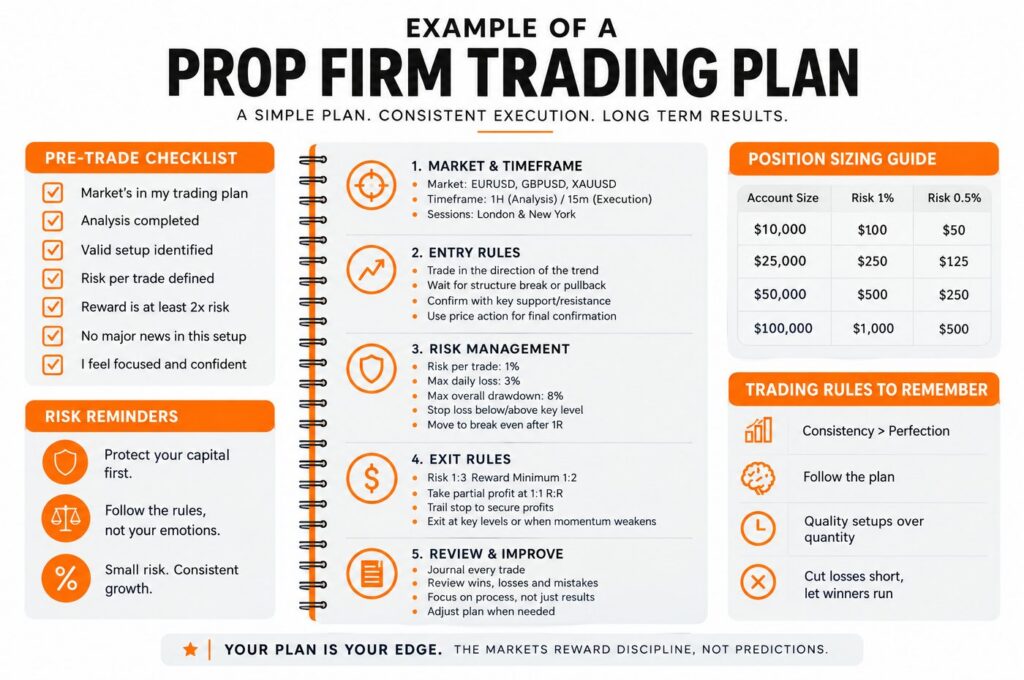
What Is a Prop Firm Trading Plan?
A prop firm trading plan is a written document that outlines exactly how you will approach the markets while following the firm’s trading rules.
Rather than making decisions based on emotion, your trading plan provides a structured process for every trading session.
A good plan defines:
- Markets you will trade.
- Trading sessions.
- Entry criteria.
- Exit strategy.
- Risk per trade.
- Maximum daily loss.
- Position sizing.
- Rules for stopping trading.
- Review process.
Professional traders rarely make decisions without first referring to their plan.
Why Every Trader Needs a Prop Firm Trading Plan
Prop firms don’t reward lucky trades.
They reward consistency.
A structured trading plan helps you:
- Reduce emotional trading.
- Stay within drawdown limits.
- Avoid overtrading.
- Maintain consistent position sizing.
- Improve long-term performance.
- Protect your funded account.
The more consistent your process becomes, the easier it is to remain funded.
Define the Markets You Will Trade
One of the biggest mistakes beginners make is trying to trade everything.
Instead, choose markets you understand well.
Examples include:
- Major Forex pairs.
- Stock index futures.
- Gold.
- NASDAQ.
- S&P 500.
- Crude oil.
Trading fewer markets allows you to recognise patterns more quickly and avoid unnecessary distractions.
Set Clear Entry Rules in Your Prop Firm Trading Plan
Every trade should meet predefined conditions.
Your prop firm trading plan should answer questions such as:
- What confirms an entry?
- Which timeframes will you use?
- What market structure do you require?
- Which indicators, if any, support the trade?
- What invalidates the setup?
If the setup doesn’t meet your criteria, don’t take the trade.
Define Your Exit Strategy
Knowing when to exit is just as important as knowing when to enter.
Your plan should include:
- Stop-loss placement.
- Profit targets.
- Risk-to-reward ratio.
- Partial profit-taking rules.
- Conditions for closing trades early.
Clear exit rules help remove emotional decision-making.
Build Risk Management Into Your Plan
Risk management should be the foundation of every trading plan.
Professional traders decide how much they’re willing to lose before thinking about potential profits.
Your plan should specify:
- Risk per trade.
- Maximum daily loss.
- Weekly loss limit.
- Maximum drawdown buffer.
- Position sizing method.
Protecting capital always comes first.
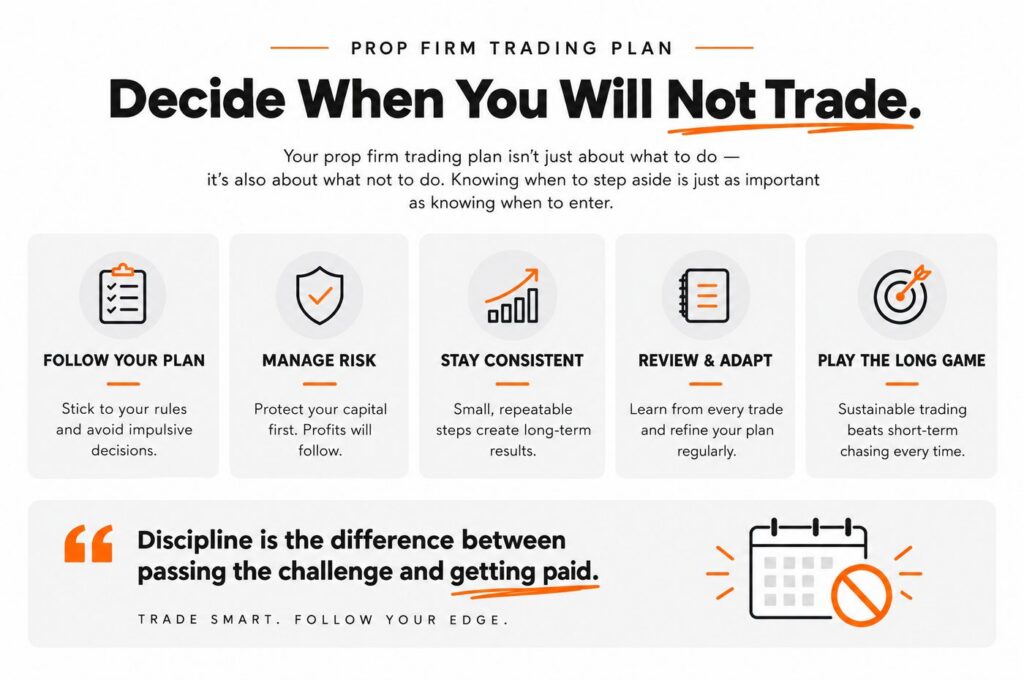
Decide When You Will Not Trade
One of the most valuable sections of a trading plan is knowing when to stay out of the market.
Avoid trading when:
- Market conditions are unclear.
- You feel emotional.
- Major news events increase volatility.
- You’ve reached your personal loss limit.
- You’re tired or distracted.
Sometimes the best trade is no trade at all.
Include Rules for Emotional Discipline
Even experienced traders experience emotions.
Your prop firm trading plan should explain how you’ll respond when emotions influence your decisions.
Examples include:
- Stop trading after consecutive losses.
- Take regular breaks.
- Avoid revenge trading.
- Reduce position size after emotional sessions.
- Review mistakes before trading again.
Managing emotions protects both your capital and your confidence.
Create a Daily Trading Routine
Consistency starts before the market opens.
Professional traders often follow a routine that includes:
- Reviewing economic news.
- Checking higher timeframes.
- Planning potential setups.
- Setting risk limits.
- Removing distractions.
A consistent routine creates consistent decision-making.
Keep a Trading Journal
A trading plan isn’t complete without regular reviews.
After every session, record:
- Entry and exit points.
- Risk percentage.
- Market conditions.
- Emotional state.
- Mistakes made.
- Lessons learned.
Over time, your journal will highlight patterns that help improve your performance.
Review and Improve Your Trading Plan
Markets evolve, and so should your trading plan.
Review it regularly to identify:
- Rules that work well.
- Areas for improvement.
- Recurring mistakes.
- Changes in market conditions.
Small improvements made consistently often produce significant long-term results.
Common Mistakes When Creating a Prop Firm Trading Plan
Many traders make their plans too complicated.
Avoid these mistakes:
- Trading without written rules.
- Constantly changing strategies.
- Ignoring risk management.
- Adding too many indicators.
- Trading every market.
- Failing to review performance.
A simple plan that you consistently follow is far more effective than a complex plan you ignore.
Final Thoughts
A successful prop firm trading plan isn’t about predicting every market move. It’s about creating a repeatable process that protects your capital and helps you make disciplined decisions.
The traders who remain funded long-term aren’t necessarily those with the best strategy. They’re the ones who consistently follow their trading plan, manage risk and learn from every trading session.
If you want to improve your chances of passing a prop firm challenge and staying funded, invest time in building a trading plan that supports consistency rather than short-term profits.
Frequently Asked Questions
What is a prop firm trading plan?
A prop firm trading plan is a written set of rules that defines how you enter trades, manage risk, exit positions and follow a prop firm’s trading requirements.
Why is a trading plan important for prop firms?
A trading plan helps traders remain disciplined, avoid emotional decisions and stay within the firm’s risk management rules.
How often should I update my trading plan?
Review your trading plan regularly, especially after identifying recurring mistakes or changes in market conditions.
Can a trading plan help me stay funded?
Yes. A structured trading plan encourages consistency, improves risk management and reduces the likelihood of breaking prop firm rules.