One-Step vs Two-Step Prop Firm Challenges: Which Is Better in 2026?
One-step vs two-step prop firm challenges: which is better? One-step is faster (single 10% target vs 8% + 5%), costs less total (one evaluation fee vs two phases), and gets you funded in weeks instead of months. Two-step has higher pass rates (10–15% vs 5–10%), lower psychological pressure (targets spread over time), and better prepares […]

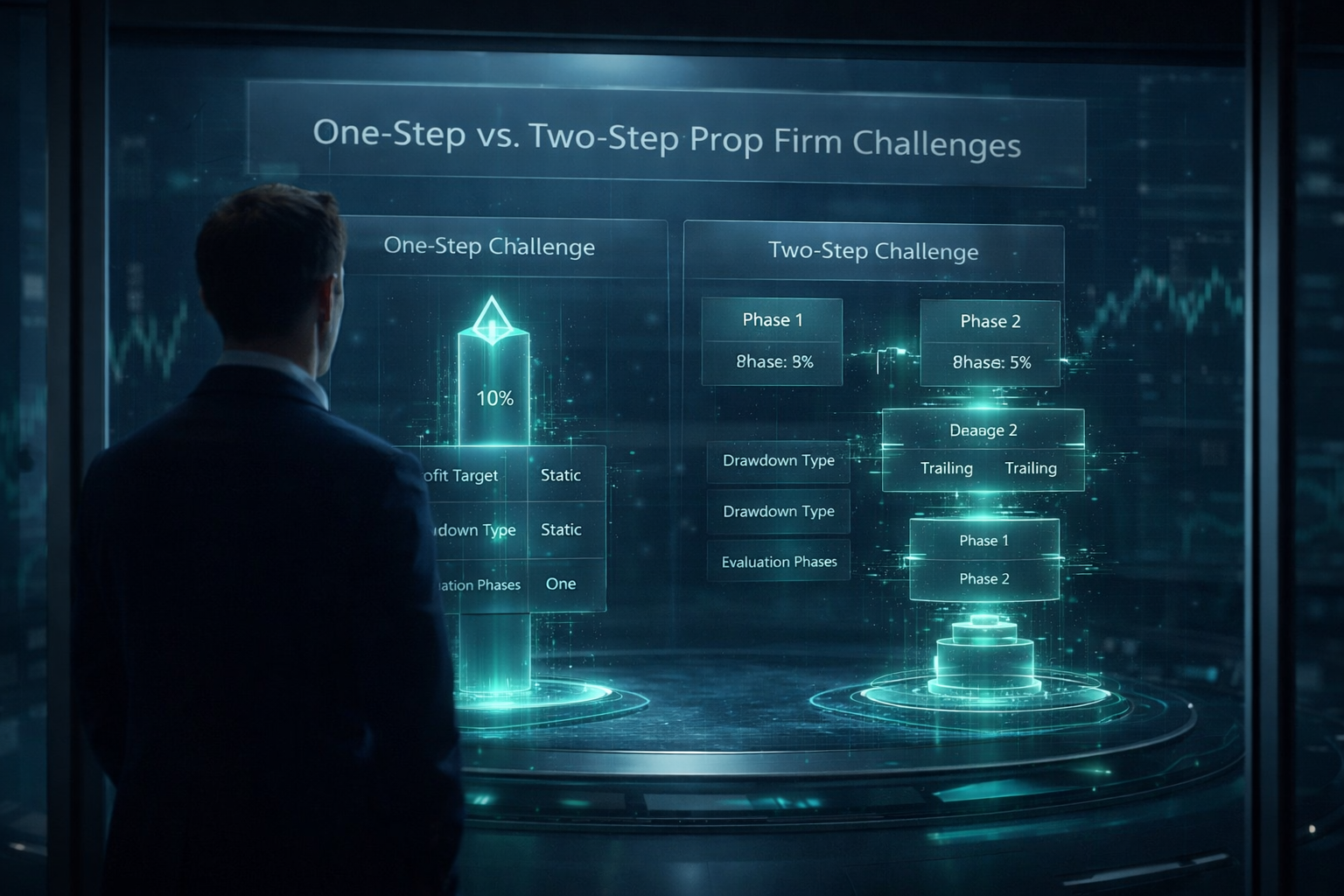
One-step vs two-step prop firm challenges: which is better? One-step is faster (single 10% target vs 8% + 5%), costs less total (one evaluation fee vs two phases), and gets you funded in weeks instead of months. Two-step has higher pass rates (10–15% vs 5–10%), lower psychological pressure (targets spread over time), and better prepares you for funded account conditions. If you’re a confident trader who values speed over safety, choose one-step. If you prioritize higher pass rates and want to build consistent habits, choose two-step.
The prop firm industry shifted heavily toward one-step evaluations in 2024–2025, with FundedNext, TTT Markets, and FundingPips all launching one-step programs. However, two-step challenges remain the dominant model at FTMO, The5ers, and most established firms. This guide covers the real differences — pass rates, costs, time to funding, and psychological pressure — so you can choose the structure that matches your trading style.
Here’s everything you need to know about one-step vs two-step prop firm challenges in 2026.
Disclosure: This article contains affiliate links. We may earn a commission if you sign up through our links, at no extra cost to you. Our reviews reflect independent, honest assessments.
| Challenge Type | Pass Rate | Total Profit Target |
| One-Step | 5–10% | 10% (single phase) |
| Two-Step | 10–15% | 13% total (8% + 5%) |
Sources: QuantVPS, PropFirmCircle, FundingTraders — February 2026
What Are One-Step and Two-Step Prop Firm Challenges?
One-Step Challenges
A one-step challenge requires you to hit a single profit target — typically 10% — in one evaluation phase. Once you hit the target and meet minimum trading day requirements (usually 3–5 days), you receive a funded account. There is no verification phase.
Standard one-step structure:
- Profit target: 10%
- Max drawdown: 5–6%
- Daily loss limit: 4–5% (some firms eliminate this)
- Minimum trading days: 3–5 days
- Time limit: Unlimited at most firms (FTMO, FundedNext, etc.)
Two-Step Challenges
A two-step challenge requires you to hit profit targets in two consecutive phases. Phase 1 typically requires 8–10% profit. Phase 2 (Verification) requires 5% profit. Both phases have separate drawdown limits and minimum trading day requirements.
Standard two-step structure:
- Phase 1 profit target: 8–10%
- Phase 2 profit target: 5%
- Max drawdown: 8–10% (both phases)
- Daily loss limit: 4–5% (both phases)
- Minimum trading days: 4–5 per phase
- Time limit: Unlimited at most firms
One-Step vs Two-Step: Pass Rates
One-Step Pass Rates: 5–10%
Industry data shows one-step challenges have lower pass rates than two-step evaluations. QuantVPS reports 5–10% pass rates across the prop firm industry in 2026. FundingTraders analyzed 50,000+ one-step challenges and confirmed pass rates “significantly higher than the industry average for classic 2-step challenges (~10%)” — but this refers to their specific program, not the industry overall.
The reason: tighter drawdown limits. One-step challenges typically enforce 5–6% max drawdown vs 8–10% on two-step. A single bad day can end your evaluation. Two-step challenges give you more room to recover.
Two-Step Pass Rates: 10–15%
2-step challenges have higher pass rates because the profit targets are split across two phases. An 8% Phase 1 target is psychologically easier to hit than a 10% single-phase target, even though the total profit required is higher (8% + 5% = 13% vs 10%).
The spread-out structure reduces daily pressure. You’re not racing to hit 10% before making a mistake. You can take profits at 8%, reset psychologically in Phase 2, and finish with a lower-stress 5% target.
Winner: Two-step — 10–15% pass rate vs 5–10% for one-step
Speed to Funding: One-Step vs Two-Step
One-Step: Weeks
One-step challenges are the fastest path to funded trading. Traders regularly pass in 7–14 days if they have a consistent strategy. FundedNext advertises “funded in 48 hours” after hitting the 10% target on their Stellar 1-Step.
Example timeline:
- Day 1–7: Trade evaluation, hit 10% target
- Day 8: Submit for review
- Day 9–10: Receive funded account
Two-Step: Months
Two-step challenges take longer because you must complete two separate phases. Even fast traders typically need 3–6 weeks to complete both phases.
Example timeline:
- Week 1–2: Trade Phase 1, hit 8% target
- Week 3–4: Trade Phase 2, hit 5% target
- Week 5: Submit for review, receive funded account
Winner: One-step — 1–2 weeks vs 4–6 weeks for two-step
Total Cost: One-Step vs Two-Step
One-Step Evaluation Fees
One-step challenges cost more upfront than two-step Phase 1 alone, but less total than completing both phases of a two-step challenge.
Example (FundedNext $100K account):
- One-step Stellar: $550 one-time
- Two-step Express: $340 (Phase 1) + evaluation time + Phase 2 = higher total cost if you fail Phase 2
Two-Step Evaluation Fees
Two-step challenges have lower Phase 1 fees but require completing both phases. If you fail Phase 2 after passing Phase 1, you’ve wasted Phase 1 fees and time.
Example (FTMO $100K account):
- Two-step Challenge: $556 total (covers both phases)
The risk: if you pass Phase 1 but fail Phase 2, you’ve lost $556 and gained nothing. With one-step, you either pass ($550 well spent) or fail ($550 lost), but there’s no “halfway loss.”
Winner: One-step — Lower total cost if you pass; less wasted cost if you fail after Phase 1
Psychological Pressure: One-Step vs Two-Step
One-Step: High Pressure
One-step challenges create “all-or-nothing” pressure. Every losing day brings you closer to the 5–6% max drawdown limit. There is no second chance. If you breach, you fail immediately.
This pressure causes many traders to overtrade or revenge trade. A $1,500 losing day on a $100K account (1.5% drawdown) feels catastrophic when you only have 5% total room. The psychological weight compounds with each loss.
Two-Step: Lower Pressure Per Phase
Two-step challenges reduce pressure by splitting the journey into manageable chunks. An 8% Phase 1 target feels achievable. Once you hit it, you mentally reset for Phase 2’s easier 5% target.
The larger max drawdown (8–10% vs 5–6%) also reduces stress. You have more room to recover from bad days without immediately fearing account breach.
Winner: Two-step — Lower psychological pressure due to split targets and larger drawdown buffers
Which Prepares You Better for Funded Trading?
Two-Step Builds Better Habits
Prop firms designed two-step challenges to test consistency. Can you hit 8% profit, then repeat disciplined trading to hit another 5%? This mirrors funded account conditions where you must perform month after month.
Traders who pass two-step challenges develop patience, emotional control, and repeatable processes — skills critical for long-term funded success.
One-Step Rewards Speed Over Consistency
One-step challenges reward traders who can execute flawlessly under pressure. However, “flawless execution for 7–14 days” is not the same skill as “consistent execution for months.” Some traders pass one-step evaluations but fail to maintain performance on funded accounts because they never developed endurance.
Winner: Two-step — Better prepares traders for the psychological demands of funded trading
Quick Comparison: One-Step vs Two-Step
| Factor | One-Step | Two-Step |
| Pass Rate | 5–10% | 10–15% |
| Speed to Funding | 1–2 weeks | 4–6 weeks |
| Total Profit Target | 10% | 13% (8% + 5%) |
| Max Drawdown | 5–6% | 8–10% |
| Psychological Pressure | High | Moderate |
| Total Cost | Lower (one fee) | Higher (if you fail Phase 2) |
| Builds Consistency | No | Yes |
When to Choose One-Step vs Two-Step
Choose One-Step If You:
- Have a proven trading strategy with documented 60%+ win rate
- Trade full-time and can dedicate 100% focus for 7–14 days
- Perform better under pressure (deadline-driven personality)
- Want to get funded as fast as possible
- Prefer “all-or-nothing” clarity over prolonged evaluations
- Have excellent risk management (can stay within 5–6% drawdown)
Choose Two-Step If You:
- Are still building consistency (win rate 50–60%)
- Trade part-time or need flexibility to take breaks
- Perform better with lower pressure and gradual targets
- Want higher pass rates (10–15% vs 5–10%)
- Need to develop patience and emotional control for long-term success
- Prefer more forgiving drawdown limits (8–10% vs 5–6%)
Best One-Step Prop Firms (2026)
- FundedNext: Stellar 1-Step with 15% profit share during evaluation
- TTT Markets: 1-Step with news trading and overnight holds allowed
- FundingPips: 1-Step with static drawdown (no trailing)
- Alpha Capital Group: 1-Step with instant activation
Best Two-Step Prop Firms (2026)
- FTMO: 10-year track record, $450M+ paid, 90% profit split
- The5ers: 4.9/5 Trustpilot, scaling to 100% profit split
- Blueberry Funded: ASIC-regulated parent company, $2M scaling
- E8 Funding: 2-Step with flexible rules and scaling options
Bottom Line: One-Step vs Two-Step Prop Firm Challenges
One-step is better if you’re a confident, experienced trader who values speed over safety. You’ll get funded faster (1–2 weeks vs 4–6 weeks), pay less total cost, and avoid the risk of passing Phase 1 but failing Phase 2.
Two-step is better if you prioritize higher pass rates (10–15% vs 5–10%), want to build consistent trading habits, and prefer lower psychological pressure. The 8–10% max drawdown gives you more room to recover from bad days, and the split targets reduce the “all-or-nothing” stress.
For most traders — especially those still building consistency — two-step challenges are the better choice. The higher pass rates and better habit formation outweigh the extra time required. However, experienced traders with proven strategies should choose one-step for faster funding and lower total costs.
Regardless of which structure you choose, success depends on the same fundamentals: proven strategy, disciplined risk management, and emotional control under evaluation pressure.
For more detailed firm-by-firm reviews, see our FundedNext review and, FTMO review
Frequently Asked Questions: One-Step vs Two-Step Prop Firm
Is a one-step challenge harder than two-step?
Yes, statistically. One-step challenges have 5–10% pass rates vs 10–15% for two-step. The tighter max drawdown (5–6% vs 8–10%) and single-phase structure create more pressure. However, one-step requires only a 10% total profit target vs 13% total (8% + 5%) for two-step. The difficulty comes from execution pressure, not target size.
Which is faster: one-step or two-step?
One-step is significantly faster. Traders regularly pass in 1–2 weeks and receive funded accounts within 48 hours after hitting targets. Two-step challenges take 4–6 weeks minimum because you must complete two separate phases. If speed to funding is your priority, one-step is the clear winner.
Do one-step challenges cost more than two-step?
Not necessarily. One-step fees are higher upfront ($550 for FundedNext $100K vs $340 for two-step Phase 1), but total cost is lower if you pass. With two-step, you pay for both phases — if you fail Phase 2 after passing Phase 1, you’ve wasted time and Phase 1 fees. One-step eliminates “halfway losses.”
Which has better pass rates: one-step or two-step?
Two-step challenges have better pass rates (10–15% vs 5–10% for one-step). The split targets reduce psychological pressure, and the larger max drawdown (8–10% vs 5–6%) gives more room to recover from losing days. Industry data confirms two-step pass rates are roughly double one-step rates.
Should beginners choose one-step or two-step challenges?
Beginners should choose two-step. The higher pass rates (10–15%), lower pressure, and habit-building structure better prepare new traders for long-term funded success. One-step challenges reward traders with proven strategies and excellent risk management — skills beginners are still developing. Start with two-step, graduate to one-step once you have 6+ months of consistent results.