Best Prop Firms for Scalping: Key Features
The best prop firms for scalping offer account conditions that fit a strategy built around frequent entries and exits. Because scalpers often target small price movements, execution, spreads, commissions and trading restrictions can have a meaningful impact on their results. Choosing a suitable prop firm involves more than comparing account sizes or advertised profit targets. […]

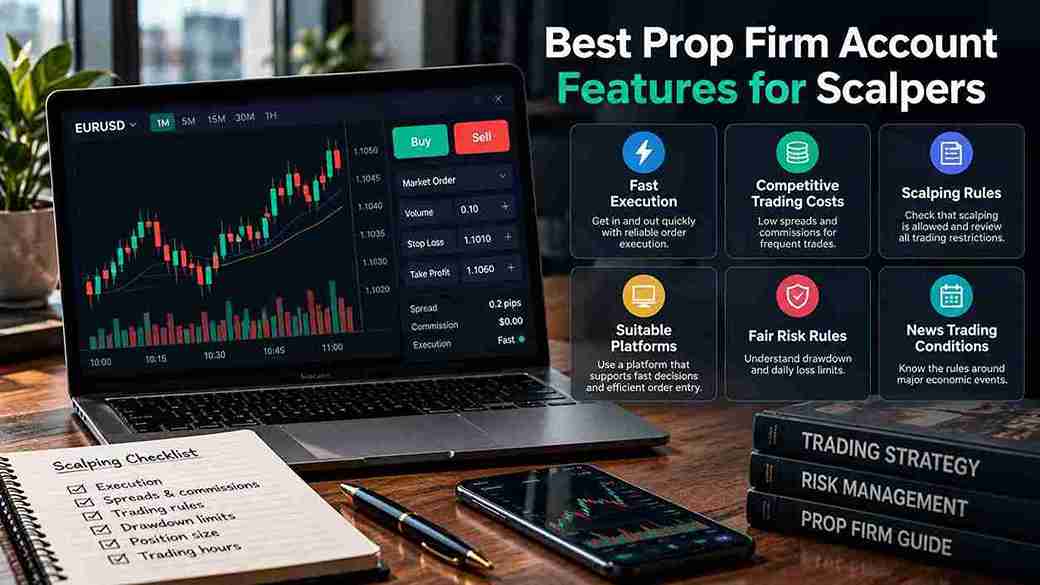
The best prop firms for scalping offer account conditions that fit a strategy built around frequent entries and exits. Because scalpers often target small price movements, execution, spreads, commissions and trading restrictions can have a meaningful impact on their results.
Choosing a suitable prop firm involves more than comparing account sizes or advertised profit targets. Traders also need to understand how the platform handles orders, what trading costs apply and whether the firm’s rules permit their specific scalping method.
In this guide, we’ll cover the key features to compare, from execution quality and trading costs to drawdown limits, news restrictions and position-size rules. This will help you assess whether an account fits your trading strategy before committing to a challenge.

What Makes a Prop Firm Suitable for Scalping?
A prop firm suitable for scalpers should have account conditions that do not conflict with the way short-term traders operate.
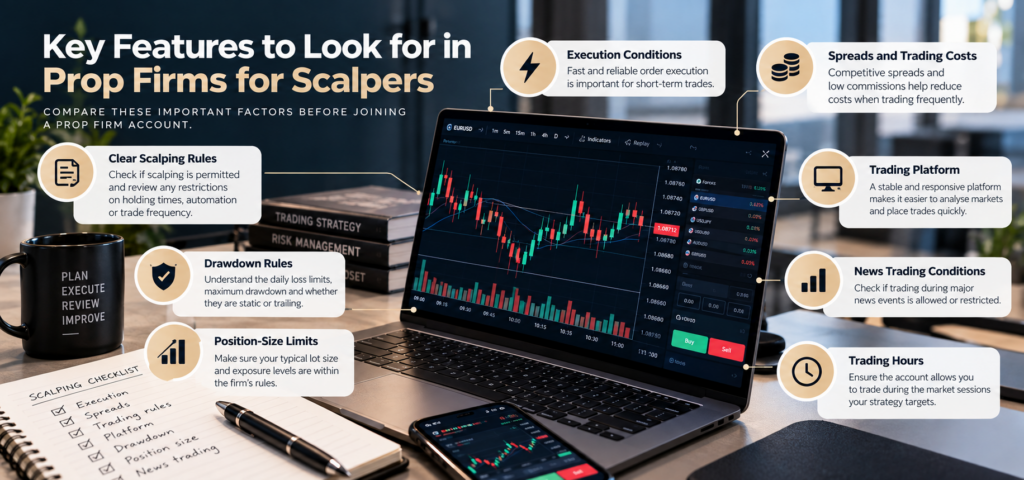
Important features to compare include:
- Execution conditions
- Spreads and trading costs
- Order types
- Platform performance
- Scalping rules
- News trading restrictions
- Daily loss limits
- Drawdown
- Position-size limits
- Trading hours
Not every firm will offer the same conditions, so traders should check the current rules before joining.
1. Clear Scalping Rules
The first thing to check is whether scalping is explicitly permitted.
Some firms may have restrictions around very short holding periods, high-frequency trading, automated strategies or specific execution methods.
Before purchasing an account, look for information about:
- Minimum holding times
- Maximum number of trades
- High-frequency trading
- Automated trading
- Trade copying
- Hedging
- News trading
If the firm’s rules are unclear, ask for clarification before trading.
2. Efficient Order Execution
Execution can be particularly important for scalpers because trades may target relatively small price movements.
A difference in entry or exit price can have a greater impact when the expected profit per trade is relatively small.
Consider whether the trading environment provides:
- Fast order placement
- Reliable order execution
- Clear order status
- Easy position management
- Suitable order types
Traders should also understand that execution can vary with market conditions and liquidity.
3. Competitive Trading Costs
Trading costs can accumulate when a strategy involves frequent entries and exits.
Consider the total cost of trading, including:
- Spreads
- Commissions
- Swap or overnight costs where applicable
- Other account-specific fees
For example, a cost that seems small on one trade can become more significant when repeated across dozens of trades.
Scalpers should therefore look at trading costs in relation to their typical trade size and frequency.
4. A Platform That Supports Fast Decisions
A suitable platform should make it easy to analyse markets and manage positions.
Useful features can include:
- Real-time charts
- Multiple timeframes
- Custom indicators
- One-click or efficient order entry
- Stop-loss and take-profit management
- Clear open-position information
- Reliable desktop or web access
The most important feature is not necessarily the number of tools. It is whether the platform allows you to execute your normal trading process efficiently.
5. Suitable Drawdown Rules
Scalpers may take multiple trades in a single session, which means several small losses can accumulate quickly.
Before choosing an account, understand:
- Maximum drawdown
- Daily loss limit
- Static or trailing drawdown
- Balance vs equity calculations
- How unrealised losses are treated
A strategy should be able to operate within these limits without requiring excessive risk per trade.
6. News Trading Conditions
Some scalpers actively trade around economic announcements because volatility can increase during these periods.
However, news trading rules vary between prop firms.
Check whether the firm:
- Allows trading during major news events
- Restricts opening new positions around announcements
- Requires positions to be closed before specific events
- Applies different conditions to certain instruments
Never assume that news trading is permitted simply because the platform allows you to place an order.
7. Position-Size Rules
Scalping often involves relatively short-term trades, but position size still needs to remain within the firm’s rules.
Check for:
- Maximum lot or contract size
- Instrument-specific limits
- Exposure limits
- Scaling restrictions
- Rules around multiple simultaneous positions
Your position size should also be consistent with the account’s drawdown and daily loss limits.
8. Trading Hours That Fit Your Strategy
Scalpers may focus on specific market sessions when liquidity and volatility are suitable for their strategy.
Check whether the prop firm has restrictions around:
- Market open
- Market close
- Overnight positions
- Weekend trading
- Specific instruments
- Scheduled market closures
The account should allow you to trade during the sessions your strategy actually targets.
9. Transparent Account Rules
Clear rules are particularly important for short-term strategies.
Before joining, make sure you understand exactly what constitutes:
- A permitted trade
- A prohibited strategy
- A drawdown breach
- A daily loss breach
- An account violation
If important restrictions are difficult to find, ask the firm before purchasing the account.
How to Compare Prop Firms for Scalping
Instead of focusing on one feature, create a simple comparison:
| Feature | Prop Firm A | Prop Firm B | Prop Firm C |
| Scalping permitted | |||
| Minimum holding time | |||
| Spread | |||
| Commission | |||
| Platform | |||
| Execution conditions | |||
| News trading | |||
| Daily loss limit | |||
| Drawdown | |||
| Maximum position size |
This makes it easier to see which account conditions match your strategy.
What Scalpers Should Avoid
Choosing Based Only on Account Size
A large advertised account does not automatically provide suitable conditions for scalping.
Ignoring Trading Costs
Frequent trading can make spreads and commissions more important to your overall results.
Assuming All Platforms Execute the Same Way
Execution conditions can vary between trading environments, instruments and market conditions.
Trading Too Close to Loss Limits
Multiple small losses can accumulate quickly. Leave sufficient room within the firm’s daily loss and drawdown limits.
Ignoring the Firm’s Scalping Rules
A strategy may be technically possible on a platform but prohibited under the firm’s account terms.
A Scalper’s Prop Firm Checklist
Before joining, check:
Trading rules
- Is scalping permitted?
- Are there minimum holding periods?
- Are automated strategies allowed?
- Is news trading permitted?
Execution
- What platform is used?
- What order types are available?
- How are positions managed?
Costs
- What are the spreads?
- Are commissions charged?
- Are there other trading costs?
Risk
- What is the daily loss limit?
- What is the maximum drawdown?
- Is drawdown static or trailing?
- Are there position-size limits?
Account conditions
- Are there trading-hour restrictions?
- Are overnight positions allowed?
- What are the payout requirements?
Final Thoughts
The best prop firms for scalping should be evaluated based on how their account conditions fit your actual trading strategy.
Execution, spreads, commissions, platform functionality, scalping restrictions and risk limits can all matter when trades are opened and closed quickly.
Rather than choosing an account because it advertises a large balance or attractive target, compare the complete trading environment. Most importantly, read the firm’s current rules and confirm that your scalping approach is permitted.
Frequently Asked Questions
What features should scalpers look for in a prop firm?
Scalpers should consider execution, spreads, commissions, platform functionality, scalping rules, drawdown, daily loss limits and position-size restrictions.
Do all prop firms allow scalping?
No. Trading rules vary between firms. Always check whether scalping and your specific trading method are permitted.
Are trading costs important for scalpers?
Yes. Because scalpers may place many trades, spreads and commissions can accumulate and become a meaningful part of trading costs.
Is a fast trading platform important for scalping?
A platform that allows efficient order placement and position management can be useful for scalpers. However, actual execution also depends on market conditions and the trading environment.
Can scalpers trade during major news events?
It depends on the firm’s rules. Some firms may allow it, while others may restrict trading around specific economic announcements.
Should scalpers choose a prop firm based on the largest account?
Not necessarily. Account size is only one factor. Scalpers should also compare execution, costs, trading restrictions and risk-management rules.