
Capital Needed for Prop Firm: A Beginner’s Guide
Last reviewed 28 September 2026. Many aspiring traders believe they need tens of thousands of dollars before they can trade professionally. Fortunately, the capital needed for a prop firm is far lower than most beginners expect. Unlike traditional trading, prop firms provide traders with access to funded accounts after they successfully complete an evaluation. Instead […]


Last reviewed 28 September 2026.
Many aspiring traders believe they need tens of thousands of dollars before they can trade professionally. Fortunately, the capital needed for a prop firm is far lower than most beginners expect.
Unlike traditional trading, prop firms provide traders with access to funded accounts after they successfully complete an evaluation. Instead of risking a large personal trading account, your primary investment is preparing for the challenge itself and ensuring you are financially stable while working towards consistent profitability.
Understanding the capital needed for a prop firm helps you budget realistically, avoid unnecessary financial pressure and focus on developing the skills required to become a funded trader.
What Is the Capital Needed for a Prop Firm?
When people hear the word “capital”, they often think of depositing thousands of dollars into a trading account. However, the capital needed for a prop firm is usually much lower because the firm provides the trading capital once you pass its evaluation.
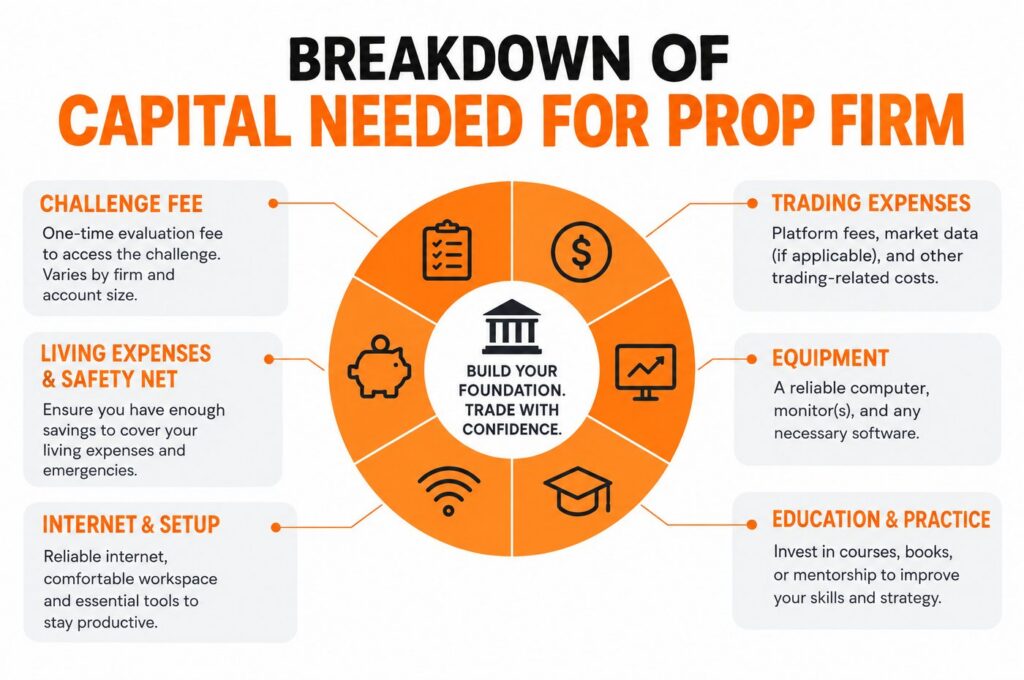
Before joining, your financial commitment generally includes:
- Evaluation or challenge fee
- Trading platform subscriptions (where applicable)
- Market data fees for some futures firms
- Reliable internet connection
- Trading equipment
- Learning resources
- Personal living expenses
Preparing for these costs gives you a much stronger foundation than simply paying the challenge fee.
The Biggest Upfront Expense in the Capital Needed for a Prop Firm
For most traders, the evaluation fee is the largest initial expense.
Challenge fees vary depending on:
- Account size
- Prop firm provider
- Evaluation model
- Trading platform
- Current promotions
Although these fees can differ considerably, they remain significantly lower than funding a personal account with the same buying power.
Rather than viewing the fee as buying a funded account, think of it as paying for the opportunity to prove your trading ability.
Why Emergency Savings Matter
One of the biggest mistakes beginners make is spending their last available money on a challenge.
The capital needed for a prop firm isn’t just about evaluation fees. Your personal financial situation also plays a major role in your success.
Ideally, you should have enough savings to comfortably cover:
- Rent or mortgage
- Food
- Utilities
- Transport
- Insurance
- Unexpected expenses
When your essential bills are already covered, you’re less likely to force trades simply because you need immediate income.
Education Is Part of Your Trading Capital
Many traders underestimate the value of investing in themselves before attempting a challenge.
Some worthwhile investments include:
- Trading books
- Online courses
- Mentorship
- Demo trading
- Risk management training
- Trading journals
Improving your skills before paying for multiple evaluations is often the smartest financial decision.
Equipment Included in the Capital Needed for a Prop Firm
Professional trading doesn’t require an expensive office or six-monitor setup.
Most traders only need:
- A reliable computer or laptop
- Stable internet
- Trading platform
- Comfortable workspace
- Backup internet if available
A dependable setup allows you to trade confidently without unnecessary distractions.
Hidden Costs Many Traders Forget
When calculating the capital needed for a prop firm, remember that some costs continue after purchasing a challenge.
These may include:
- Platform subscriptions
- Exchange or market data fees
- Challenge resets
- Additional evaluations
- Computer maintenance
- Internet upgrades
Budgeting for these expenses helps prevent financial surprises.
Capital Needed for a Prop Firm vs Personal Trading
One reason prop firms have become increasingly popular is their lower financial barrier to entry.
Personal Trading
Requires:
- Depositing your own capital
- Accepting all trading losses
- Growing your account gradually
Prop Firm Trading
Requires:
- Paying an evaluation fee
- Passing the firm’s assessment
- Following strict risk management rules
For many traders, joining a prop firm provides access to significantly more buying power without risking a large personal account.
How Much Money Should Beginners Have?
Every trader’s financial situation is different, but it’s wise to prepare for more than just the challenge fee.
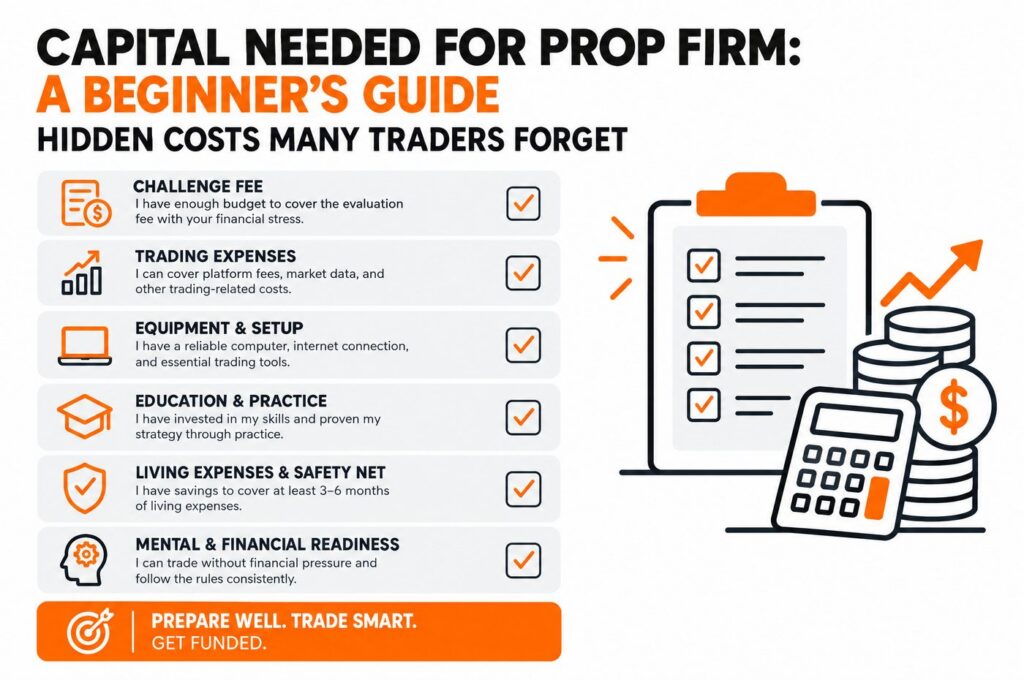
Before joining a prop firm, consider whether you have enough money to cover:
- Evaluation costs
- Personal expenses
- Trading equipment
- Educational resources
- Emergency savings
- Possible challenge retakes
Being financially prepared allows you to trade with patience rather than pressure.
Common Financial Mistakes
Many aspiring traders delay their success by making avoidable financial mistakes.
These include:
- Paying for a challenge before becoming consistently profitable
- Trading with money needed for rent or bills
- Ignoring education
- Buying unnecessary trading software
- Repeatedly purchasing new challenges after every failure without improving
Avoiding these mistakes can save both money and frustration.
Are You Financially Ready to Join a Prop Firm?
Before purchasing a challenge, ask yourself these questions:
- Can I comfortably afford the evaluation fee?
- Do I have emergency savings?
- Have I practised consistently on a demo account?
- Do I understand risk management?
- Am I financially stable enough to trade patiently?
If you answer yes to each question, you’re likely in a much stronger position to pursue funded trading.
Final Thoughts
The capital needed for a prop firm is often much lower than many beginners expect. However, joining a prop firm isn’t just about paying an evaluation fee. It also requires financial discipline, proper preparation and realistic expectations.
By budgeting for challenge fees, living expenses, education and ongoing trading costs, you’ll reduce unnecessary stress and give yourself the best possible chance of passing an evaluation and maintaining a funded account.
Frequently Asked Questions
How much capital do I need to join a prop firm?
Most traders only need enough money to pay the evaluation fee and cover related trading expenses rather than funding a large personal trading account.
Do prop firms provide the trading capital?
Yes. Once you successfully complete the evaluation, the prop firm provides access to a funded trading account subject to its rules and risk limits.
Should beginners save money before joining a prop firm?
Yes. Having emergency savings helps reduce financial pressure and allows you to focus on disciplined trading instead of immediate profits.
Is joining a prop firm cheaper than trading with my own capital?
For many traders, yes. Prop firms usually require only an evaluation fee instead of a large personal trading balance.