
Instant Funding vs Evaluation: Which Is Better?
Last reviewed 28 September 2026. If you’re choosing your first prop firm, one of the biggest decisions you’ll face is instant funding vs evaluation. Both funding models give traders access to larger amounts of capital, but they work in very different ways. An evaluation account requires you to prove your trading skills before receiving a […]


Last reviewed 28 September 2026.
If you’re choosing your first prop firm, one of the biggest decisions you’ll face is instant funding vs evaluation. Both funding models give traders access to larger amounts of capital, but they work in very different ways.
An evaluation account requires you to prove your trading skills before receiving a funded account. Instant funding allows you to start trading immediately, although it usually comes with higher upfront costs and different trading conditions.
Understanding the strengths and weaknesses of each option will help you choose the funding model that best matches your experience, trading style and long-term goals.
In this guide, we’ll compare instant funding vs evaluation, explain the key differences and help you decide which approach makes the most sense.
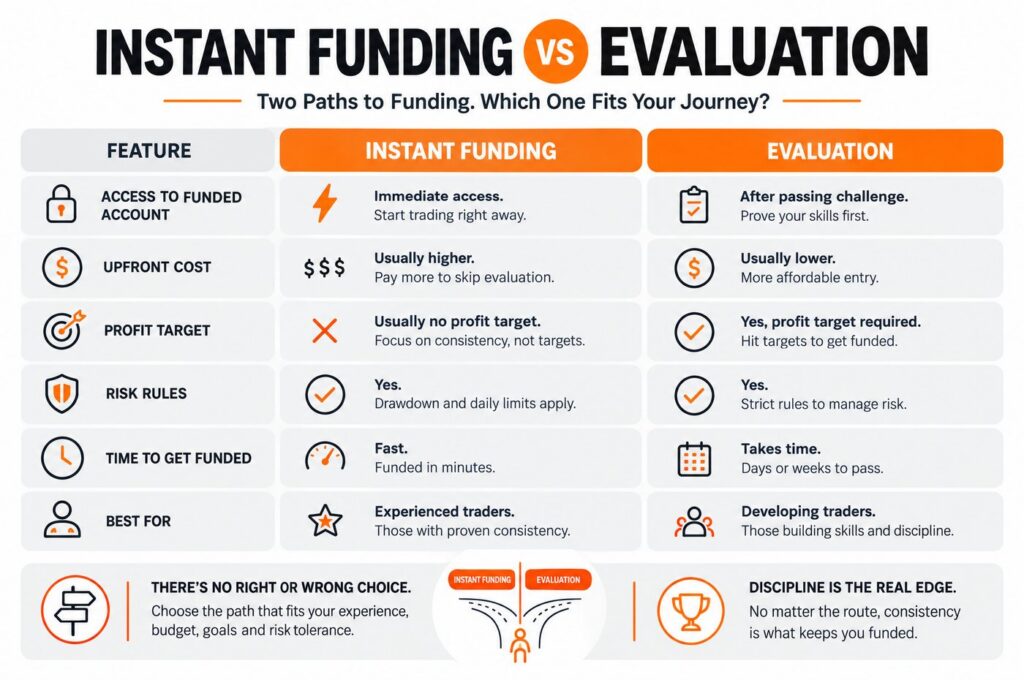
Instant Funding vs Evaluation: How Do They Work?
Although both models aim to provide traders with access to funded capital, the journey is very different.
Evaluation Model
With an evaluation, traders must complete one or more assessment stages before becoming funded.
Typical requirements include:
- Profit target
- Maximum drawdown
- Daily loss limit
- Risk management rules
- Consistency requirements
Once these objectives are met, traders receive a funded account.
Instant Funding
Instant funding removes the evaluation phase.
Instead, traders pay a higher fee and receive immediate access to a funded account.
Most instant funding programmes still include:
- Maximum drawdown
- Daily loss limits
- Position sizing rules
- Trading restrictions
- Profit split agreements
Skipping the evaluation doesn’t remove the need for disciplined trading.
Instant Funding vs Evaluation: Key Differences
| Feature | Evaluation | Instant Funding |
|---|---|---|
| Access to funded account | After passing evaluation | Immediately |
| Upfront cost | Usually lower | Usually higher |
| Profit target | Yes | Usually no |
| Risk rules | Yes | Yes |
| Drawdown limits | Yes | Yes |
| Payout eligibility | After funding | Usually immediate or sooner |
| Best for | Patient traders | Experienced traders |
Advantages of Evaluation Accounts
Evaluation accounts remain the most popular funding option.
Benefits include:
- Lower entry cost.
- Opportunity to prove consistency.
- Access to larger account sizes.
- Lower financial commitment.
- Strong preparation for funded trading.
Many traders also find that completing an evaluation builds discipline before managing a live funded account.
Advantages of Instant Funding
For experienced traders, instant funding offers several advantages.
These include:
- Immediate funded account access.
- No profit target.
- Faster route to payouts.
- Less time spent completing assessments.
- Ability to focus entirely on trading.
However, instant funding often requires greater discipline because mistakes happen immediately on a funded account.
Which Traders Should Choose an Evaluation?
Evaluation programmes are generally better suited for:
- Beginners.
- Developing traders.
- Traders refining consistency.
- Those with smaller budgets.
- Traders comfortable working towards long-term goals.
Passing an evaluation can also improve confidence before managing larger capital.
Which Traders Should Choose Instant Funding?
Instant funding may be better suited for:
- Experienced traders.
- Consistently profitable traders.
- Traders with proven risk management.
- Those wanting faster access to payouts.
- Traders comfortable paying higher upfront fees.
The ability to skip the evaluation is attractive, but only if you already have the discipline to protect funded capital.
Common Mistakes Traders Make
Regardless of which funding model you choose, the same mistakes often appear.
These include:
- Risking too much per trade.
- Ignoring drawdown rules.
- Trading emotionally.
- Overtrading.
- Chasing losses.
- Breaking firm rules.
Neither funding model can compensate for poor trading discipline.
Which Option Offers Better Value?
The answer depends on your goals.
An evaluation offers lower costs and allows traders to prove consistency before receiving funding.
Instant funding provides immediate access but usually requires a larger investment and greater responsibility from day one.
Instead of asking which option is objectively better, ask which one fits your trading experience.
The right choice depends on your skills rather than the funding model itself.
Final Verdict
When comparing instant funding vs evaluation, there isn’t a universal winner.
Evaluation accounts offer an affordable pathway for traders developing consistency, while instant funding rewards experienced traders who already have disciplined risk management.
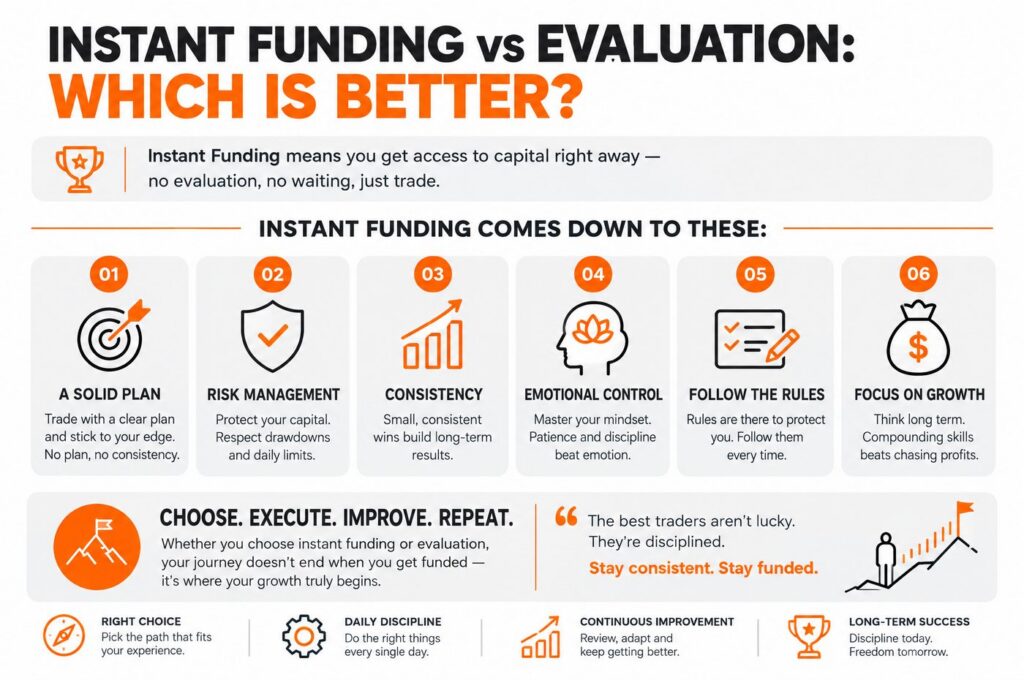
Whichever option you choose, your long-term success will depend less on the funding model and more on your ability to follow a trading plan, manage risk and remain consistent.
The best funding programme is the one that matches your experience, protects your capital and supports sustainable trading growth.
Frequently Asked Questions
What is the difference between instant funding and evaluation?
Evaluation accounts require traders to pass an assessment before receiving funding, while instant funding provides immediate access to a funded account without an evaluation phase.
Is instant funding better than an evaluation?
It depends on your experience. Beginners often benefit from the discipline of an evaluation, while experienced traders may prefer immediate access through instant funding.
Is instant funding more expensive?
Generally, yes. Instant funding programmes usually charge higher upfront fees because traders skip the evaluation process.
Which option is best for beginners?
Most beginners are better suited to evaluation programmes because they provide valuable experience while encouraging disciplined trading habits.